ABI Compatibility, Compilation Firewalls, and Linking
- Three independent questions
- Compilation firewall
- Linking and symbol dependency
- ABI compatibility
- The two properties are independent
- Applying the model to virtual interfaces and PImpl
Three independent questions
Compilation firewalls, linking, and ABI compatibility are related, but they answer different questions at different stages:

| Concern | Question | Primary level |
|---|---|---|
| Compilation firewall | Did a private source change invalidate client compilation inputs? | Source and build dependency |
| Linking | Can referenced symbols be connected to definitions? | Object files and symbols |
| ABI compatibility | Can an already-compiled client safely use this library binary? | Binary contract across versions |
The shortest useful formulation is:
A compilation firewall makes reusing an old client object file possible. ABI compatibility makes reusing that object file correct. Linking connects its symbol references, but successful symbol resolution alone does not prove ABI compatibility.
Compilation firewall
A compilation firewall is a source-architecture and dependency-isolation technique. It prevents private implementation changes from propagating into the client’s compilation inputs.

It does not mean that the client and library are independent. The client may still have build-order, symbol, runtime, and behavioral dependencies on the library. A better descriptive phrase is often recompilation firewall.
Typical techniques include incomplete types and PImpl, abstract interfaces, opaque C handles, forward declarations, minimal public headers, and out-of-line public functions. The deeper rule is not merely to avoid a file named implementation header; it is to keep private representation and logic out of the client’s compilation inputs.
For a static library, a private implementation change commonly requires relinking the executable even though client source files do not recompile:

Linking and symbol dependency
A compiled client can contain undefined references to public library symbols:
client.o:
    U Widget::Widget()
    U Widget::process()
    U Widget::~Widget()

libwidget.so:
    T Widget::Widget()
    T Widget::process()
    T Widget::~Widget()
For an ordinary executable, required strong symbols normally must be resolved when it is linked. On ELF/Linux, a shared library may retain some unresolved symbols to be provided by another shared object, the loading executable, or the runtime environment. Options such as -Wl,-z,defs can require stricter resolution while building a shared library.
Deferring symbol resolution does not remove the dependency; it moves resolution to shared-library load time or, with lazy binding, first use.
Successful linking establishes only that the linker found acceptable symbols and relocations. It does not prove agreement about C++ layouts, calling conventions, vtables, ownership, exceptions, or semantics.
ABI compatibility
ABI compatibility is a binary-substitution assurance between versions:
Can a client binary built against library version 1 safely use library version 2 without recompilation?

The assurance can depend on exported symbol names and versions, calling conventions, parameter and return representations, public object size and alignment, member offsets, vtable and base-class layouts, RTTI and exception conventions, compiler and standard-library ABI, packing, visibility, allocation, and ownership across the boundary.
An unchanged header is strong evidence of source-API stability, but it is not by itself proof about the produced library binary. The compiler configuration, export map, definitions, and toolchain must also preserve the contract.
The two properties are independent
Compilation firewall preserved, ABI compatibility broken
Keep the public header unchanged:
class Widget {
public:
    Widget();
    ~Widget();
    void process();

private:
    class Impl;
    std::unique_ptr<Impl> impl_;
};
If a new library accidentally omits the definition of Widget::process(), the client’s compilation inputs have not changed, so recompiling the client is unnecessary and would produce the same symbol reference. However, the new library no longer supplies that public symbol, so linking or loading fails.

This is not an ordinary private PImpl layout change; it is the new library failing to preserve its published binary contract. Other examples include incompatible compiler ABI settings, changed visibility or symbol versioning, or different packing and calling-convention options while the header text remains unchanged.
If a change is truly confined to private PImpl fields or algorithms and the library continues to honor the same exported ABI, the old client binary should work. That is the intended safe case.
Compilation firewall broken, ABI compatibility preserved
Suppose the public header unnecessarily includes the complete implementation type:
// widget_impl.hpp
class WidgetImpl {
public:
    int value;
};

// widget.hpp
#include "widget_impl.hpp"

class Widget {
public:
    Widget();
    ~Widget();
    void process();

private:
    WidgetImpl* impl_;
};
Changing WidgetImpl by adding private state invalidates the transitive compilation input of every client:

But Widget still contains exactly one pointer and its public symbols can remain unchanged. An existing client binary can therefore remain ABI-compatible with the new shared library even though the source dependency graph caused an unnecessary rebuild.
Using a forward declaration repairs the firewall:
class WidgetImpl;

class Widget {
public:
    Widget();
    ~Widget();
    void process();

private:
    WidgetImpl* impl_;
};
The complete WidgetImpl definition then belongs only in the library’s implementation file.
Independence matrix
| Compilation firewall | ABI compatible | Meaning |
|---|---|---|
| Yes | Yes | Desired private implementation change |
| Yes | No | Client object is reusable by the build graph, but unsafe with the new binary |
| No | Yes | Client recompiles unnecessarily, although its old binary would still work |
| No | No | Source changes propagate and existing binaries cannot use the replacement |
Applying the model to virtual interfaces and PImpl
Virtual interfaces and PImpl share one architectural principle: both put an indirection boundary between a stable public API/ABI and hidden implementation details. They are not, however, the same low-level mechanism and they solve different primary problems:
- A virtual interface provides behavioral indirection. A call is dispatched according to the object’s dynamic type, so different implementations can be selected per object at runtime.
- PImpl provides representation indirection. A concrete public facade owns an opaque pointer to library-private state whose type is normally fixed by the library.
Both can be compilation firewalls and both can improve ABI robustness. Object creation is separated from usage by a factory or a library-defined constructor; that separation is related to, but not inherently guaranteed by, either kind of indirection.
Shared architectural principle

In both designs, the client can compile without including implementation headers. Changes confined behind the public contract therefore normally require rebuilding the library, but not recompiling the client.
This protection can be weakened by exposing private details through public data members, inline implementations, templates, third-party types, or unstable function signatures.
Virtual interface
class Transport {
public:
    virtual ~Transport() = default;
    virtual void send() = 0;
};

std::unique_ptr<Transport> create_transport(Protocol protocol);
The dynamic type of each object determines which implementation receives a virtual call:
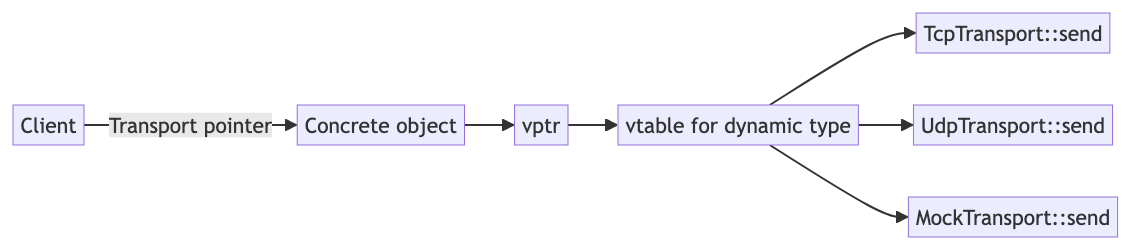
The important property is runtime substitutability. Different implementations can coexist in the same process, and the public design may allow clients, tests, or plugins to provide additional derived classes.
A virtual interface does not itself hide construction. If TcpTransport is public, a client can construct it directly. Construction becomes library-owned when the concrete type is hidden and a factory such as create_transport() is provided. If the client constructs the derived object itself, the construction site must know the concrete type’s construction-facing definition and link to its constructor and other required concrete symbols. The client consequently acquires a direct compile-time and link-time dependency on that implementation, reversing the intended isolation. A provider-owned factory confines the concrete layout, constructor, dependencies, and allocation policy to the provider and returns only the abstract interface.
PImpl
class Transport {
public:
    Transport();
    ~Transport();
    void send();

private:
    class Impl;
    std::unique_ptr<Impl> impl_;
};
The complete implementation exists only in the library source:
class Transport::Impl {
public:
    void send();
    // Private dependencies and state.
};

void Transport::send() {
    impl_->send();
}

The public Transport is still one concrete type. The opaque pointer hides its representation and private dependencies, while keeping the facade layout stable (often one pointer). The pointer normally locates hidden state; it does not dynamically choose behavior because Transport::Impl is statically known inside the library.
The client depends on public facade symbols such as Transport::Transport(), Transport::~Transport(), and Transport::send(). It does not normally depend directly on Transport::Impl symbols. The facade’s library object code has that private dependency.
Creation and selection
Creation policy is separate from the indirection technique:

For a conventional PImpl, the library defines the private Impl type. Changing that implementation means rebuilding the library and, for dynamically linked clients, possibly replacing the shared library while preserving its public ABI. For static linking, the implementation becomes part of the executable at final link time; for shared linking, it is resolved when the shared library is loaded.
PImpl can still perform private runtime selection. For example, Impl may own a TCP, UDP, or vendor-specific backend selected from configuration. The difference is that this variability remains library-controlled rather than being exposed as public client-side polymorphism.