Interfaces and Runtime Binding
To let a client invoke an implementation without directly referencing that implementation’s symbols, use three steps:
- Define a common interface.
- Represent the implementation through a callable value.
- Bind that value to a concrete implementation at runtime.
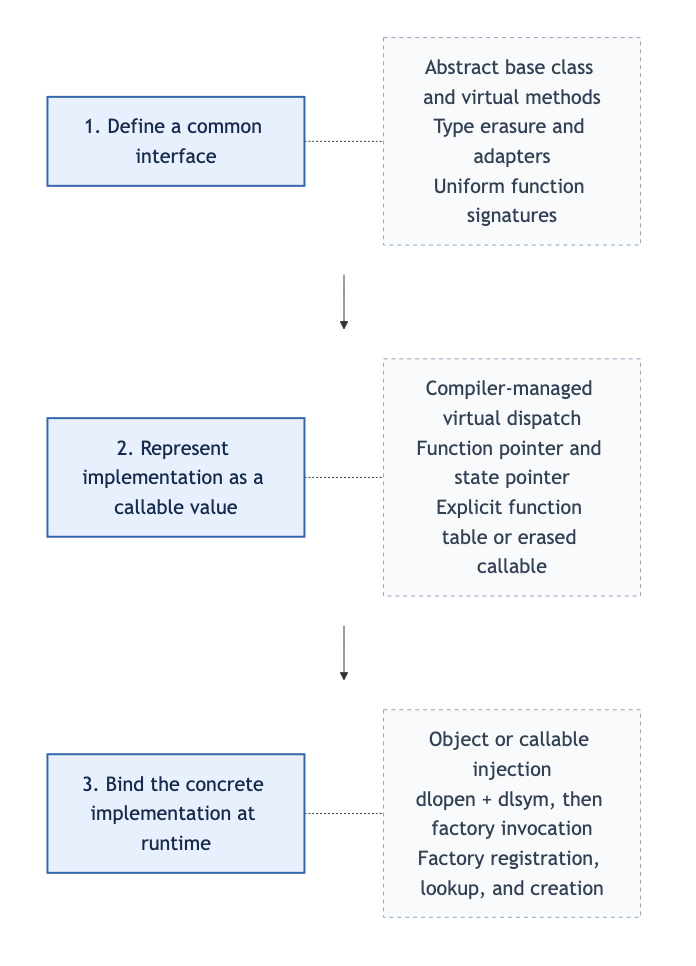
The dependency does not disappear. It moves from a concrete symbol referenced at link time to an implementation selected and supplied at runtime.
- Start with a direct dependency
- Step 1: define a common interface
- Step 2: represent the implementation as a callable value
- Step 3: bind a concrete implementation at runtime
- Selecting an implementation from a loaded library
- Why PImpl is different
Start with a direct dependency
Suppose a client calls process() directly:
struct Data {
    int value;
};

void process(Data& data);

void client(Data& data)
{
    process(data);
}
The object file containing client() refers to the symbol for process().
Moving the definition of process() to another source file hides its body, but
the program must still provide that symbol when it is linked or loaded.
To remove this direct reference, the client must call an operation supplied as
a value instead of naming process().
Step 1: define a common interface
First, define the operation without naming an implementation:
struct Data {
    int value;
};

using ProcessFunction = void (*)(Data& data);
Every implementation will be invoked through this signature.
Step 2: represent the implementation as a callable value
Pass the operation as a function-pointer value:
void client(const ProcessFunction process, Data& data)
{
    process(data);
}
client() now refers only to the ProcessFunction signature. It does not
refer to a concrete implementation function.
Step 3: bind a concrete implementation at runtime
Define a concrete implementation:
void multiply_by_three(Data& data)
{
    data.value *= 3;
}

void host()
{
    const ProcessFunction process = &multiply_by_three;

    Data data{7};
    client(process, data);  // data.value is now 21.
}
The host refers to multiply_by_three; client() does not. Assigning its
address to process creates the runtime binding, and calling process(data)
dispatches through it.
Virtual methods use the same underlying idea on common C++ ABIs. A base-class pointer provides the common interface, the object carries a pointer to a table of virtual functions, and a virtual call selects a function address from that table. The compiler generates this binding and dispatch machinery. C++ specifies virtual-call behavior but does not require a particular vtable representation.
Selecting an implementation from a loaded library
The preceding example selects multiply_by_three in ordinary host code. A
host can instead select an implementation from a shared library at runtime.
With dlopen() and dlsym(), the host actively looks up the provider using
strings:
using GetProcessFunction = ProcessFunction (*)();

void* library = dlopen("libmultiplier.so", RTLD_NOW | RTLD_LOCAL);
void* symbol = dlsym(library, "get_process_function");
The plugin exports the known lookup entry point:
extern "C" ProcessFunction get_process_function();
The example omits error handling, conversion of the dlsym() result, and RAII
management of the library handle. Those details are required in production.
The library must remain loaded while the returned function pointer may be
called.
A registry reverses the lookup direction. Libraries register their function pointers when they are loaded, and the host later asks the registry for one:
load library -> register function -> look up function -> call implementation
The host no longer has an ordinary link-time reference to the selected function. It depends instead on the loader or registry contract, and the concrete provider is resolved at runtime.
Why PImpl is different
PImpl hides a concrete implementation definition behind an opaque pointer:
#include <memory>

class Widget {
public:
    Widget();
    ~Widget();

    void run();

private:
    class Impl;
    std::unique_ptr<Impl> impl_;
};
The client does not need the definition of Widget::Impl, so changes to its
private representation need not cause client recompilation.
The client still refers to the public symbols:
Widget::Widget()
Widget::run()
Widget::~Widget()
The library defining those symbols must therefore still be linked and loaded. PImpl hides representation; it does not by itself replace direct calls with a runtime-supplied callable value.