Inside std::enable_shared_from_this
std::enable_shared_from_this<T> lets an object obtain a shared_ptr to
itself without creating a second ownership group. The returned shared_ptr
shares the control block that already owns the object.
- 1. CRTP supplies the object type
- 2. shared_ptr establishes the connection
- 3. shared_from_this acquires a strong reference
- When shared_from_this fails
- The ownership sequence
- Do not create another control block
- Conclusion
1. CRTP supplies the object type
A class derives from enable_shared_from_this specialized with itself:
#include <memory>

class Foo : public std::enable_shared_from_this<Foo> {
public:
    [[nodiscard]] std::shared_ptr<Foo> get_shared()
    {
        return shared_from_this();
    }
};
This CRTP relationship tells the base class which pointer type to return. A
simplified model of the base contains a weak_ptr<Foo> that will later refer
to the object’s ownership control block. It does not contain another Foo.
2. shared_ptr establishes the connection
Object construction and ownership setup are separate operations:
const auto owner = std::make_shared<Foo>();
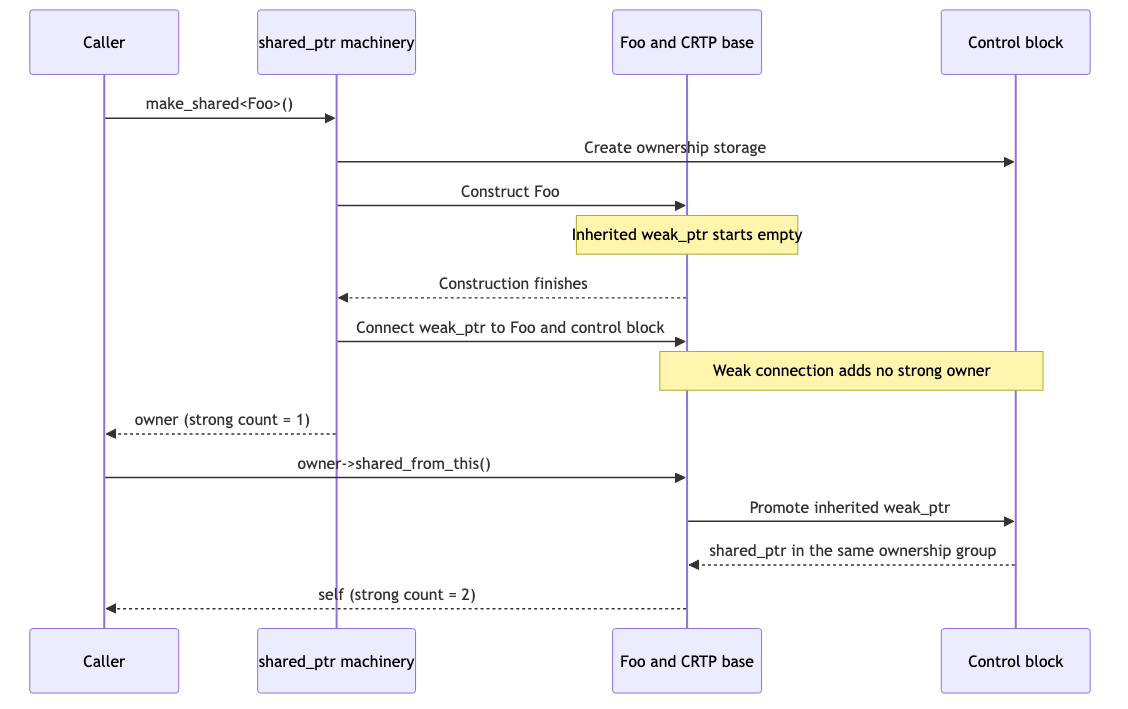
Conceptually, make_shared<Foo>() performs these steps:
- Allocate storage for the control block and
Foo. - Construct
Foo; its inherited weak pointer is initially empty. - Connect that weak pointer to
Fooand the new control block. - Return the owning
shared_ptr<Foo>.
The connection is established by the shared_ptr machinery after the Foo
constructor finishes. It is weak, so it does not increase the strong reference
count or create a self-ownership cycle.
3. shared_from_this acquires a strong reference
After ownership has been established, the object can promote its inherited weak pointer:
const auto owner = std::make_shared<Foo>();
const auto self = owner->get_shared();
owner and self point to the same Foo and share the same control block.
Creating self increases the strong reference count; it does not create a new
control block.
Conceptually, shared_from_this() constructs a shared_ptr<Foo> from the
inherited weak pointer. The standard library manages that weak pointer; it is
not a public data member.
When shared_from_this fails
If no live shared_ptr has established the weak connection,
shared_from_this() throws std::bad_weak_ptr:
Foo foo;
const auto self = foo.get_shared();  // Throws std::bad_weak_ptr.
An object owned only by unique_ptr has the same problem:
const auto owner = std::make_unique<Foo>();
const auto self = owner->get_shared();  // Throws std::bad_weak_ptr.
Calling shared_from_this() from the object’s constructor is also too early.
With make_shared<Foo>(), the weak connection is not established until after
construction of Foo has finished.
Since C++17, weak_from_this().lock() provides a non-throwing alternative:
const auto self = weak_from_this().lock();
if (!self) {
    // No live shared ownership has been established.
}
It returns an empty shared_ptr when the weak connection is empty or expired.
The ownership sequence
construct Foo
    -> establish shared ownership and its control block
    -> connect the inherited weak_ptr to that control block
    -> shared_from_this() promotes the weak_ptr
    -> return another shared_ptr in the same ownership group
Because the inherited connection is weak, releasing the last strong owner can
still destroy Foo normally.
Do not create another control block
Constructing a new shared_ptr directly from this does not recover the
existing ownership:
std::shared_ptr<Foo> incorrect()
{
    return std::shared_ptr<Foo>{this};
}
It creates a second control block for the same object. The two ownership groups
can then attempt to destroy the object independently. Use shared_from_this()
to join the existing ownership group.
Conclusion
enable_shared_from_this works through a hidden weak connection. The owning
shared_ptr connects that weak pointer to the object’s control block, and
shared_from_this() promotes it to another strong reference in the same
ownership group.