Type Erasure VIII — Final Thoughts
Previously:
- Type Erasure I — Core Logic
- Type Erasure II — std::function
- Type Erasure III — Trade-offs
- Type Erasure IV — ROS 2 Messages
- V — Closed Tagged Dispatch
- Type Erasure VI — dynamic_cast & RTTI
- Type Erasure VII — std::any
Editor’s note: This synthesis was revised to separate
std::variant’s closed tagged dispatch from type-erased interfaces.
Parts I–VII walked through virtual dispatch, std::function, ROS 2 handles,
std::variant, RTTI, and std::any. This closing part separates the mechanisms
that perform type erasure from related runtime-polymorphism techniques. They all
preserve C++ static typing, but they do not all erase types.
- 1. The core implementation logic
- 2. Compile time and runtime — C++ stays statically typed
- 3. What type erasure brings to programming — generalization, not “runtime types”
- 4. Type recovery — the reverse direction
- Summary
- Series index
- References
1. The core implementation logic
Part I named the pattern. The type-erased facilities in this series share this implementation logic:
- Same interface, specific type in implementation — the call site sees one uniform type; concrete logic lives elsewhere.
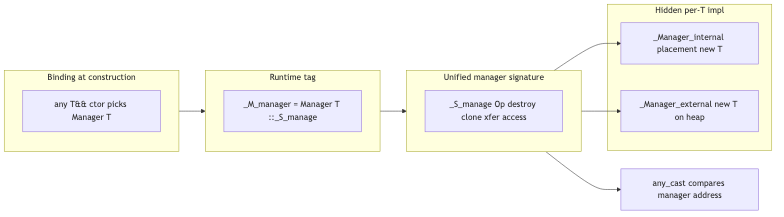
- Binding — compile time generates each type’s handler and hardcodes it in the binary; construction records which handler an erased object carries (
_M_manager, vptr). Binding does not invoke the handler. - Runtime dispatch — a call through the uniform interface selects and jumps to the handler via function pointers of the same signature.
Interface (uniform) → Tag (runtime) → Table / fn-ptr (same signature) → Concrete T handler
Binding vs dispatch — three phases
| Phase | What happens | Examples |
|---|---|---|
| Compile time (generation) | Compiler/codegen generates per-type handlers and fixes them in the binary | vtables, _Function_handler<F>, _Manager<T>::_S_manage, ROS 2 typesupport entry per .msg |
| Construction (binding) | This object records which erased handler is active | a Circle object receives its vptr; std::function stores a lambda; any = 42 sets _M_manager for int |
| Runtime (dispatch) | A call selects and invokes the handler already in the binary | vtable slot jump, _M_invoker, _M_manager, handle->func |
After construction, the interface no longer names the active type. Dispatch at runtime selects among handlers already hardcoded — it does not generate new handlers or new types.
Type-erased interfaces and their redirects
| Facility | Interface at call site | Runtime tag | Redirect | Candidates |
|---|---|---|---|---|
| Virtual inheritance | Base& |
vptr + slot | vtable | Open — Part I |
std::function |
R(Args…) |
_M_manager + _M_invoker |
manager + invoke | Open callables — Part II |
std::any |
std::any |
_M_manager |
opcode _S_manage |
Open stored types — Part VII |
| ROS 2 messages | const rosidl_message_type_support_t * |
handle + typesupport_identifier |
handle->func resolver |
Open — one generated entry per message — Part IV |
std::function, virtual hierarchies, std::any, and ROS 2 share the same
operational type-erasure pattern — a uniform interface omits concrete
implementation types while runtime state redirects to type-specific code.
std::variant is the important counterexample. It also has runtime state and
generated dispatch code, but variant<Ts...> exposes the complete alternative
set. It is a closed tagged union and runtime polymorphism without type erasure.

ROS 2 — same signature, per-message generated entry
Type Erasure IV — ROS 2 Messages is the same pattern at ecosystem scale. Middleware and rcl/rclcpp hold const rosidl_message_type_support_t * — one handle type — not demo_pkg::msg::DemoStatus at every call site. Each message type gets its own extern "C" entry function at codegen time; every entry shares the same signature:
// Generated once per message type — same return type and signature for all messages
extern "C"
const rosidl_message_type_support_t *
ROSIDL_TYPESUPPORT_INTERFACE__MESSAGE_SYMBOL_NAME(
  rosidl_typesupport_c, demo_pkg, msg, DemoStatus)()
{
  return &::demo_pkg::msg::rosidl_typesupport_c::DemoStatus_message_type_support_handle;
}
For DemoCommand, code generation emits a different function (…__DemoCommand) that returns that message’s handle — parallel to less vs more in Part I’s qsort, or _Manager<int>::_S_manage vs _Manager<string>::_S_manage in Part VII. The macro expands to a unique symbol per (package, msg, Type); the function pointer type is always const rosidl_message_type_support_t *(*)().
Handlers are generated and hardcoded at build time: rosidl_generate_interfaces emits the handle struct, dispatch map, and entry symbol for each .msg file. Dispatch happens at runtime when generic code calls handle->func(handle, "rosidl_typesupport_fastrtps_c") — same-signature redirect through the resolver — to reach FastDDS serialize callbacks for that message. No middleware layer branches on “if DemoStatus … else if DemoCommand …”; each type’s logic lives in generated code wired through the uniform handle.
rcl publish path          const rosidl_message_type_support_t *     Per-message generated code
void* + handle            handle->func (same signature)             DemoStatus vs DemoCommand entries
Dispatch is redirection of function pointers, with the same signature. — Part I
That sentence covers virtual slots, std::function’s _M_invoker, any’s
_S_manage opcodes, and ROS 2’s
rosidl_message_typesupport_handle_function. std::variant may also use
function tables, but its public type still enumerates every alternative; the
shared dispatch instruction does not make it erased.
2. Compile time and runtime — C++ stays statically typed
Type erasure, std::variant, RTTI, and dynamic_cast do not turn C++ into
a dynamically typed language. Type erasure changes what a consumer interface
must name; variant exposes a closed list but changes which member is active;
RTTI verifies a compile-time-named type. None changes which C++ types exist in
the program.
| Misread | Correct |
|---|---|
| “Runtime polymorphism = types appear at runtime” | Types are fixed at compile time; which handler runs varies at runtime |
| “RTTI discovers new types” | RTTI checks type_info for types named in source — Part VI |
“any holds unknown types” |
any holds one of many compile-time-known T; construction records which handler is active |
Every type in play — base classes, derived classes, lambda closure types, each member of variant<int, string, …>, every T ever stored in an any, every ROS 2 .msg type with its generated typesupport symbol — must be known when you compile and have handler code hardcoded in the binary before the program runs. Runtime never introduces a usable type the compiler did not already generate.
What actually splits compile time, construction, and runtime:
- Compile time (generation) — generate all handlers; each type’s logic is
fixed in the object file (
Circle::draw,_Manager<string>::_S_manage, and visitor branches for every variant alternative). - Construction (runtime state) — an erased object records its matching
operation state (
_M_manager, vptr); a variant records its activeindex(). - Runtime (dispatch) — a call follows the abstraction’s dispatch protocol to an already-generated handler. No new type or handler is generated.
Part VI stated this rule for RTTI; it applies equally to every part of the series:
C++ is statically typed. If your program can use a type, that type must be known at compile time. Dispatch at runtime selects among handlers already hardcoded in the binary.
3. What type erasure brings to programming — generalization, not “runtime types”
The essence of type erasure is not “runtime typing.” It is generalization: write common logic once over a uniform interface, without that common code depending on which concrete types will use it later.
The variation point
Part I used qsort + bool (*)(const void*, const void*):
qsortimplements sorting once — common behavior over an erased compare interface.less/moresupply per-type compare logic at the edge.- Without the erased interface, you duplicate the sort algorithm for every element type.
The same shape appears everywhere in this series:
| Common logic (sunk down) | Erased interface | Per-type detail at the edge |
|---|---|---|
| Sorting | compare fn-ptr | less, more for each struct |
| Draw pipeline | Shape& + virtual draw() |
Circle::draw, Rectangle::draw |
| Callback registration | std::function<void()> |
each lambda or function object passed in |
| Heterogeneous bag | std::any / vector<any> |
each any = T construction site |
| Closed tagged dispatch | std::visit(f, v) |
each compile-time-enumerated handler branch for Ti |
| ROS 2 publish / serialize | rosidl_message_type_support_t + void* |
per-message ROSIDL_TYPESUPPORT_INTERFACE__MESSAGE_SYMBOL_NAME(…) entry — Part IV |
Type erasure improves maintainability because shared algorithms live in one place and new implementation types plug in at the binding edge. Closed tagged dispatch also centralizes behavior, but adding a new variant alternative changes the public union type and requires recompiling exhaustive visitors.
Common behavior, not concrete types
Type erasure abstracts behavior shared by many types — comparing, drawing, invoking, storing, serializing — and pushes type-specific facts to constructors, overrides, and cast sites. The middle layer speaks only the uniform interface.
That is the engineering payoff: decouple general algorithms from the types that will eventually use them, while staying in a statically typed language.
Where RTTI fits (without conflating it with erasure)
RTTI is not type erasure. It attaches type identity metadata to polymorphic objects so code can verify “is this actually a Circle?” — still for types named in source at compile time. It supports checks and tooling, not the “hide type at call site / dispatch behavior through one interface” goal of Parts I–IV, VII, and ROS 2 in IV.
Use the split deliberately:
- Type erasure (Parts I–IV, VII, ROS 2 in IV) — call sites must not name every concrete type; behavior dispatches through a uniform interface.
- Closed tagged dispatch (Part V) — the public union type names every alternative and runtime selects the active one.
- RTTI (Part VI) — when identity metadata is needed for verification on open hierarchies.
All types — base, derived, and stored alternatives — are known at compile time. Compile time generates each handler and hardcodes it in the binary; runtime state selects among those handlers through the mechanism defined by the abstraction.
4. Type recovery — the reverse direction
Type erasure removes concrete type names from call sites. dynamic_cast and any_cast re-introduce them — on purpose, at specific boundaries.
| Direction | Mechanism | Call site names T? |
|---|---|---|
| Type erasure | uniform interface + fn-ptr dispatch | No — Base&, std::any at use site |
| Closed tagged dispatch | variant<Ts...> + active index |
Yes, in the public alternative list |
| Type recovery | dynamic_cast<T>, any_cast<T> |
Yes — you write T in the cast |
dynamic_cast<Derived*>(Part VI) — recoverDerived*fromBase*when you need a derived-only API (radius()onCircle, not onShape).any_cast<T>(Part VII) — recover storedTfromany; compare types withtype()first, then cast. Value comparison also requires namingT— see Comparing twostd::anyobjects.
Recovery is the reverse of erasure: you trade the uniform interface for concrete type knowledge at this line of code.
Use recovery sparingly
Every dynamic_cast or any_cast ties a call site to a specific type again. That offsets the maintainability benefit of erasure if it spreads through the codebase. The pattern that works:
- Erasure for general algorithms, plugin boundaries, and shared containers — logic that should not know future user types.
- Recovery as a localized escape hatch — optimization, derived-only APIs, serialization adapters, assertions at a boundary.
Most code should call draw() on Shape& or hold std::any in a generic pipeline; only the few lines that truly need Circle should say Circle.
Summary
- Type erasure — virtual interfaces,
std::function,std::any, and ROS 2 handles hide concrete implementation types behind uniform contracts and runtime redirects. - Closed tagged dispatch is different —
std::variantperforms runtime selection while explicitly enumerating every alternative in its public type. - Static typing unchanged — every type is compile-time-known; dispatch at runtime selects among handlers already in the binary.
- Real benefit: generalization — sink common behavior; per-type details at the edges; not “runtime types.”
- Recovery is the complement —
dynamic_cast/any_castre-expose concrete types; use sparingly so erasure keeps its leverage.
Series index
| Part | Topic |
|---|---|
| I — Core Logic | Interface, binding, dispatch; qsort; virtual erasure |
| II — std::function | Callable erasure; _M_manager + _M_invoker |
| III — Trade-offs | Costs and when not to erase |
| IV — ROS 2 | Erased handles in a message system |
| V — Closed Tagged Dispatch | std::variant; closed union; index() + dispatch |
| VI — RTTI / dynamic_cast | Type identity; static typing rule |
| VII — std::any | Open-set value erasure; manager pointer tag |
| VIII — Final Thoughts (this post) | Synthesis: one mechanism, generalization, recovery |