Type Erasure VI — dynamic_cast & RTTI
Previously:
- Type Erasure I — Core Logic
- Type Erasure II — std::function
- Type Erasure III — Trade-offs
- Type Erasure IV — ROS 2 Messages
- V — Closed Tagged Dispatch
- Type Erasure VII — std::any
Editor’s note: References to
std::variantwere revised to classify it as closed tagged dispatch rather than type erasure.
In Part I I described type erasure as hiding concrete type information behind a uniform interface, with runtime dispatch redirecting through function pointers of the same signature. Virtual dispatch and std::function fit that model. Part V contrasts that model with a closed alternative list: variant<Ts...> exposes every alternative and uses index() for tagged dispatch. This part covers another runtime mechanism: RTTI and dynamic_cast, where selection is keyed by type identity rather than by a pre-planned behavior slot.
One rule underlies all of this — virtual dispatch, type erasure, RTTI, and (in the companion variant post) std::variant:
C++ is statically typed. If your program can use a type, that type must be known at compile time. Runtime never introduces a type the compiler did not already generate code for. Runtime only selects among compile-time-known alternatives.
- The static typing rule
- Dispatch by type identity, not by behavior slot
- Theory behind RTTI
- Type erasure, virtual dispatch, and recovery — same static rule
- What RTTI / dynamic_cast is for
- Examples
- Summary
The static typing rule
This sounds obvious, but it is easy to misread runtime polymorphism as “the type is unknown until runtime.” That is not what happens in C++.
| What varies at runtime | What is fixed at compile time |
|---|---|
Which override runs (Circle::draw vs Rectangle::draw) |
Shape, Circle, Rectangle, and virtual draw() all declared in source |
Whether dynamic_cast<Circle*> succeeds |
The name Circle in the cast; code for Circle compiled into the binary |
Which alternative is active in a variant |
Every member of variant<int, string, …> listed in the type |
There is no path where you use a type at runtime that was not known when the program was compiled. Deferred binding (Parts I–IV) means: which implementation runs is decided later — not that new types appear later.
Implication for RTTI: dynamic_cast<Derived*> does not “discover” Derived at runtime. You named Derived in source; the compiler emitted type_info and hierarchy metadata for it. Runtime only checks whether the object’s dynamic type matches that already-known Derived.
Implication for virtual dispatch: inheritance abstracts call sites to Base&, but Base, every Derived, and every virtual override are still authored and compiled before run. The vtable holds pointers to functions that already exist in the text segment.
RTTI and virtual dispatch look like opposites — one hides derived types behind Base*, one recovers Derived* — but both obey the same static rule: every type in the game is fixed at compile time. They differ in what the call site is allowed to name and what runtime selects.
Dispatch by type identity, not by behavior slot
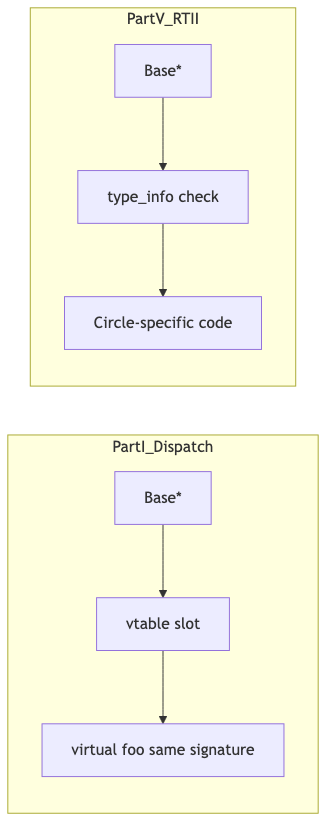
Part I dispatch picks among implementations that share one interface:
- Virtual call:
base->draw()→ vtable slot →Circle::draworRectangle::draw— same signature, behavior declared on the base. - Type-erased function pointer:
compare(void*, void*)→lessormore— same signature, bound at construction.
dynamic_cast introduces a different runtime decision:
- The branch is keyed by
type_info(runtime type identity), not by a vtable behavior slot. - The branch names are fixed at compile time (
dynamic_cast<Circle*>), but which branch runs is decided at runtime. - After a successful cast, the caller may use the full derived API — virtual or not, with different signatures per branch.
Conceptually:
// Not literal generated code — illustrates the decision shape
if (object.type_info == typeid(Circle)) {
  // full Circle API, including non-virtual radius()
} else if (object.type_info == typeid(Rectangle)) {
  // completely different methods
}
Dispatch is still runtime, but it is not “pick among function pointers with the same signature.”
Closed tagged dispatch with std::variant and std::visit uses an explicit
discriminant over alternatives enumerated in variant<Ts...>; it is runtime
polymorphism without type erasure. See
V — Closed Tagged Dispatch
and Double Dispatch with std::variant and std::visit.
Open-set value erasure with std::any
uses a manager function pointer as tag; any_cast compares that address
(primary path), with type_info as RTTI fallback. RTTI (this part) is
different again: recovery by type_info on polymorphic hierarchies.
Theory behind RTTI
What the compiler stores
A class with at least one virtual function is polymorphic. For such types the compiler typically:
- Emits one
type_infoobject per polymorphic type (stable address for the program lifetime). - Attaches a vtable to the class; on common ABIs (Itanium) the vtable holds a pointer to
type_info(often at index-1). - Places a vptr in each polymorphic object pointing at that vtable.
Binding of which branches exist (dynamic_cast<Circle*>, dynamic_cast<Rectangle*>) is fixed when you write the source. The choice among them happens at runtime — but only among types the compiler already knows.
RTTI metadata lives on the vtable because polymorphic types already have one. That is an implementation bundle, not proof that type identity requires virtual functions in principle — std::variant stores an explicit index tag without any virtual function; std::any stores a manager pointer tag without inheritance. C++ simply chose to attach type_info to polymorphic class metadata rather than to every object.
What runtime reads
typeid(*p)— for polymorphicp, returns the dynamic type’stype_info.dynamic_cast<T>(p)— compares the object’s dynamictype_infoagainstT’s place in the inheritance graph. On success returns an adjusted pointer or reference; on failure returnsnullptr(pointer form) or throwsstd::bad_cast(reference form).
This is C++’s built-in introspection for polymorphic types (Type Systems I — Data & Type Format). It is not reflection (no arbitrary “get field by name”), not open-ended dynamic typing (contrast Python or nlohmann::json), and unavailable when the translation unit is built with -fno-rtti. It still does not violate static typing: typeid returns metadata for types that were compiled in, not types invented at runtime.
Type erasure, virtual dispatch, and recovery — same static rule
All three patterns defer which branch runs; none defer knowing the types:
| Pattern | Call site names | Compile time generates | Runtime selects |
|---|---|---|---|
| Virtual dispatch | Base& only |
vtable slots for each override | which override |
| Type erasure (Part I) | erased interface only | per-type implementations | which function pointer |
| Closed tagged dispatch (Part V) | complete variant<Ts...> list |
handlers for every alternative | active index |
dynamic_cast |
Derived explicitly |
type_info, cast paths |
whether object is that Derived |
Virtual dispatch and inheritance abstract the call site away from derived types — that is the design purpose of Base*. dynamic_cast reverses that at one line of code by naming Derived again. That feels like a contradiction until you see both as selection among compile-time-known types, with different rules for what the caller may spell in source.
Type is erased from the caller’s interface, not from the object and not from the compiler’s model. A Shape& hides Circle from the caller, but Circle is still in the binary, and a polymorphic Circle still carries vtable metadata including type_info.
| Virtual / type erasure | RTTI / dynamic_cast |
|
|---|---|---|
| Caller names concrete type at compile time? | No | Yes (in dynamic_cast<T>) |
| Callable surface after dispatch | Base interface only | Full derived API |
| Signatures across branches | Uniform | May differ |
| Typical goal | Generic algorithm over many types | Verify and recover one named type at a boundary |
RTTI lets a specific call site opt back in to a compile-time-named type after a runtime check. You never opt in to a type the compiler did not already know — that is why it should stay a boundary tool, not the default design.
What RTTI / dynamic_cast is for
1. Safe downcast
- Problem: Code holds
Base*but this path needsDerived*(extra members, non-virtual helpers). - Mechanism:
dynamic_cast<Derived*>(p)compares runtimetype_info. - Benefit: Avoid undefined behavior of
static_castwhen the dynamic type might not beDerived.
2. Typed recovery from erased storage
- Problem: A container erases type (
shared_ptrcontrol block, custom deleter) but the caller needs the original typed resource. - Mechanism: Store the concrete type in the implementation; expose a
typeidquery at runtime.
3. Operations outside the virtual interface
- Problem: The base class cannot list every future operation (fat visitor, cross-cutting concerns).
- Mechanism: First dispatch via virtual
accept; second viadynamic_cast<SpecificVisitor*>then non-virtualvisitCircle. - Benefit: Add operations without growing the base vtable — at the cost of coupling visited code to named visitor subtypes.
See Double Dispatch and the Visitor Pattern — Step 7 for the fine-grained visitor variant.
4. Localized escape hatch
- Problem: Most code is generic on
Base&, but one hot path needs concrete type. - Mechanism: Generic path uses the base interface; the exception path uses
dynamic_cast. - Benefit: Breach abstraction only where justified, without redesigning the hierarchy.
What it is not
RTTI does not let callers avoid knowing T at compile time — you must write dynamic_cast<T>. It does not add types at runtime that were absent from the build. It does not replace virtual dispatch or type erasure for open-ended generic algorithms (Parts I–IV and VII). Overuse breaks the open/closed principle — same cost as chaining dynamic_cast in visitor code.
Examples
Shape / Circle — non-virtual API after recovery
struct Shape {
  virtual ~Shape() = default;
  virtual void draw() const = 0;
};

struct Circle : Shape {
  void draw() const override { /* ... */ }
  double radius() const { return r_; }
  double r_;
};

void maybe_optimize(const Shape& s) {
  if (auto* c = dynamic_cast<const Circle*>(&s)) {
    use_fast_circle_path(c->radius());  // non-virtual, derived-only
  } else {
    s.draw();
  }
}
Most callers call draw() and never name Circle in source — the static type at the call site is Shape. maybe_optimize does name Circle, because radius() is not on Shape; RTTI verifies the object matches that compile-time-named type before calling it.
Summary
C++ is statically typed: runtime dispatch — virtual, type-erased, or RTTI — always selects among types the compiler already knew. It never introduces a usable type that was absent from the build.
Parts I–IV hide concrete implementation types behind uniform interfaces. Part
V is the contrast: variant<Ts...> keeps every alternative visible while a
runtime index selects the active one. Part VI adds another distinction: on
polymorphic objects, type identity survives as metadata, and RTTI lets you
name a derived type in source and verify it at runtime before using
derived-only APIs.
Rule of thumb: use virtual dispatch and type erasure when call sites should not name concrete types; use dynamic_cast sparingly when a specific call site must name and verify T — understanding that T was always a compile-time commitment.
Full series synthesis: Type Erasure VIII — Final Thoughts.