Double Dispatch with std::variant and std::visit
This post complements Double Dispatch and the Visitor Pattern in C++. That post uses virtual dispatch on open class hierarchies (accept + visitCircle). Here we cover closed tagged runtime dispatch over the compile-time alternative list in std::variant, using std::visit.
Editor’s note: This article previously described
std::variantas type erasure. It now treats it as a type-safe union with closed tagged dispatch because every alternative remains explicit invariant<Ts...>.
Both posts are about double dispatch — picking behavior when element type and operation both matter — but the mechanisms diverge: virtual dispatch uses two runtime vtable hops on shared bases; variant/visit uses one runtime index hop plus separate monomorphized call sites per operation.
Foundation: C++ is statically typed. A variant<int, std::string> does not hold “some unknown type” at runtime — it holds one of int or string, both declared in the type before the program runs. std::visit must provide a handler for every alternative; if any is missing, the program does not compile. Runtime reads index() and picks among branches the compiler already generated.
Closed tagged dispatch, not type erasure — variant<Ts...> explicitly
enumerates every alternative in its public type. Runtime reads index() and
selects a generated branch, but no alternative has been erased from the
interface. Virtual Visitor differs: Shape& and Visitor& hide concrete
derived types behind compiler-generated vtables. Full theory:
V — Closed Tagged Dispatch.
- Static typing: why variant lists every alternative
- Double dispatch on a closed type set — and how it differs from virtual dispatch
- What std::variant stores
- Index + closed tagged dispatch
- std::visit vs classic Visitor pattern
- Summary
- References
Static typing: why variant lists every alternative
There is no C++ feature that lets you use a type at runtime that was unknown at compile time. std::variant is often mistaken for “runtime typing,” but it is really compile-time typing with runtime selection:
std::variant<int, std::string> v = 42;
// The type std::variant<int, std::string> fixes the set {int, string} at compile time.
// v.index() at runtime returns 0 or 1 — it does not discover a third type.
| Compile time | Runtime |
|---|---|
Alternatives int, string appear in variant<int, string> |
index() says which one is active |
Compiler generates storage, dtors, and visit thunks for each alternative |
Only the active alternative’s logic runs |
std::visit(f, v) requires f to be callable with every Ti& |
Dispatch picks the matching Ti for this v |
Adding a new alternative means changing the type to e.g. variant<int, string, double> and recompiling — the closed set is a compile-time contract, not a runtime discovery.
The same rule applies to virtual Visitor double dispatch: Circle, Rectangle, visitCircle, and visitRectangle are all known when you build; runtime only selects among them. See Type Erasure VI — dynamic_cast & RTTI for the open-hierarchy case with dynamic_cast.
Double dispatch on a closed type set — and how it differs from virtual dispatch
When you call std::visit(visitor, v) on std::variant<int, std::string> v,
runtime dispatch happens through the active index and an implementation
chosen switch or table. The static type still names both int and
std::string; runtime selects which enumerated alternative is active.
Within one std::visit call, the library:
- reads
v.index()at runtime; - jumps through a compile-generated table to the branch for the active alternative;
- invokes your callable with the concrete active type (
int&orstring&).
That is the only runtime axis inside a single call: index → which Ti& to pass into which overload of this callable.
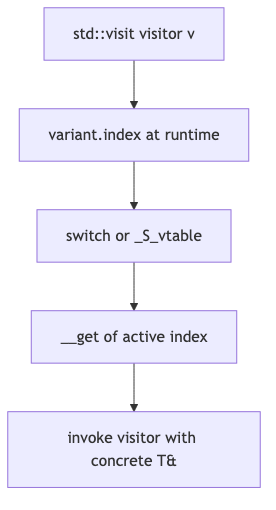
The second axis of classic virtual double dispatch — which operation / which Visitor runs — works very differently here. It is not a second runtime vtable lookup on a shared Visitor base. It is realized by different std::visit call sites, each passing a different callable that accepts every Ti in variant<Ts...>:
std::variant<int, std::string> v = /* ... */;

// Each callable must accept every alternative (int& and string&):
std::visit([](auto&& x) {
  using T = std::decay_t<decltype(x)>;
  if constexpr (std::is_same_v<T, int>) { /* print int */ }
  else { /* print string */ }
}, v);   // "PrintVisitor" at this call site

std::visit([](auto&& x) {
  using T = std::decay_t<decltype(x)>;
  if constexpr (std::is_same_v<T, int>) { /* hash int */ }
  else { /* hash string */ }
}, v);   // "HashVisitor" at this call site
// same v, different callables → different monomorphized visit specializations
Each call is a unique template instantiation — determined by the exact callable type and exact variant<Ts...> type. The compiler generates separate dispatch machinery per pair. That is like writing a new derived Visitor class for each operation in the virtual pattern — except the binding is static at the call site, not runtime polymorphism on a visitor object.
| Axis | Virtual Visitor | variant / visit |
|---|---|---|
| 1 — stored / element type | Runtime: virtual accept → visitCircle(c) |
Runtime: index() → invoke with int& or string& |
| 2 — operation / visitor type | Runtime: virtual visitXxx on a shared Visitor& |
Compile time per call site: each std::visit(different_callable, v) is its own monomorphized implementation |
| Uniform interface? | Yes — Visitor base, Shape& |
Yes — variant<Ts...> at the use site |
| Type erasure? | Yes in this series’ operational taxonomy — Shape& / Visitor& hide concrete derived types; vtable dispatch (Part I) |
No — variant<Ts...> enumerates every alternative (Part V) |
| Open vs closed | Open — new Derived can be added elsewhere |
Closed — every Ti fixed in variant<Ts...> |
Analogy that makes them comparable: treat each
std::visit(my_callable, v) as one concrete visitor implementation, like
PrintVisitor : Visitor. The intent is the same—pick behavior by element type
and operation—but the abstraction boundaries differ. Virtual Visitor erases
derived implementations behind bases; variant keeps a closed alternative
manifest in its public type.
What std::variant stores
cppreference defines std::variant as a type-safe union: an instance holds a value of one of its alternative types, or (rarely) no value (valueless_by_exception). The active object is nested within the variant — not heap-allocated separately.
Constraints worth remembering:
- Cannot hold references, arrays, or
void. - All alternatives must be destructible.
- The alternative list is fixed at compile time in the type signature — this is not negotiable in a statically compiled language.
index()returns the zero-based index of the active alternative;variant_nposmarks the invalid state.
The type std::variant<int, string> is the compile-time manifest of allowed types. Runtime never widens that set.
Memory model: union + index
Conceptually:
variant<int, string>
  └── storage
        ├── _M_u   union buffer (one of int, string is lifetime-active)
        └── _M_index   0 or 1 at runtime
Alternatives are not separate live sub-objects side by side. At most one T is constructed in the union buffer. Inactive slots are not destroyed — they were never constructed.
Destruction uses index dispatch
In libstdc++, _Variant_storage::_M_reset() destroys only the active member:
// libstdc++ — simplified
std::__do_visit([](auto&& __this_mem) mutable {
  std::_Destroy(std::__addressof(__this_mem));
}, __variant_cast<_Types...>(*this));
_M_index = variant_npos;
Only ~T for the active T runs — and T is always one of the alternatives the compiler already knew about. The library dispatches by index through the same machinery as std::visit — it does not hand-write if (index==0) … else ….
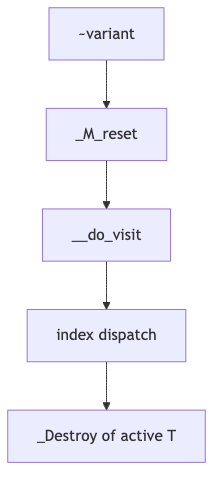
Copy, move, and assignment reuse __raw_idx_visit — the same
index-driven dispatch for every special member function. Construction
placement-news the real T_N into slot N; destruction calls the real ~T
for the active member only. Lifetime management uses the same closed tagged
selection as std::visit.
Index + closed tagged dispatch
std::variant / std::visit perform runtime selection through the active
index. An implementation may use a switch, jump table, or function-pointer
table. See V — Closed Tagged Dispatch
for the full treatment. The important comparison with virtual dispatch is the
public type boundary:
| Virtual (Part I) | variant / visit (Part V) |
|
|---|---|---|
| Open vs closed | Open — new Derived elsewhere |
Closed — every Ti in variant<Ts...> |
| Runtime tag | vtable pointer + slot | index() |
| Dispatch implementation | vtable | switch, jump table, or visit thunks |
Callable in visit |
N/A | Not erased — monomorphized per call site (contrast std::function) |
| Compiler output | One interface type; concrete types behind vtable | Monomorphized per Ti and per callable; tag+table for axis 1 |
| Type erasure? | Yes in this series’ operational taxonomy | No; every Ti is public |
Virtual hides derived implementations behind an open base interface. variant
records which member of a closed, publicly enumerated list is active.
What the compiler generates (all concrete)
For std::variant<int, float, std::string>, the implementation is fully specialized at compile time:
- Storage —
_Variadic_union<int, float, string>with_M_index. - Construction —
in_place_index<N>→ placement-new of the actualT_N. - Destruction / copy / move / assign —
__do_visit/__raw_idx_visitthunks that call_Destroy,_Construct, etc. on the concrete activeT&. std::visit(f, v)— a function template instantiated for your exactf;__visit_invokecallsstd::__invoke(f, concrete_T&...).
Nothing in that pipeline forgets which Ti or which visitor type you passed. The function-pointer table libstdc++ builds (_S_vtable of __visit_invoke thunks) dispatches index → call visitor with int& vs string&. It does not erase your lambda into a generic callable the way std::function does.
Virtual:       Shape& → (vtable tag) → vtable → concrete override
variant/visit: variant<Ts...> → (index tag) → table → concrete Ti handler
The machine-level dispatch shapes can look similar, but only the virtual base removes concrete alternatives from the consumer-visible interface.
Each std::visit call is a unique instantiation
std::visit is a function template. Every distinct pair (Visitor, variant<Ts...>) at a call site gets its own generated dispatcher — index table, thunks, and overload checks included:
std::visit([](auto&& x) { /* A */ }, v);              // instantiation 1
std::visit([](auto&& x) { /* B */ }, v);              // instantiation 2 (different Visitor)
std::visit(f, std::variant<int, float>{});            // instantiation 3 (different Ts...)
Nothing is shared through a type-erased std::function-like interface unless you wrap the callable that way. The runtime half is always the same within one instantiation: read index(), call the matching branch of this callable.
Callables can be lambdas, function objects, function pointers, or std::function in an overload set — visit accepts any type that is invocable with every alternative. The template argument is always the concrete callable type you pass in.
std::visit vs classic Visitor pattern
Your handlers in std::visit are not virtual methods on a Visitor base class. They are static overloads or a generic lambda with if constexpr — each branch is typed at compile time, invoked through a library-generated thunk at runtime.
| Classic Visitor | std::visit |
|
|---|---|---|
| All types known when? | Compile time (Circle, visitCircle, …) |
Compile time (variant<Ts...>, each overload) |
| Goal | Different operation per concrete type | Same |
| Visitor API | Virtual visitCircle, visitRectangle on one Visitor base |
No base class — each operation = new callable at new call site |
| Dispatch axis 1 (element) | Runtime virtual accept on element |
Runtime index() → Ti& |
| Dispatch axis 2 (operation) | Runtime virtual visitXxx on visitor object |
Compile time: separate std::visit(callable, v) per operation |
| Uniform signature? | Visitor& + Shape& |
variant<Ts...> at use site; callable monomorphized per call site |
| Library “vtable” | User-defined on element + visitor | _S_vtable of __visit_invoke thunks (axis 1 only) |
Classic:  shape.accept(visitor)     →  2 runtime vtables (element + visitor)
visit:    std::visit(callable, v)     →  1 runtime index dispatch + callable fixed at call site
          std::visit(other_callable, v)  →  separate monomorphization ≈ new Visitor subclass
Both pursue double dispatch in intent (element tag + operation). Virtual
dispatch runs both selections at runtime through shared bases (Shape&,
Visitor&) and vtables. std::visit runs one runtime selection (index());
the operation dimension is the concrete callable compiled at that call site.
The virtual design uses erased open interfaces, whereas variant uses a closed
tagged union (Part V).
Summary
- Different abstraction boundaries: virtual bases hide derived types;
variant<Ts...>publicly enumerates every alternative. - Key difference: open vs closed — virtual: user can implement new
Derivedelsewhere;variant: author must list all possible types invariant<Ts...>. - Each
std::visit(callable, v)≈ a new visitor derived class with its own handler table; runtime readsindex()and jumps to the matching branch within that instantiation. - Double dispatch axis 2 differs in encoding: virtual uses a second runtime vtable on
Visitor&;variantuses separate monomorphized call sites per operation. - Details: V — Closed Tagged Dispatch; Double Dispatch and the Visitor Pattern (virtual double dispatch); RTTI in Part VI.
References
- std::variant — cppreference
- std::visit — cppreference
- libstdc++
include/std/variant— GCC mirror - Double Dispatch and the Visitor Pattern in C++
- Type Erasure I — Core Logic (fn-ptr dispatch vocabulary)
- V — Closed Tagged Dispatch
- Type Erasure VI — dynamic_cast & RTTI (open hierarchy, RTTI recovery)