Double Dispatch and the Visitor Pattern in C++
Double dispatch is the technique C++ uses to pick the right behavior when two object types matter at runtime — for example, which print routine runs for a Circle on an InkjetPrinter vs a LaserPrinter. This post walks through the Visitor pattern step by step, using one shape hierarchy and concrete, compilable code at every stage.
Editor’s note: The comparison with
std::variantnow distinguishes virtual type erasure from closed tagged dispatch; a runtime tag or function table alone does not imply type erasure.
- Overview: two dispatches, one operation
- Step 1 — The problem: single dispatch is not enough
- Step 2 — The visited side:
accept()is the entrance - Step 3 — The visitor side: one
visitXxxper visited type - Step 4 — Optional
visit()sugar on the visitor - Step 5 — Partial visitors: compile-time checks and intentional no-ops
- Step 6 — Two styles of visitor API: overloaded
visit()vs namedvisitXxx() - Step 7 — Fine-grained visitors: one operation per derived class
- Step 8 — Propagating the visitor through a graph of visited objects
- Related runtime dispatch, different abstraction boundaries
- Golden rules
- References
Overview: two dispatches, one operation
When a client calls shape.accept(printer), two runtime decisions happen in sequence:
- First dispatch — virtual
accepton the shape picks the concrete type (Circle,Rectangle, …). - Second dispatch — the shape calls
printer.printCircle(*this)(orprintRectangle, …), which resolves to the concrete printer override (InkjetPrinter,LaserPrinter, …).
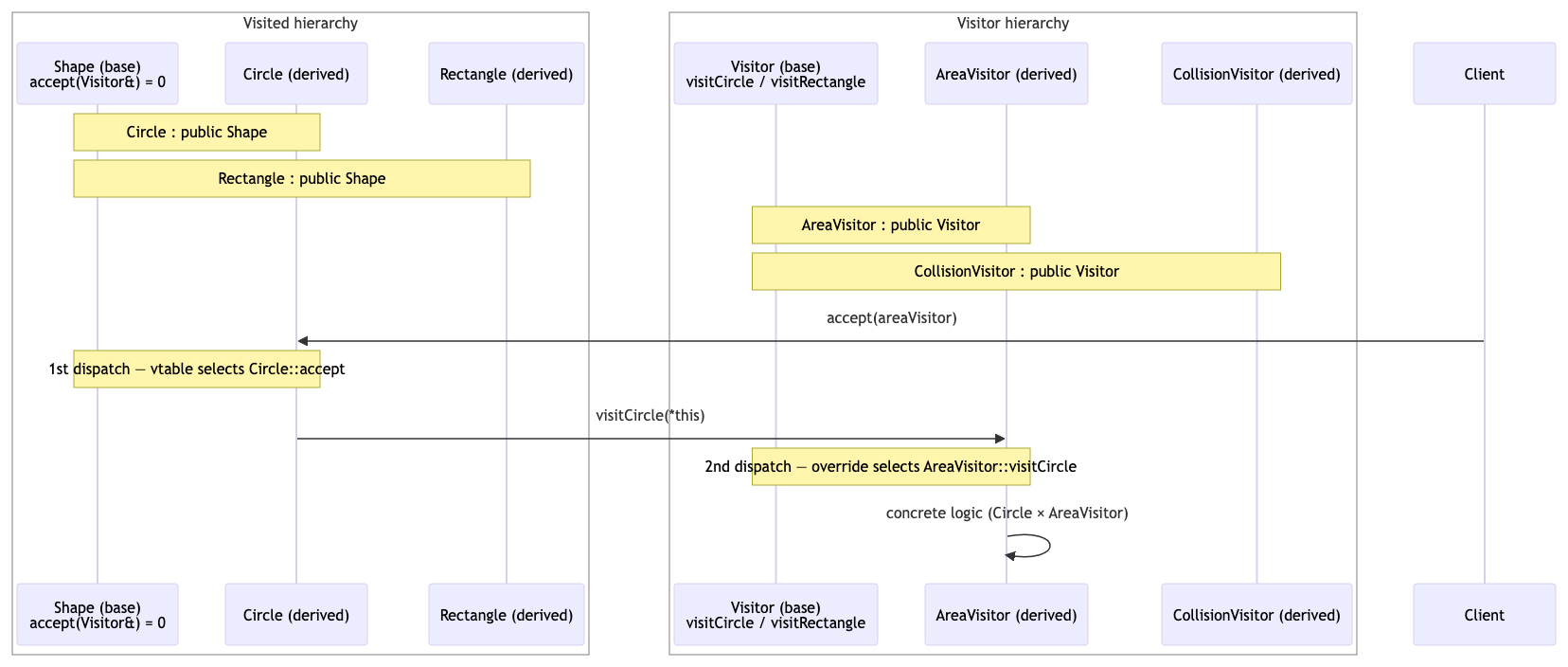
The rest of this post builds that mechanism from scratch.
Step 1 — The problem: single dispatch is not enough
Suppose we want to print shapes (Circle, Rectangle) on different printers (InkjetPrinter, LaserPrinter). The correct routine depends on both runtime types — shape and printer. C++ virtual functions alone only give single dispatch: one virtual call resolves the type of one object.
Single dispatch: only the printer type varies
If every call site already holds a Circle&, a single virtual on Printer is enough — only the printer is polymorphic:
#include <iostream>

class Circle {
public:
  explicit Circle(double radius) : radius_(radius) {}
  double radius() const { return radius_; }

private:
  double radius_;
};

class Printer {
public:
  virtual void printCircle(Circle& c) = 0;
  virtual ~Printer() = default;
};

class InkjetPrinter : public Printer {
  void printCircle(Circle& c) override {
    std::cout << "Inkjet: circle r=" << c.radius() << '\n';
  }
};

class LaserPrinter : public Printer {
  void printCircle(Circle& c) override {
    std::cout << "Laser: circle r=" << c.radius() << '\n';
  }
};

int main() {
  Circle c{3.0};
  InkjetPrinter inkjet;
  LaserPrinter laser;

  Printer* p1 = &inkjet;
  Printer* p2 = &laser;
  p1->printCircle(c);  // Inkjet — one runtime dispatch on printer
  p2->printCircle(c);  // Laser
}
Inkjet: circle r=3
Laser: circle r=3
The shape type (Circle) is fixed at compile time. The vtable picks InkjetPrinter::printCircle vs LaserPrinter::printCircle. That is single dispatch on the printer.
Two shape types: one virtual print(Shape&) is not enough
Add Rectangle as a second shape and store shapes as Shape&. Each shape calls into the printer via accept, but a naive Printer exposes only one method for all shapes:
class Shape {
public:
  virtual void accept(Printer& p) = 0;
  virtual ~Shape() = default;
};

class Circle : public Shape {
public:
  explicit Circle(double radius) : radius_(radius) {}
  double radius() const { return radius_; }
  void accept(Printer& p) override { p.print(*this); }

private:
  double radius_;
};

class Rectangle : public Shape {
public:
  Rectangle(double w, double h) : width_(w), height_(h) {}
  double width() const { return width_; }
  double height() const { return height_; }
  void accept(Printer& p) override { p.print(*this); }

private:
  double width_, height_;
};

class Printer {
public:
  virtual void print(Shape& shape) = 0;  // single method for all shapes
};

class InkjetPrinter : public Printer {
  void print(Shape& shape) override {
    // Need Inkjet×Circle vs Inkjet×Rectangle logic.
    // But `shape` is Shape& — compiler does not know which shape.
    // dynamic_cast<Circle*>(&shape)? Fragile and scatters logic.
  }
};
Circle c{3.0};
Rectangle r{4.0, 5.0};
InkjetPrinter inkjet;

c.accept(inkjet);
r.accept(inkjet);
The first dispatch works: c.accept(inkjet) resolves to Circle::accept. But p.print(*this) always calls print(Shape&) — the compiler never sees Circle& or Rectangle& inside InkjetPrinter. We need a second dispatch that passes the shape’s concrete type into the printer.
What double dispatch gives us (preview)
Give Printer one virtual method per shape type. Each shape’s accept calls the matching one; InkjetPrinter and LaserPrinter override both:
class Printer {
public:
  virtual void printCircle(Circle& c) = 0;
  virtual void printRectangle(Rectangle& r) = 0;
  virtual ~Printer() = default;
};

class Circle : public Shape {
public:
  explicit Circle(double radius) : radius_(radius) {}
  double radius() const { return radius_; }
  void accept(Printer& p) override {
    p.printCircle(*this);  // passes Circle& — second dispatch via printer vtable
  }

private:
  double radius_;
};

class Rectangle : public Shape {
public:
  Rectangle(double w, double h) : width_(w), height_(h) {}
  double width() const { return width_; }
  double height() const { return height_; }
  void accept(Printer& p) override {
    p.printRectangle(*this);  // passes Rectangle&
  }

private:
  double width_, height_;
};

class InkjetPrinter : public Printer {
  void printCircle(Circle& c) override {
    std::cout << "Inkjet: circle r=" << c.radius() << '\n';
  }
  void printRectangle(Rectangle& r) override {
    std::cout << "Inkjet: rectangle " << r.width() << 'x' << r.height() << '\n';
  }
};

class LaserPrinter : public Printer {
  void printCircle(Circle& c) override {
    std::cout << "Laser: circle r=" << c.radius() << '\n';
  }
  void printRectangle(Rectangle& r) override {
    std::cout << "Laser: rectangle " << r.width() << 'x' << r.height() << '\n';
  }
};
Circle c{3.0};
Rectangle r{4.0, 5.0};
InkjetPrinter inkjet;
LaserPrinter laser;

c.accept(inkjet);  // 1st: Circle::accept  2nd: InkjetPrinter::printCircle
r.accept(laser);   // 1st: Rectangle::accept  2nd: LaserPrinter::printRectangle
Inkjet: circle r=3
Laser: rectangle 4x5
Inside InkjetPrinter::printCircle, both types are known: the shape is Circle& and the printer is InkjetPrinter. The same pattern generalizes to a Visitor base with visitCircle / visitRectangle in the steps below.
Step 2 — The visited side: accept() is the entrance
Every visited class must implement accept(Visitor&). In best practice, accept is a pure virtual method on the base class so no concrete shape can forget it.
Visited hierarchy
Forward-declare Visitor (defined in the next step):
#include <iostream>

class Visitor;  // forward declaration

class Shape {
public:
  virtual ~Shape() = default;
  virtual void accept(Visitor& v) = 0;  // pure virtual — enforces contract
};

class Circle : public Shape {
public:
  explicit Circle(double radius) : radius_(radius) {}
  double radius() const { return radius_; }
  void accept(Visitor& v) override;

private:
  double radius_;
};

class Rectangle : public Shape {
public:
  Rectangle(double w, double h) : width_(w), height_(h) {}
  double width() const { return width_; }
  double height() const { return height_; }
  void accept(Visitor& v) override;

private:
  double width_, height_;
};
accept implementations
Each derived class calls the matching method on the visitor, passing its own concrete type:
void Circle::accept(Visitor& v) { v.visitCircle(*this); }
void Rectangle::accept(Visitor& v) { v.visitRectangle(*this); }
Note: accept is always the entrance on the visited side. Client code starts double dispatch by calling shape.accept(visitor), never by calling visitXxx on the visitor directly (unless both types are already known — covered in Step 8).
Best practice: pure virtual accept catches missing implementations
If a new derived class forgets to override accept:
class Triangle : public Shape {
  // forgot accept()
};

int main() {
  Triangle t;  // error: abstract type
}
error: cannot declare variable 't' to be of abstract type 'Triangle'
note: because the following virtual functions are pure within 'Triangle':
note:   virtual void Shape::accept(Visitor&)
The compiler enforces that every concrete visited class participates in the protocol.
Step 3 — The visitor side: one visitXxx per visited type
The visitor base class declares a visitXxx method for every visited type. Each concrete visitor implements all of them. Inside a visitXxx override, the compiler knows both the visitor subclass and the visited type — that is where application logic belongs.
First complete program: AreaVisitor
#include <iostream>

class Visitor;

class Shape {
public:
  virtual ~Shape() = default;
  virtual void accept(Visitor& v) = 0;
};

class Circle : public Shape {
public:
  explicit Circle(double radius) : radius_(radius) {}
  double radius() const { return radius_; }
  void accept(Visitor& v) override;

private:
  double radius_;
};

class Rectangle : public Shape {
public:
  Rectangle(double w, double h) : width_(w), height_(h) {}
  double width() const { return width_; }
  double height() const { return height_; }
  void accept(Visitor& v) override;

private:
  double width_, height_;
};

class Visitor {
public:
  virtual ~Visitor() = default;
  virtual void visitCircle(Circle& c) = 0;
  virtual void visitRectangle(Rectangle& r) = 0;
};

void Circle::accept(Visitor& v) { v.visitCircle(*this); }
void Rectangle::accept(Visitor& v) { v.visitRectangle(*this); }

class AreaVisitor : public Visitor {
public:
  void visitCircle(Circle& c) override {
    // HERE: dynamic type of *this is AreaVisitor
    // HERE: static type of c is Circle&
    // => implement Circle × Area logic in one place
    std::cout << "Circle area: " << 3.14159 * c.radius() * c.radius() << '\n';
  }
  void visitRectangle(Rectangle& r) override {
    std::cout << "Rectangle area: " << r.width() * r.height() << '\n';
  }
};

int main() {
  Circle c{3.0};
  Rectangle r{4.0, 5.0};
  AreaVisitor av;
  c.accept(av);
  r.accept(av);
}
Circle area: 28.2743
Rectangle area: 20
Extensibility cost
The Visitor pattern trades two different extensibility axes:
Adding a new visited type (e.g. Triangle : Shape) ripples through the whole protocol:
// Adding Triangle : Shape requires:
//   1. Triangle::accept       -> v.visitTriangle(*this)
//   2. Visitor::visitTriangle (pure virtual on base)
//   3. AreaVisitor::visitTriangle, PrintVisitor::visitTriangle, ...  (every existing visitor)
Adding a new operation (e.g. PrintVisitor : Visitor) only requires a new visitor class that implements every visitXxx already declared on the visitor base. The visited side does not change — Circle::accept still calls v.visitCircle(*this); Rectangle::accept still calls v.visitRectangle(*this). Those accept implementations are fixed when the hierarchy is wired up; they dispatch through the Visitor& vtable to whichever concrete visitor you pass in.
class PrintVisitor : public Visitor {
public:
  void visitCircle(Circle& c) override { /* print circle */ }
  void visitRectangle(Rectangle& r) override { /* print rectangle */ }
};

// No edits to Circle::accept, Rectangle::accept, or Shape — just use the new visitor:
c.accept(PrintVisitor{});
This trade-off favors a stable class hierarchy with many operations — compilers, ASTs, scene graphs. Adding a new shape type is expensive; adding a new pass or renderer is cheap.
Step 4 — Optional visit() sugar on the visitor
The visitor may provide a convenience helper that forwards to accept. This is syntactic sugar only; accept on the visited object remains the canonical entrance.
class Visitor {
public:
  virtual ~Visitor() = default;
  virtual void visitCircle(Circle& c) = 0;
  virtual void visitRectangle(Rectangle& r) = 0;

  void visit(Shape& s) { s.accept(*this); }  // sugar — not the pattern's entry point
};

int main() {
  Circle c{1.0};
  Rectangle r{2.0, 3.0};
  AreaVisitor av;
  c.accept(av);   // canonical: entrance on visited object
  av.visit(r);    // equivalent sugar — ends up in r.accept(av)
}
Both styles produce the same output:
Circle area: 3.14159
Rectangle area: 6
Note: Prefer shape.accept(visitor) in APIs that define the visited hierarchy. The visit(Shape&) helper is optional ergonomics for call sites that hold a visitor and want to pass shapes in reverse order.
Step 5 — Partial visitors: compile-time checks and intentional no-ops
With a fat visitor base (Step 3), every concrete visitor must implement all visitXxx methods declared on the base. That is enforced at compile time: an incomplete visitor is an abstract class and cannot be instantiated. Step 5 also covers two other valid partial designs — no-op defaults and a base that omits some visitXxx APIs — where excluded shape types are never visited, again with compile-time checks.
Compile-time check: incomplete visitor is abstract
If Visitor keeps visitRectangle pure virtual, a visitor that only handles circles does not compile:
class PrintCircleOnlyVisitor : public Visitor {
public:
  void visitCircle(Circle& c) override {
    std::cout << "Circle r=" << c.radius() << '\n';
  }
  // missing visitRectangle — class stays abstract
};

int main() {
  PrintCircleOnlyVisitor pv;  // error: abstract type
}
error: cannot declare variable 'pv' to be of abstract type 'PrintCircleOnlyVisitor'
note: because the following virtual functions are pure within 'PrintCircleOnlyVisitor':
note:   virtual void Visitor::visitRectangle(Rectangle&)
This is a feature of the strict design: the type system refuses a half-implemented visitor. Every accept ↔ visitXxx pair on the base must have a real override in every concrete visitor you construct.
When you want partial behavior: no-op defaults (intentional design)
Sometimes a visitor should only do work for some shape types; for others, doing nothing is correct. That is not an error — it is a deliberate API choice. Provide empty default implementations on the visitor base instead of pure virtual for the pairs you want to opt out of:
class PartialVisitor {
public:
  virtual ~PartialVisitor() = default;
  virtual void visitCircle(Circle& c) = 0;       // must implement — circles matter
  virtual void visitRectangle(Rectangle&) {}     // default no-op — rectangles optional
};

class PrintCircleOnlyVisitor : public PartialVisitor {
public:
  void visitCircle(Circle& c) override {
    std::cout << "Circle r=" << c.radius() << '\n';
  }
  // visitRectangle inherits empty default — intentional
};

int main() {
  Circle c{2.0};
  Rectangle r{1.0, 1.0};
  PrintCircleOnlyVisitor pv;

  c.accept(pv);  // prints
  r.accept(pv);  // calls inherited no-op — valid if that is what you designed
}
Here Rectangle::accept still calls v.visitRectangle(*this); the empty base implementation runs. That is by design, not silent failure — you chose a base where unhandled pairs are no-ops. Document which visitors handle which shapes, same as you would document any other API contract.
When the base omits visitXxx entirely
You can also define a narrower visitor base that declares only the visitXxx methods you need — and leave others out of the API altogether. Shapes outside that protocol are simply never visited through it; that is still a valid, compile-time-checked design.
class CircleOnlyVisitor {
public:
  virtual ~CircleOnlyVisitor() = default;
  virtual void visitCircle(Circle& c) = 0;
  // no visitRectangle — not part of this protocol
};

class Circle : public Shape {
public:
  // ...
  void accept(CircleOnlyVisitor& v) { v.visitCircle(*this); }
};

class Rectangle : public Shape {
public:
  // ...
  void accept(Visitor& v) override { v.visitRectangle(*this); }  // full Visitor only
  // no accept(CircleOnlyVisitor&) — rectangles never enter the circle-only protocol
};

class PrintCircleOnlyVisitor : public CircleOnlyVisitor {
public:
  void visitCircle(Circle& c) override {
    std::cout << "Circle r=" << c.radius() << '\n';
  }
};

int main() {
  Circle c{2.0};
  Rectangle r{1.0, 1.0};
  PrintCircleOnlyVisitor pv;

  c.accept(pv);   // OK — double dispatch runs
  // r.accept(pv);  // compile error — Rectangle has no accept(CircleOnlyVisitor&)
}
If you try to wire a shape into a protocol the base does not support, the compiler fails immediately — same as Style B in Step 6:
void Rectangle::accept(CircleOnlyVisitor& v) {
  v.visitRectangle(*this);  // error: CircleOnlyVisitor has no member named visitRectangle
}
So a missing visitXxx on the base means that node is outside this visitor API — it will never be reached via accept on that base type. No runtime surprise: either the shape has no matching accept overload, or the accept body names a method the base does not declare. All of it is resolved at compile time.
The visitor base API is the type contract
As long as the visitor base declares the correct visitXxx signatures and each shape’s accept calls the matching method with *this, the pairing cannot go wrong at the visitXxx call. The compiler checks every link:
class CircleOnlyVisitor {
public:
  virtual ~CircleOnlyVisitor() = default;
  virtual void visitCircle(Circle& c) = 0;
  // no visitRectangle — not part of this protocol
};

void Circle::accept(CircleOnlyVisitor& v) {
  v.visitCircle(*this);  // *this is Circle& — only visitCircle(Circle&) applies
}
Circle::accept(v)
  → v.visitCircle(*this)
      *this static type: Circle&     ✓ matches visitCircle(Circle&)
      cannot become Rectangle&      ✗ no conversion, no wrong overload
There is no path through accept that passes a Rectangle& into visitCircle(Circle&) or calls a visitXxx the base does not declare. Style B names each method explicitly (visitCircle, not overloaded visit(Shape&)), so the visited type and the visitor parameter type are locked together at compile time. Wrong wiring is a compile error; wrong runtime instance types at visitXxx are not possible once the API is correct.
That is why partial and narrow visitor bases remain safe: the protocol you define in the base class is the type system the compiler enforces — not a convention you hope call sites follow at runtime.
Choosing between the three
| Base design | Incomplete concrete visitor | Shape not in protocol |
|---|---|---|
Pure virtual every visitXxx on fat base |
Compile error — cannot instantiate | N/A — all wired shapes must have matching visitXxx |
Default no-op for some visitXxx |
Compiles — missing overrides inherit no-op | All wired shapes call accept; unhandled pairs run no-op |
visitXxx omitted from base |
Concrete visitor implements only declared methods | Never visited — no accept overload or compile error if mis-wired |
Recommendation: use pure virtual visitXxx on the main Visitor base when every operation must handle every shape (Style B in Step 6). Introduce no-op defaults on a separate base (e.g. PartialVisitor) only when partial behavior is an explicit product requirement. Use a narrow base that omits visitXxx when entire shape types should not participate in that protocol at all — still compile-time safe, with those nodes simply never visited.
Both strict and partial designs keep wrong visitor class definitions and wrong wiring visible at compile time (abstract type, missing member, or missing accept overload). With a correct base API, there is also no wrong argument type at visitXxx through the accept path — *this and the method parameter type are fixed together. The difference is whether unhandled shapes are forbidden, no-ops, or excluded from the API entirely.
Step 6 — Two styles of visitor API: overloaded visit() vs named visitXxx()
There are two common ways to name the visitor methods. Both achieve double dispatch; they differ in clarity and safety.
Style A — uniform visit() with overloads
Same Circle / Rectangle as before; accept calls overloaded visit:
#include <iostream>

class OverloadVisitor;

class Circle {
public:
  explicit Circle(double radius) : radius_(radius) {}
  double radius() const { return radius_; }
  void accept(OverloadVisitor& v);

private:
  double radius_;
};

class Rectangle {
public:
  Rectangle(double w, double h) : width_(w), height_(h) {}
  double width() const { return width_; }
  double height() const { return height_; }
  void accept(OverloadVisitor& v);

private:
  double width_, height_;
};

class OverloadVisitor {
public:
  virtual ~OverloadVisitor() = default;
  virtual void visit(Circle& c) = 0;
  virtual void visit(Rectangle& r) = 0;
};

void Circle::accept(OverloadVisitor& v) { v.visit(*this); }
void Rectangle::accept(OverloadVisitor& v) { v.visit(*this); }

class AreaOverloadVisitor : public OverloadVisitor {
public:
  void visit(Circle& c) override {
    std::cout << "Circle area: " << 3.14159 * c.radius() * c.radius() << '\n';
  }
  void visit(Rectangle& r) override {
    std::cout << "Rectangle area: " << r.width() * r.height() << '\n';
  }
};

int main() {
  Circle c{3.0};
  Rectangle r{4.0, 5.0};
  AreaOverloadVisitor av;
  c.accept(av);
  r.accept(av);
}
Circle::accept calls v.visit(*this); overload resolution picks visit(Circle&) because *this is a Circle&.
Style B — named visitXxx() (recommended)
Identical main(), different visitor API surface:
#include <iostream>

class NamedVisitor;

class Circle {
public:
  explicit Circle(double radius) : radius_(radius) {}
  double radius() const { return radius_; }
  void accept(NamedVisitor& v);

private:
  double radius_;
};

class Rectangle {
public:
  Rectangle(double w, double h) : width_(w), height_(h) {}
  double width() const { return width_; }
  double height() const { return height_; }
  void accept(NamedVisitor& v);

private:
  double width_, height_;
};

class NamedVisitor {
public:
  virtual ~NamedVisitor() = default;
  virtual void visitCircle(Circle& c) = 0;
  virtual void visitRectangle(Rectangle& r) = 0;
};

void Circle::accept(NamedVisitor& v) { v.visitCircle(*this); }
void Rectangle::accept(NamedVisitor& v) { v.visitRectangle(*this); }

class AreaNamedVisitor : public NamedVisitor {
public:
  void visitCircle(Circle& c) override {
    std::cout << "Circle area: " << 3.14159 * c.radius() * c.radius() << '\n';
  }
  void visitRectangle(Rectangle& r) override {
    std::cout << "Rectangle area: " << r.width() * r.height() << '\n';
  }
};

int main() {
  Circle c{3.0};
  Rectangle r{4.0, 5.0};
  AreaNamedVisitor av;
  c.accept(av);
  r.accept(av);
}
Same dispatch, but each method name documents which visited type it handles.
Comparison
| Aspect | Style A: visit(Circle&) |
Style B: visitCircle(Circle&) |
|---|---|---|
| Readability | Compact | Explicit, grep-friendly |
| Overload ambiguity | Possible if many visit(T&) overloads coexist |
Unlikely — names are unique |
| Refactoring | Renaming a shape class affects overload set | Rename one method |
| Missing handler for new shape | visit(*this) may bind to visit(Shape&) — compiles, wrong at runtime |
visitEllipse(*this) — compile error until base adds it |
| Partial / incomplete visitor | Easy to hide gaps behind overload resolution | Pure virtual visitXxx forces every concrete visitor to implement or fail at compile time |
Style A pitfall — a helper plus many overloads can surprise you:
class OverloadVisitor {
public:
  virtual void visit(Circle& c) = 0;
  virtual void visit(Rectangle& r) = 0;
  void visit(Shape& s) { s.accept(*this); }  // convenience helper
};
// Adding visit(Ellipse&) in a subclass, or an ambiguous using-declaration,
// can change which overload binds in subtle ways.
Style A pitfall — missing overload falls back to visit(Shape&):
Add a new shape but forget to add visit(Ellipse&) on the visitor base:
class Ellipse : public Shape {
public:
  void accept(OverloadVisitor& v) override {
    v.visit(*this);  // no visit(Ellipse&) — binds to visit(Shape&) instead!
  }
};

void OverloadVisitor::visit(Shape& s) { s.accept(*this); }  // helper
// Ellipse::accept → visit(Shape&) → accept → visit(Shape&) → …
Because Ellipse& converts to Shape&, the call compiles but can recurse forever or hit the wrong logic. There is no error pointing at a missing visit(Ellipse&).
Style B — same mistake is a clear compile error:
class Ellipse : public Shape {
public:
  void accept(Visitor& v) override {
    v.visitEllipse(*this);  // error: Visitor has no member named visitEllipse
  }
};
Each accept names exactly one method. If the visitor base lacks that visitXxx, the compiler fails immediately. This is the same property as Step 5’s strict base: Circle::accept calls visitCircle; with pure virtual on the base, a visitor that omits it cannot be instantiated.
Recommendation: always prefer Style B (visitCircle, visitRectangle, …). Do not use overloaded visit(T&) as the primary double-dispatch API — missing pairs compile silently with Style A but fail loudly with Style B.
Both styles produce identical output when wired correctly:
Circle area: 28.2743
Rectangle area: 20
Step 7 — Fine-grained visitors: one operation per derived class
Instead of one fat visitor with every visitXxx, you can split each operation into its own small derived class. The base Visitor stays empty — no shared virtual API — and each derived visitor implements only the Style B visitXxx methods it needs. The visited side only knows Visitor& and must dynamic_cast to the specific derived visitor before calling visitXxx.
Empty base + per-shape visitors
struct Visitor {
  virtual ~Visitor() = default;
};  // no shared visitXxx API on base

struct CircleAreaVisitor : Visitor {
  void visitCircle(Circle& c) {
    std::cout << "Circle area: " << 3.14159 * c.radius() * c.radius() << '\n';
  }
};

struct RectangleAreaVisitor : Visitor {
  void visitRectangle(Rectangle& r) {
    std::cout << "Rectangle area: " << r.width() * r.height() << '\n';
  }
};
Visited side: dynamic_cast (compile-time names, runtime choice)
Because accept only receives Visitor&, each shape hard-codes which derived visitors it supports, then calls the matching visitXxx:
void Circle::accept(Visitor& v) {
  if (auto* av = dynamic_cast<CircleAreaVisitor*>(&v)) {
    av->visitCircle(*this);
  }
  // wrong visitor type? falls through — silent no-op unless you add an else branch
}

void Rectangle::accept(Visitor& v) {
  if (auto* av = dynamic_cast<RectangleAreaVisitor*>(&v)) {
    av->visitRectangle(*this);
  }
}
Demonstrating match and mismatch
int main() {
  Circle c{2.0};
  Rectangle r{3.0, 4.0};
  CircleAreaVisitor cav;

  c.accept(cav);  // prints area
  r.accept(cav);  // silent no-op — CircleAreaVisitor is wrong for Rectangle
}
Circle area: 12.5664
- Benefit: each visitor class is tiny and implements only its
visitXxx(Style B); no fat visitor with every pair. - Cost: visited classes know visitor subtypes by name;
dynamic_casttargets andvisitXxxnames are fixed at compile time. Wrong visitor → no-op or manual error handling. Less open/closed than the classic fat-visitor design.
This still involves two runtime type decisions (vtable for accept, RTTI for dynamic_cast), but the second step is deferred: the base has no virtual visitXxx, so dispatch goes through dynamic_cast + a non-virtual visitCircle / visitRectangle on the derived visitor.
Step 8 — Propagating the visitor through a graph of visited objects
When shapes contain other shapes, or a collision pairs two operands, there are two ways to pass the visitor along.
Strategy A — accept chaining (unknown static type)
Use when the next object is held as Shape& or unique_ptr<Shape> and you need double dispatch for each node. The example below adds CompositeShape to the hierarchy from Step 3:
// ... Shape, Circle, Rectangle, Visitor, AreaVisitor from Step 3 ...

class CompositeShape : public Shape {
  std::vector<std::unique_ptr<Shape>> children_;

public:
  void add(std::unique_ptr<Shape> s) { children_.push_back(std::move(s)); }

  void accept(Visitor& v) override {
    for (auto& child : children_) {
      child->accept(v);  // propagate via accept — double dispatch per child
    }
  }
};

int main() {
  CompositeShape group;
  group.add(std::make_unique<Circle>(1.0));
  group.add(std::make_unique<Rectangle>(2.0, 3.0));
  AreaVisitor av;
  group.accept(av);
}
Circle area: 3.14159
Rectangle area: 6
Each child calls its own accept, so the correct visitXxx runs even though the composite only stores Shape*.
Strategy B — call visitXxx inside another visitXxx when the type is known
Use when you are already inside a visitXxx handler and the next shape is held as a concrete reference (Rectangle&, not Shape&). Call the matching visitXxx directly — no other.accept(*this) needed.
Example: detect collision between one circle and one rectangle. The visitor carries the rectangle; the circle enters via accept:
// ... Shape, Circle, Rectangle, Visitor from Step 3 ...

class CircleRectangleCollisionVisitor : public Visitor {
public:
  explicit CircleRectangleCollisionVisitor(Rectangle& rect) : rect_(rect) {}

  void visitCircle(Circle& c) override {
    circle_ = &c;
    visitRectangle(rect_);  // rect_ is Rectangle& — type known, skip rect_.accept(*this)
  }

  void visitRectangle(Rectangle& r) override {
    std::cout << "Circle-Rectangle check: r=" << circle_->radius()
              << ", rect=" << r.width() << 'x' << r.height() << '\n';
  }

private:
  Rectangle& rect_;
  Circle* circle_ = nullptr;
};

int main() {
  Circle c{5.0};
  Rectangle r{4.0, 6.0};
  CircleRectangleCollisionVisitor cv{r};

  c.accept(cv);  // 1st dispatch: Circle::accept → visitCircle
                 // inside visitCircle: visitRectangle(rect_) — 2nd call, no accept on r
}
Circle-Rectangle check: r=5, rect=4x6
Only the circle uses accept to start the chain. The rectangle’s type is already known as Rectangle&, so visitCircle calls visitRectangle(rect_) directly instead of rect_.accept(*this).
Compare with Strategy A when the partner type is not known at compile time:
void visitCircle(Circle& c) override {
  circle_ = &c;
  partner_->accept(*this);  // partner_ is Shape& — must accept to dispatch
}
Rule of thumb
| Situation | Use |
|---|---|
Next object stored as Shape& / unique_ptr<Shape> |
other.accept(v) inside visitXxx |
Next object already concrete (Rectangle& r in scope or as member) |
Call visitRectangle(r) directly inside visitCircle — no second accept |
You can mix both in one visitor: other.accept(*this) when the partner is polymorphic; visitRectangle(other) when you already know it is a Rectangle&.
Related runtime dispatch, different abstraction boundaries
Virtual Visitor and std::variant/std::visit both perform runtime dispatch,
but only the virtual interface is type-erased under the taxonomy used in this
series:
- Virtual type erasure: call sites hold
Shape&/Visitor&without enumerating concrete derived types. Compiler-generated vtables act as operation tables over an open implementation set. - Closed tagged dispatch: every alternative is fixed and visible in
variant<Ts...>;index()selects among compile-time-generated branches.
Full treatment: V — Closed Tagged Dispatch. RTTI recovery on open hierarchies: Part VI. Closed-set double dispatch: Double Dispatch with std::variant and std::visit.
Golden rules
accept(Visitor&)pure virtual on the shape base — every concrete shape must implement it.- Each
acceptcalls one Style B method:v.visitCircle(*this), never overloadedv.visit(*this)onShape&. visitCircle,visitRectangle, … — named methods, not overloadedvisit(T&).- Every
visitXxxpure virtual onVisitor— same strict contract asaccept; every concrete visitor implements all of them. visitXxxshould cover all kinds of visited types, this makes life easier by enforce one to one mapping ofvisitXxxand visited types.- Put logic in
visitXxxoverrides — both types are known there. - New operation → new visitor class only. New shape →
accept+visitXxxon base + every existing visitor. - Propagate through graphs:
other.accept(v)whenotherisShape&;visitYyy(other)whenotheris already concrete. visitor.visit(shape)is optional sugar; preferacceptin APIs you define.
References
- Double dispatch — Wikipedia
- Double Dispatch in C++ — Vishesh Chovatiya (Medium)
- Double Dispatch — behnamasadi/cpp_tutorials
- Double Dispatch / Visitor Design Pattern in Modern C++ — vishalchovatiya.com
- Double Dispatch with std::variant and std::visit — closed alternative list,
index()+ static visitor overloads (companion to this post)