Closed Tagged Dispatch — std::variant
Previously:
- Type Erasure I — Core Logic
- Type Erasure II — std::function
- Type Erasure III — Trade-offs
- Type Erasure IV — ROS 2 Messages
Editor’s note: An earlier version classified
std::variantas type erasure because it combines a runtime tag with generated dispatch machinery. This article now follows the more precise taxonomy developed in Polymorphism, Type Erasure, and std::function:std::variantis a type-safe union with closed tagged dispatch, not type erasure.
std::variant<Ts...> provides runtime selection among a set of alternatives
that is completely enumerated in its public C++ type. For example,
std::variant<int, std::string> says directly that the value may contain an
int or a std::string. Runtime state records which alternative is active,
but no alternative has disappeared from the interface.
This makes std::variant a form of runtime polymorphism, specifically
closed tagged dispatch. It is not type erasure under the definition used in
this series because the consumer-visible type still names the complete set of
concrete alternatives.
- A type-safe union with a closed alternative set
- Construction and the active alternative
- Runtime dispatch through
std::visit - The visitor is also not erased
- Closed tagged dispatch versus virtual type erasure
- Double dispatch on a closed set
- What this mechanism is not
- Summary
- References
A type-safe union with a closed alternative set
The WG21 proposal that introduced std::variant describes it as a
type-safe union. Its template arguments form the closed set of possible
stored types:
using Value = std::variant<int, std::string>;

Value value = 42;
// Value still exposes the complete set: int or std::string.
// value.index() == 0, so int is currently active.
The static type Value exposes both alternatives. Adding double requires a
different type, std::variant<int, std::string, double>, and recompilation of
code that depends on that type.
This is the decisive distinction from an erased wrapper:
Type-erased interface:
    std::function<int(int)>
    -> public type names the signature, not the callable types

Closed tagged union:
    std::variant<int, std::string>
    -> public type explicitly enumerates every alternative

Construction and the active alternative
When code constructs, assigns, or emplaces an alternative, the implementation:
- Destroys the previous active member when necessary.
- Constructs the selected
Tin the variant’s storage. - Records the compile-time-known alternative index as runtime state.
Value value = 42;
value.emplace<std::string>("hello");
After the emplace, the active alternative is std::string. A later assignment
may change it again. This is ordinary discriminated-union state, not a permanent
binding to an erased implementation.
Runtime dispatch through std::visit
std::visit reads the active alternative and invokes the supplied callable
with the corresponding concrete reference:
std::visit(
    [](const auto& item) {
        use(item);
    },
    value);
The callable must be valid for every possible alternative. Its concrete type
and the complete variant<Ts...> type are known when the call site is compiled.
The compiler therefore instantiates the required handler for each Ti.
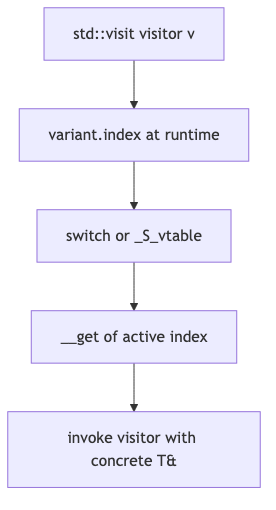
An implementation may realize this selection with a switch, a jump table, or a
function-pointer table. libstdc++ uses machinery such as __do_visit and, for
some cases, generated __visit_invoke thunks. These are implementation
techniques. A function table does not by itself make the public abstraction
type-erased.
The visitor is also not erased
Each distinct (Visitor, variant<Ts...>) pair produces its own template
instantiation. Passing two different lambdas creates two statically distinct
operations:
std::visit([](const auto& item) { print(item); }, value);
std::visit([](const auto& item) { hash(item); }, value);
Runtime chooses the active alternative for one already-compiled operation. It
does not choose among erased visitor implementations. Wrapping a visitor in
std::function would add callable erasure, but std::visit does not require
that wrapper.
Closed tagged dispatch versus virtual type erasure
This series classifies a virtual interface operationally as type erasure. A
caller using Shape& does not enumerate Circle, Rectangle, or future
derived types. The compiler-generated vtable is an operation table that
preserves selected behavior after the derived type is hidden.
That terminology is broader than common usage, which often reserves type
erasure for wrappers such as std::function and std::any. The operational
reason for including virtual interfaces is that Base& hides the derived type
behind a uniform behavioral contract in the same way an explicit erased
function table does.
std::variant differs at the public boundary:
| Property | Virtual interface | std::variant<Ts...> |
|---|---|---|
| Runtime-polymorphic selection | Yes | Yes |
| Consumer-visible type | Base&; derived types are not enumerated |
Every Ti is enumerated |
| Runtime state | vptr and selected vtable | active index() |
| Dispatch mechanism | vtable slot | switch, jump table, or visit table |
| Extensibility | Open derived-type set | Closed alternative set |
| Type erasure in this taxonomy | Yes | No |
The similar tag-and-dispatch shape is useful for comparing implementations, but it does not erase the static distinction between an open behavioral interface and a closed discriminated union.
Double dispatch on a closed set
std::variant and std::visit are useful when behavior depends on the active
alternative and the selected operation. The alternative axis is selected at
runtime through index(). The operation axis is represented by the concrete
callable at each compiled std::visit call site, not by a second runtime
vtable.
See Double Dispatch with std::variant and std::visit for the detailed comparison with the virtual Visitor pattern.
What this mechanism is not
- Not type erasure: the public
variant<Ts...>type enumerates all alternatives. - Not runtime typing: every
Tiand every visitor branch is known during compilation. - Not RTTI: selection uses the variant’s discriminant rather than
type_infoordynamic_cast. - Not callable erasure:
std::visitis instantiated for the concrete visitor type.
Summary
std::variant<Ts...>is a type-safe union with a closed compile-time set of alternatives.- Runtime state records which alternative is active, and
std::visitperforms closed tagged dispatch to an already-generated handler. - Switches and function tables are possible dispatch implementations; neither one changes the public type into an erased interface.
- Virtual interfaces and
std::functionhide concrete implementation types;std::variantexplicitly lists them. std::variantdemonstrates that runtime polymorphism does not require type erasure.