Python/C II — tp_call
- Section 3: General Python Interpreter Execution Model
- Section 4: Pure Python Bytecode Execution
- Section 5: C Extension Execution
- 5.1 Method Definition and Registration
- 5.2
PyType_Ready()Creates Method Descriptors - 5.3 Attribute Lookup: From
tp_dictDescriptor to BoundPyCFunctionObject - 5.4 Call Dispatch:
PyCFunction_Call - 5.5 C Extension Slots and Built-in Types
- 5.6 Type Tags: How the Interpreter “Knows”
- 5.7 Summary: C Extension Execution Path
- Section 6: Execution Path Comparison — Pure Python vs C Extension
- References
This article covers how CPython executes code: the shared interpreter model, pure Python bytecode, C extension method dispatch, and a side-by-side comparison of the two paths. It continues from Part I — Overview (Sections 1–2). Part III — ctypes and CFFI covers calling plain C libraries without hand-writing PyInit_* for each library. Part IV — Complex ctypes Structs and Handles covers ctypes struct handles (fd, capsule, Structure) and user API above them. Part VII — pybind11 covers compile-time C++ bindings that follow the same direct PyCFunctionObject dispatch path as Part I. Part VIII — Extensions vs Bindings clarifies extension authoring vs binding patterns across the series.
Runnable demos for the Python examples below live in the python repository.
| Section | Demo folder |
|---|---|
| §4.1 | c_ext_exec_python_config |
| §4.2 | c_ext_exec_class_bytecode |
| §5.1, §5.3 | c_ext_config_basic, c_ext_config_nested |
| §6.5 | c_ext_exec_compare |
Section 3: General Python Interpreter Execution Model
Before comparing Python classes and C extensions, it helps to see the shared machinery both paths use. CPython runs programs in two phases: compile Python source to bytecode, then execute bytecode in an interpreter loop. Every callable — Python function, C function, bound method, or type object — is ultimately invoked through the same tp_call dispatch on ob_type.
Note: Opcode names, frame layout, and internal function names vary by Python version (especially 3.11+). The model below is conceptual; use
dison your target version for exact bytecode.
3.1 Two-Phase Execution: Compile, Then Interpret
Python source  →  compiler  →  code objects (bytecode + constants + names)
                                    ↓
                             eval loop (PyEval_EvalFrameEx / _PyEval_EvalFrame)
                                    ↓
                             PyObject results, exceptions, or returns
- Compile time: functions, class bodies, and module top-level code become
PyCodeObjectinstances. -
Run time: the eval loop reads opcodes from a frame, operates on an operand stack, and calls C API helpers (
PyObject_Call,PyObject_SetAttr, etc.).A frame is the runtime context for one active function call — bytecode, locals, instruction pointer, and that call’s stack. The eval loop fetches the next opcode from the frame, executes it, and repeats.
The operand stack is an internal stack of
PyObject *values. Opcodes such asLOAD_FASTpush locals onto it;STORE_ATTRpops from it. Forself.timeout = timeout, the stack might go[timeout]→[timeout, self]→[].Bytecode instructions are tiny; the real work is done by C API helpers. The eval loop dispatches opcodes to well-defined C routines rather than reimplementing Python semantics in raw pointer manipulation:
Opcode (examples) C API helper (conceptually) STORE_ATTRPyObject_SetAttr(obj, name, value)CALLPyObject_Call(...)or a fast path (§3.5)BINARY_OP/ multiplyPyNumber_Multiply(left, right)
C extension code runs inside this loop when Python calls into it; it bypasses the loop only when the callable’s tp_call goes directly to native code (e.g. PyCFunction_Call).
3.2 Everything Is an Object: PyObject and ob_type
typedef struct _object {
    PyObject_HEAD   /* ob_refcnt + ob_type pointer */
} PyObject;
Every value — int, list, function, module, type — is a PyObject. The ob_type pointer identifies what the object is and which operations apply:
PyTypeObject *type = Py_TYPE(obj);
type->tp_call;      /* how to call it */
type->tp_getattro;  /* attribute lookup */
type->tp_dealloc;   /* destruction */
/* ... dozens of slots ... */
Python’s runtime is a tagged union: behavior is selected by ob_type, not by inspecting raw memory.
3.3 Universal Call Dispatch: PyObject_Call and tp_call
All calls converge here (simplified from Objects/call.c):
PyObject *
PyObject_Call(PyObject *callable, PyObject *args, PyObject *kwds)
{
    ternaryfunc call = callable->ob_type->tp_call;
    if (call != NULL)
        return call(callable, args, kwds);
    PyErr_Format(PyExc_TypeError, "'%.200s' object is not callable",
                 callable->ob_type->tp_name);
    return NULL;
}
Each callable type registers its own tp_call:
| Callable type | tp_call implementation |
What runs |
|---|---|---|
PyFunctionObject |
PyFunction_Call |
Build frame → bytecode eval loop |
PyCFunctionObject |
PyCFunction_Call |
Direct C function pointer |
PyTypeObject (class) |
type_call |
tp_new + tp_init |
User object with __call__ |
slot_tp_call |
Looks up __call__, then recurses |
Section 4 traces the Python function branch; Section 5 traces the C function branch.
3.4 The Eval Loop: Frames, Stack, and Opcodes
When tp_call leads to a PyFunctionObject, CPython builds a frame and runs its bytecode:
/* Conceptual eval loop — not complete CPython source */
PyObject *
PyEval_EvalFrame(PyFrameObject *frame)
{
    unsigned char *bytecode = PyBytes_AS_STRING(frame->f_code->co_code);
    PyObject **stack = frame->f_valuestack;
    PyObject **locals = frame->f_localsplus;
    PyObject *obj, *value, *left, *right, *name, *result;

    for (;;) {
        unsigned char opcode = *bytecode++;
        unsigned char oparg = *bytecode++;

        switch (opcode) {
        case LOAD_FAST:
            /* stack: [...] → [..., locals[oparg]] */
            PUSH(locals[oparg]);
            break;

        case LOAD_CONST:
            /* stack: [...] → [..., co_consts[oparg]] */
            PUSH(PyTuple_GET_ITEM(frame->f_code->co_consts, oparg));
            break;

        case STORE_ATTR:
            /* self.timeout = timeout
             * stack: [timeout, self] → [] */
            value = POP();
            obj = POP();
            name = PyTuple_GET_ITEM(frame->f_code->co_names, oparg);
            PyObject_SetAttr(obj, name, value);  /* C API helper */
            Py_DECREF(obj);
            Py_DECREF(value);
            break;

        case BINARY_OP:  /* or BINARY_MULTIPLY in older bytecode */
            /* self.timeout * 2
             * stack: [2, timeout] → [result] */
            right = POP();
            left = POP();
            result = PyNumber_Multiply(left, right);  /* C API helper */
            Py_DECREF(left);
            Py_DECREF(right);
            PUSH(result);
            break;

        case CALL:
            /* stack: [..., arg1, callable] → [..., result] */
            result = call_function(...);  /* → PyObject_Call or fast path (§3.5) */
            PUSH(result);
            break;

        case RETURN_VALUE:
            return POP();
        /* ... hundreds of other opcodes ... */
        }
    }
}
Each case is thin: decode opcode → shuffle stack → call a C API helper. STORE_ATTR delegates to PyObject_SetAttr; multiplication delegates to PyNumber_Multiply; calls delegate to call_function / PyObject_Call.
Key ideas:
- Frame — binds a
PyCodeObjectto locals, stack depth, and instruction pointer. - Stack machine — most opcodes push/pop
PyObject *references. - Per-opcode cost — dispatch, refcounting, and dynamic checks; far more expensive than a single C statement.
3.5 The CALL Opcode: call_function and Fast Paths
This section is about what happens when the eval loop executes the CALL bytecode instruction — not every way Python can invoke a callable. Calls made directly from C extension code via PyObject_Call() or PyObject_CallObject() skip the eval loop entirely; they go straight to tp_call. Here we focus on calls that originate inside running bytecode.
When bytecode runs obj.process(), the eval loop hits CALL. Arguments and the callable already sit on the operand stack as individual PyObject * values — not yet packed into a tuple or dict.
Generic (slow) path: pack, then PyObject_Call
The fully general route (do_call in ceval.c) does extra work:
- Pop positional arguments off the stack into a new
PyTuple. - Pop keyword arguments into a new
PyDict. - Call
PyObject_Call(callable, tuple, dict)→callable->ob_type->tp_call(...). - Inside
tp_call, the callee often unpacks that tuple again.
This is correct for any callable, but allocating and filling tuple/dict on every call is expensive when the common cases are plain Python functions and C functions with positional args only.
Fast path: recognize the type, skip packing
A fast path is an optimization inside call_function() (Python/ceval.c) that handles frequent cases before building tuple/dict. It still ends up running the same tp_call logic (or equivalent), but avoids the packing step.
The check is explicit type identification — the same ob_type tag from §3.2:
/* Simplified from ceval.c — not complete source */
static PyObject *
call_function(PyThreadState *tstate, PyObject ***pp_stack, int oparg)
{
    int na = PyVectorcall_NARGS(oparg);   /* positional arg count */
    int nk = oparg >> 8;                  /* keyword arg count */
    PyObject **stack = *pp_stack;
    PyObject *callable = stack[-na - nk - 1];

    /* --- Fast path 1: C function, no keyword arguments --- */
    if (PyCFunction_Check(callable) && nk == 0) {
        PyCFunctionObject *cf = (PyCFunctionObject *)callable;
        PyCFunction meth = cf->m_ml->ml_meth;
        /* Call meth(self, ...) using values still on the stack */
        return /* direct invoke based on METH_* flags */;
    }

    /* --- Fast path 2: Python function --- */
    if (PyFunction_Check(callable)) {
        return fast_function(tstate, pp_stack, oparg, na, nk);
        /* Builds a frame; keeps args on stack where possible */
    }

    /* --- Slow path: arbitrary callable --- */
    return do_call(callable, stack, na, nk);
    /* Builds tuple + dict → PyObject_Call → tp_call */
}
How the interpreter decides:
| Step | What is checked | Meaning |
|---|---|---|
| 1 | PyCFunction_Check(callable) |
Py_TYPE(callable) == &PyCFunction_Type? |
| 2 | nk == 0 |
No keyword arguments on this CALL? |
| 3 | METH_* flags |
C API allows this arg layout (e.g. METH_NOARGS, METH_VARARGS)? |
| 4 | else PyFunction_Check(callable) |
Py_TYPE(callable) == &PyFunction_Type? → fast_function() |
| 5 | else | Fall back to do_call → PyObject_Call |
PyCFunction_Check and PyFunction_Check are pointer comparisons on ob_type, not introspection of Python source code.
Concrete example: math.sqrt(9) from bytecode
CALL 1 # one positional arg, zero keywords
- Stack (bottom → top):
[..., sqrt, 9] call_functionseescallable = sqrt,na = 1,nk = 0.PyCFunction_Check(sqrt)is true → fast path.- Reads
sqrt’sml_methpointer, calls it with9— no tuple allocated, noPyObject_Callwrapper. - Result pushed back on the stack.
Concrete example: f(x, y) for a Python def
PyFunction_Check(f)is true →fast_function()builds an execution frame wired tof->func_codeand runsPyEval_EvalFrame.- Still no generic
PyObject_Call+ tuple round-trip when the fast path applies.
Concrete example: obj(key=value) or a custom __call__
nk > 0or callable is neitherPyCFunctionnorPyFunction→ slow path.do_callpacks stack values into tuple/dict, thenPyObject_Call→ that type’stp_call(e.g.slot_tp_callfor a class instance).
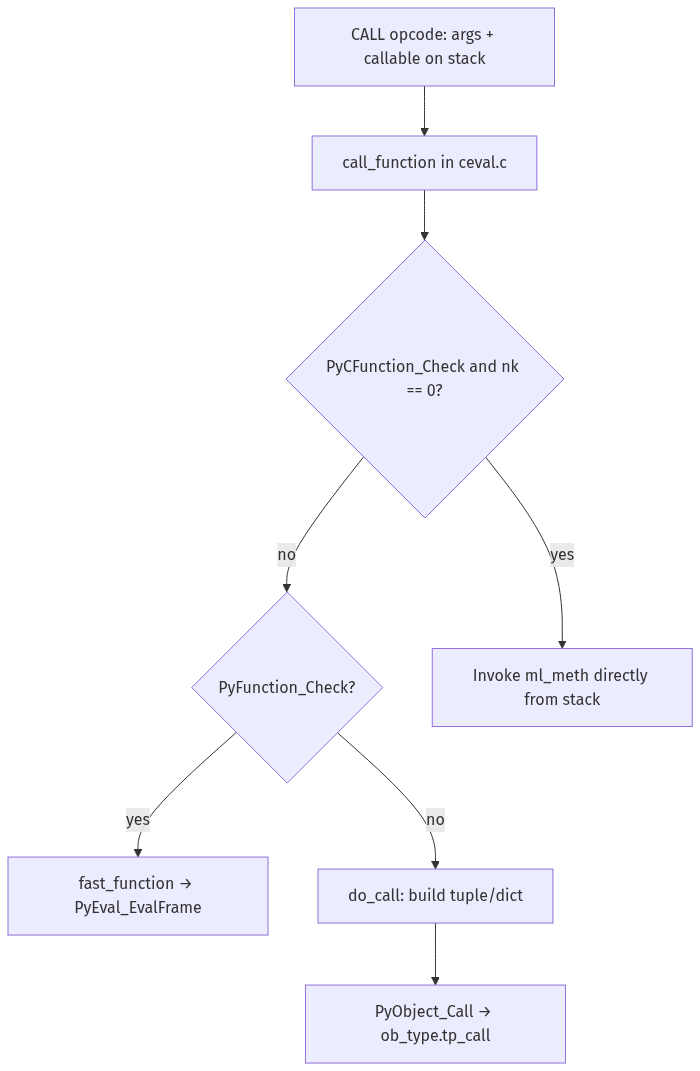
Takeaway: Python and C extension calls both start as the same CALL opcode. They diverge inside call_function() when ob_type is inspected. Fast paths are not a different calling convention — they are shortcuts to the same tp_call implementations (PyCFunction_Call, PyFunction_Call) that skip tuple/dict allocation when the stack layout already matches what those functions need.
PyObject_Call does not always create a frame. It only invokes callable->ob_type->tp_call:
PyObject_Call(callable, args, kwds)
  → tp_call(callable, args, kwds)
       → PyFunction_Call  → new frame → PyEval_EvalFrame   (bytecode)
       → PyCFunction_Call → ml_meth(...) in C               (no frame)
Whether a new eval frame appears depends on the callable type, not on fast vs slow path:
| Path | PyObject_Call? |
New frame? | Runs bytecode? |
|---|---|---|---|
C fast path (PyCFunction_Check, nk == 0) |
usually skipped | no | no — native C |
Python fast path (PyFunction_Check → fast_function) |
skipped | yes | yes |
Slow path → C (do_call → PyCFunction_Call) |
yes | no | no |
Slow path → Python (do_call → PyFunction_Call) |
yes | yes | yes |
C extension call from bytecode:
CALL → call_function (C fast path) → Config_process(self, args) → result on stack
No PyObject_Call, no new frame — there is no bytecode for the C method.
Python function call from bytecode:
CALL → fast_function → new frame → PyEval_EvalFrame
        (slow path: do_call → PyObject_Call → PyFunction_Call → same destination)
Fast path for Python functions saves tuple/dict packing; it does not skip bytecode execution.
Calls made directly from C extension code via PyObject_Call() never hit the CALL opcode at all — they go straight to tp_call with no eval-loop involvement.
Section 4: Pure Python Bytecode Execution
Pure Python classes and functions store logic as bytecode inside PyFunctionObject. Section 3 showed the generic eval loop; this section shows what Python-specific structures are built and how a class method reaches that loop.
4.1 Compilation: Source to Bytecode
Full source: c_ext_exec_python_config — config.py, test_config.py
When Python encounters a class or function definition, it compiles the body into a code object:
class Config:
    def __init__(self, timeout):
        self.timeout = timeout

    def process(self):
        return self.timeout * 2
Inspect the bytecode for __init__:
import dis
dis.dis(Config.__init__)
Output on Python 3.12:
  4           0 RESUME                   0

  5           2 LOAD_FAST                1 (timeout)
              4 LOAD_FAST                0 (self)
              6 STORE_ATTR               0 (timeout)
             16 RETURN_CONST             0 (None)
Code object structure (conceptual; see Code objects):
typedef struct {
    PyObject_HEAD
    int co_argcount;
    int co_flags;
    PyObject *co_code;      /* bytecode bytes */
    PyObject *co_consts;    /* constants tuple */
    PyObject *co_names;     /* names used */
    PyObject *co_varnames;  /* local variable names */
    int co_stacksize;
    /* ... */
} PyCodeObject;
A function object wraps a code object with defaults and globals:
typedef struct {
    PyObject_HEAD
    PyCodeObject *func_code;
    PyObject *func_globals;
    PyObject *func_defaults;
    /* ... */
} PyFunctionObject;
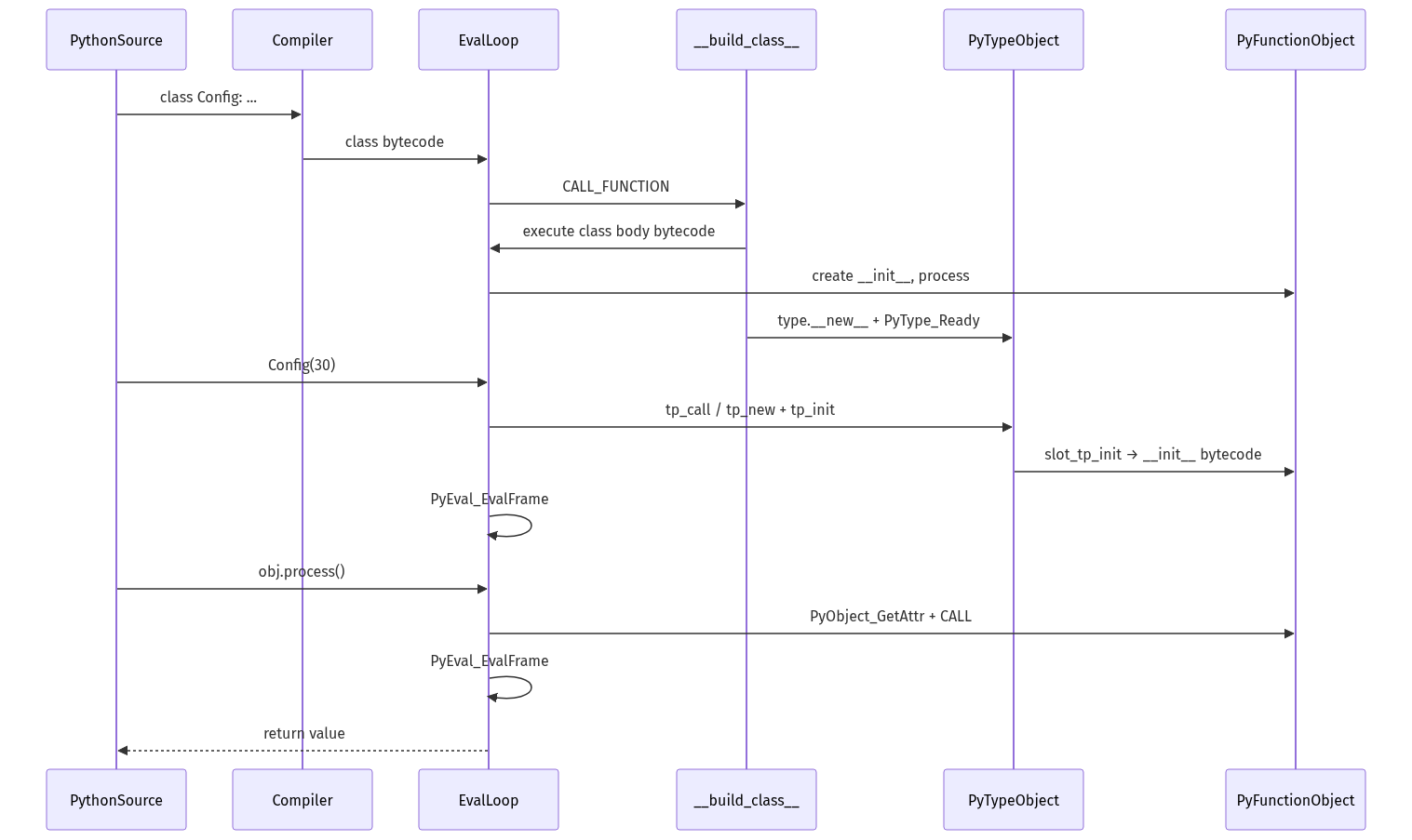
4.2 Class Creation via Bytecode Execution
Full source: c_ext_exec_class_bytecode — test_class_bytecode.py
The class statement itself compiles to bytecode:
import dis
dis.dis("class Config:\n    def __init__(self, timeout):\n        self.timeout = timeout")
Output on Python 3.12:
  0           0 RESUME                   0

  1           2 PUSH_NULL
              4 LOAD_BUILD_CLASS
              6 LOAD_CONST               0 (<code object Config ...>)
              8 MAKE_FUNCTION            0
             10 LOAD_CONST               1 ('Config')
             12 CALL                     2
             20 STORE_NAME               0 (Config)
             22 RETURN_CONST             2 (None)
Execution steps:
LOAD_BUILD_CLASS— push__build_class__onto the stack.LOAD_CONST/MAKE_FUNCTION— wrap the class body in aPyFunctionObject.CALL— call__build_class__(func, "Config", ...)(Section 3 eval loop).STORE_NAME— bind the resultingPyTypeObjecttoConfig.
4.3 How __build_class__ Creates a PyTypeObject
Simplified illustration (not verbatim CPython source):
PyObject *
__build_class__(PyObject *func, PyObject *name, ...)
{
    PyObject *namespace = PyDict_New();
    PyObject_Call(func, ...);
    /* namespace: "__init__", "process", ... as PyFunctionObjects */

    PyTypeObject *new_type = (PyTypeObject *)
        type_new(&PyType_Type, name, bases, namespace);

    if (PyDict_GetItemString(namespace, "__init__"))
        new_type->tp_init = slot_tp_init;
    if (PyDict_GetItemString(namespace, "__repr__"))
        new_type->tp_repr = slot_tp_repr;

    new_type->tp_dict = namespace;
    PyType_Ready(new_type);
    return (PyObject *)new_type;
}
The class body runs as ordinary bytecode. Each def creates a PyFunctionObject in the namespace dictionary.
4.4 Generic Slot Wrappers
CPython provides shared generic wrappers for Python-defined classes. __init__ in source does not become tp_init directly — it becomes a PyFunctionObject in tp_dict, and tp_init points to slot_tp_init:
static int
slot_tp_init(PyObject *self, PyObject *args, PyObject *kwds)
{
    PyObject *meth = lookup_special_method(self, "__init__");
    if (meth == NULL)
        return 0;

    PyObject *full_args = /* tuple with self prepended */;
    PyObject *res = PyObject_Call(meth, full_args, kwds);
    /* validate res is None, cleanup, return */
}
The wrapper calls PyObject_Call on the Python __init__ function → PyFunction_Call → bytecode eval loop (Section 3.4).
4.5 Python Method Execution Path
For obj.process() on a pure Python class (Section 6 compares this path side by side with the C extension path):
obj.process()
  → PyObject_GetAttr(obj, "process")       # tp_dict → PyFunctionObject
  → bound method or function lookup
  → CALL opcode → PyObject_Call / fast_function
  → PyFunction_Type.tp_call → PyFunction_Call
  → PyEval_EvalFrame                       # Section 3.4
  → per-opcode dispatch until RETURN_VALUE
Example: self.timeout = timeout in __init__:
LOAD_FAST   1 (timeout)
LOAD_FAST   0 (self)
STORE_ATTR  0 (timeout)
Stack: push timeout, push self, then STORE_ATTR calls PyObject_SetAttr(self, "timeout", timeout).
Each opcode pays interpreter dispatch, stack manipulation, refcounting, and dynamic checks — far more than a direct C field write.
4.6 Complete Execution Flow for a Python Class
Section 5: C Extension Execution
Full source: c_ext_config_basic (Config.process, §5.3–§5.7), c_ext_config_nested (get_value / set_value / get_values, §5.1)
C extension types and module functions store logic as C function pointers, not bytecode. Section 3 showed that all calls go through tp_call; this section traces the C extension path from PyMethodDef to direct native execution.
5.1 Method Definition and Registration
Full source: mymodule.c (nested Config), mymodule.c (basic Config)
From the nested Config type:
static PyMethodDef Config_methods[] = {
    {"get_value", (PyCFunction)Config_get_value, METH_VARARGS, "Get value by index"},
    {"set_value", (PyCFunction)Config_set_value, METH_VARARGS, "Set value by index"},
    {"get_values", (PyCFunction)Config_get_values, METH_NOARGS, "Get all values"},
    {NULL}
};

static PyTypeObject ConfigType = {
    /* ... */
    .tp_methods = Config_methods,
};
The basic Config type in §2.2.2 of the overview article registers process with METH_NOARGS the same way.
PyMethodDef structure:
typedef struct PyMethodDef {
    const char  *ml_name;
    PyCFunction  ml_meth;   /* C function pointer — not bytecode */
    int          ml_flags;
    const char  *ml_doc;
} PyMethodDef;
| Flag | C signature |
|---|---|
METH_NOARGS |
PyObject *func(PyObject *self) |
METH_O |
PyObject *func(PyObject *self, PyObject *arg) |
METH_VARARGS |
PyObject *func(PyObject *self, PyObject *args) |
METH_KEYWORDS |
PyObject *func(PyObject *self, PyObject *args, PyObject *kwargs) |
5.2 PyType_Ready() Creates Method Descriptors
At import time, PyType_Ready() converts each PyMethodDef into a PyMethodDescrObject in tp_dict:
int
PyType_Ready(PyTypeObject *type)
{
    if (type->tp_dict == NULL)
        type->tp_dict = PyDict_New();

    if (type->tp_methods != NULL) {
        for (PyMethodDef *meth = type->tp_methods; meth->ml_name != NULL; meth++) {
            PyObject *descr = PyDescr_NewMethod(type, meth);
            PyDict_SetItemString(type->tp_dict, meth->ml_name, descr);
            Py_DECREF(descr);
        }
    }
    return 0;
}
The C pointer lives in the descriptor’s embedded PyMethodDef, not in a PyCodeObject.
5.3 Attribute Lookup: From tp_dict Descriptor to Bound PyCFunctionObject
At import time (PyType_Ready), the type’s dictionary holds unbound method descriptors — not callables you can invoke directly without an instance:
ConfigType->tp_dict = {
    "process": PyMethodDescrObject {
        ob_type = &PyMethodDescr_Type,
        d_type  = &ConfigType,              /* owner type */
        d_name  = "process",
        d_method = &Config_methods[0],       /* PyMethodDef { ml_meth = Config_process } */
    },
    "get_value": PyMethodDescrObject { ... },
}
The C pointer (Config_process) lives inside the descriptor’s PyMethodDef. Nothing is bound to a particular config instance yet.
At runtime, config.process runs attribute lookup on the instance:
Full source: c_ext_config_basic — mymodule.c, test_mymodule.py
import mymodule

config = mymodule.Config(timeout=30)
bound = config.process   # step 1: lookup — returns a bound PyCFunctionObject
result = config.process()  # step 2: CALL → Config_process(config, NULL) → 60
Step-by-step (simplified from Objects/object.c and descriptor code):
config.process
  │
  ├─ 1. PyObject_GetAttr(config, "process")
  │      type = Py_TYPE(config)  →  &ConfigType
  │
  ├─ 2. PyDict_GetItem(type->tp_dict, "process")
  │      → PyMethodDescrObject  (found on the class, not on the instance)
  │
  ├─ 3. Descriptor protocol: method descriptors are "non-data" descriptors
  │      When accessed on an instance, call descr->ob_type->tp_descr_get(descr, config, ConfigType)
  │      → PyMethodDescr_Get(...)
  │
  └─ 4. PyMethodDescr_Get builds a fresh PyCFunctionObject:
         m_ml   = same PyMethodDef * as in the descriptor  (still Config_process)
         m_self = config                                       ← "binding"
         ob_type = &PyCFunction_Type
What “bound” means: the descriptor is shared by all Config instances (one entry in tp_dict). Binding copies the PyMethodDef pointer into a new PyCFunctionObject and sets m_self = config so Config_process receives the correct instance as its first argument.
Before (in tp_dict, shared by all instances):
  PyMethodDescrObject  →  PyMethodDef { ml_meth = Config_process }
                          (no instance attached)

After config.process (per lookup, a new wrapper object):
  PyCFunctionObject {
      ob_type = &PyCFunction_Type,
      m_ml    = PyMethodDef { ml_meth = Config_process, ml_flags = METH_NOARGS },
      m_self  = <ConfigObject * for this config>,
  }
Why two object types?
| Object | Lives where | Role |
|---|---|---|
PyMethodDescrObject |
ConfigType->tp_dict["process"] |
Template: name + C pointer + owner type |
PyCFunctionObject |
Created on each config.process access |
Callable: C pointer + bound self |
ConfigType.process (access on the class) would bind differently (m_self = NULL or the class object); config.process (on an instance) sets m_self to that instance.
Lookup on config.process() (the call, not the lookup):
LOAD_ATTR / attribute load  →  PyObject_GetAttr  →  bound PyCFunctionObject  (above)
CALL opcode                 →  call_function / PyCFunction_Call
                            →  meth = m_ml->ml_meth;  meth(m_self, args)
                            →  Config_process(config, NULL)
So the chain in §5.7 is:
PyMethodDef.ml_meth
  → PyType_Ready → PyMethodDescrObject in tp_dict["process"]
  → config.process → PyObject_GetAttr → tp_descr_get → PyCFunctionObject (m_self=config)
  → config.process() → CALL → PyCFunction_Call → Config_process
5.4 Call Dispatch: PyCFunction_Call
When config.process() runs, the CALL opcode reaches PyCFunction_Type.tp_call:
PyObject *
PyCFunction_Call(PyObject *func_obj, PyObject *args, PyObject *kwds)
{
    PyCFunctionObject *func = (PyCFunctionObject *)func_obj;
    PyCFunction meth = func->m_ml->ml_meth;
    PyObject *self = func->m_self;
    int flags = func->m_ml->ml_flags;

    if (flags & METH_NOARGS) {
        return meth(self, NULL);
    }
    else if (flags & METH_VARARGS) {
        return meth(self, args);
    }
    /* ... METH_KEYWORDS, etc. ... */
}
This is a direct C call — no PyEval_EvalFrame, no bytecode. The eval loop’s call_function() fast path can invoke meth even without going through PyObject_Call when kwargs are absent.
5.5 C Extension Slots and Built-in Types
Special methods can bypass Python entirely. A C type sets tp_as_sequence->sq_length directly:
static Py_ssize_t
Config_len(ConfigObject *self)
{
    return self->size;
}

static PySequenceMethods Config_as_sequence = {
    .sq_length = (lenfunc)Config_len,
};
Built-in list, dict, str, etc. use the same model — native slots and tp_methods, all registered on PyTypeObject at startup.
5.6 Type Tags: How the Interpreter “Knows”
#define PyCFunction_Check(op) Py_IS_TYPE(op, &PyCFunction_Type)
#define PyFunction_Check(op)  Py_IS_TYPE(op, &PyFunction_Type)
ob_type is the identity card. PyCFunction_Type.tp_call runs C code; PyFunction_Type.tp_call runs bytecode. Section 3’s PyObject_Call and call_function() branch on these tags.
5.7 Summary: C Extension Execution Path
Section 6 places this chain next to the pure Python path from §4.5.
PyMethodDef.ml_meth  (C pointer at definition)
        ↓
PyType_Ready → PyMethodDescrObject in tp_dict["process"]
        ↓
config.process → PyObject_GetAttr → tp_descr_get → PyCFunctionObject (m_self = config)
        ↓
config.process() → CALL → PyCFunction_Call → meth(m_self, args)
        ↓
Native machine code (Config_process)
No bytecode is ever compiled for Config_process. The only interpreter involvement is reaching the call site and marshalling arguments.
Section 6: Execution Path Comparison — Pure Python vs C Extension
Full source: c_ext_exec_compare — py_config.py, test_compare.py; C extension side uses c_ext_config_basic
Sections 4 and 5 traced each path in isolation. This section lines them up for the same operation — instance.process() — so you can see where they match and where they diverge.
Both paths assume bytecode is already running (for example inside a script that calls obj.process() or config.process()). Section 3 established that all callables are PyObject * values dispatched through ob_type->tp_call; Section 6 shows what sits behind that dispatch for each kind of method.
6.1 Shared Steps Up to the CALL Opcode
For either a pure Python class or a C extension type, the call site looks the same from the eval loop’s perspective:
instance.process()
  → LOAD_ATTR (or equivalent) → PyObject_GetAttr(instance, "process")
  → operand stack holds a bound callable
  → CALL opcode → call_function()                    # §3.5
Attribute lookup always consults the instance’s type (instance->ob_type->tp_dict). The type of object returned from lookup is where the two paths split.
6.2 Pure Python Method Path (§4.5)
For obj.process() on a class defined in Python:
obj.process()
  → PyObject_GetAttr(obj, "process")       # tp_dict → PyFunctionObject
  → bound method or function lookup
  → CALL opcode → PyObject_Call / fast_function
  → PyFunction_Type.tp_call → PyFunction_Call
  → PyEval_EvalFrame                       # §3.4
  → per-opcode dispatch until RETURN_VALUE
What is stored at definition time: a PyFunctionObject whose func_code points to a PyCodeObject (bytecode produced when the class body ran — §4.2–§4.4).
What binding produces: a PyMethodObject (or similar bound callable) that pairs the function with obj as self.
What execution does: enters a new frame and runs the bytecode instruction loop — LOAD_FAST, STORE_ATTR, CALL, and so on — until RETURN_VALUE. Every statement in the method pays interpreter overhead.
6.3 C Extension Method Path (§5.7)
For config.process() on a type defined in C:
PyMethodDef.ml_meth  (C pointer at definition)
        ↓
PyType_Ready → PyMethodDescrObject in tp_dict["process"]
        ↓
config.process → PyObject_GetAttr → tp_descr_get → PyCFunctionObject (m_self = config)
        ↓
config.process() → CALL → PyCFunction_Call → meth(m_self, args)
        ↓
Native machine code (Config_process)
What is stored at definition time: a PyMethodDef row with ml_meth = Config_process — a C function pointer, not bytecode (§5.1).
What binding produces: a PyCFunctionObject with m_self = config and the same PyMethodDef * (§5.3).
What execution does: PyCFunction_Call reads ml_meth and m_self, then jumps directly into C (§5.4). No PyCodeObject, no PyEval_EvalFrame, no opcode loop inside the method body.
6.4 Stage-by-Stage Comparison
| Stage | Pure Python (obj.process()) |
C extension (config.process()) |
|---|---|---|
| Method definition | def process(self): ... compiled to PyCodeObject |
PyMethodDef + C function Config_process |
In tp_dict |
PyFunctionObject (unbound function) |
PyMethodDescrObject (wraps PyMethodDef) |
instance.process lookup |
Function descriptor → bound PyMethodObject |
Method descriptor → PyCFunctionObject (m_self = instance) |
Callable ob_type |
&PyFunction_Type |
&PyCFunction_Type |
CALL fast path |
fast_function() → new frame, args on stack |
Direct meth(self, ...) from stack (§3.5) |
tp_call handler |
PyFunction_Call → PyEval_EvalFrame |
PyCFunction_Call → C function pointer |
| Method body runs as | Bytecode opcodes in a nested frame | Native machine instructions |
| Interpreter loop after call returns | Resumes in caller’s frame | Resumes in caller’s frame (same) |
The last row matters: once process() returns, both paths land back in the caller’s bytecode frame. Only the callee differs — nested eval loop vs direct native execution.
6.5 Side-by-Side at the Divergence Point
Runnable check:
Full source: test_compare.py
import mymodule  # c_ext_config_basic

class PyConfig:
    def __init__(self, timeout):
        self.timeout = timeout

    def process(self):
        return self.timeout * 2

py_cfg = PyConfig(30)
c_cfg = mymodule.Config(timeout=30)
assert py_cfg.process() == c_cfg.process() == 60

# Python: bound method has __code__ (bytecode)
assert hasattr(PyConfig.process, "__code__") or hasattr(py_cfg.process, "__code__")

# C extension: bound method is builtin_function_or_method — no bytecode
assert str(type(c_cfg.process)) == "<class 'builtin_function_or_method'>"
assert not hasattr(c_cfg.process, "__code__")
After PyObject_GetAttr, the eval loop has a callable on the stack. From there:
Pure Python                          C extension
────────────────────────────────     ────────────────────────────────
PyFunctionObject                     PyCFunctionObject
  func_code → PyCodeObject             m_ml → PyMethodDef { ml_meth }
  (bytecode)                           m_self → ConfigObject *

CALL → PyFunction_Type.tp_call       CALL → PyCFunction_Type.tp_call
     → PyFunction_Call                    → PyCFunction_Call
     → PyEval_EvalFrame                   → Config_process(config, NULL)
     → LOAD_FAST / STORE_ATTR / ...       → (direct field access, no opcodes)
     → RETURN_VALUE
For a one-line method like self.timeout = timeout, the Python path executes multiple opcodes and dynamic attribute machinery (§4.5). The C extension path can assign self->timeout in a single native store inside Config_init or Config_process — no nested frame.
6.6 Unified Diagram
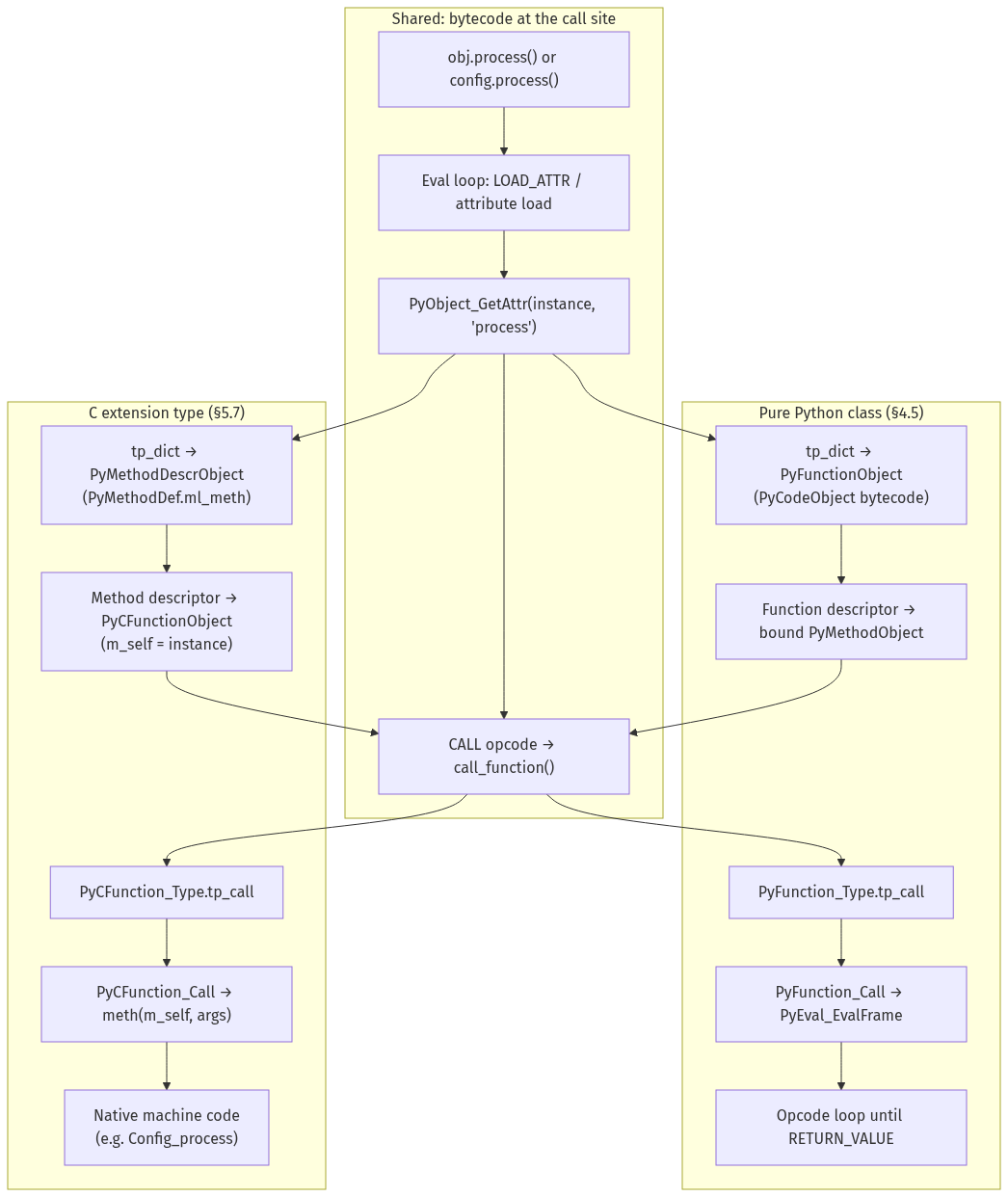
The diagram shows the fork after PyObject_GetAttr: Python methods re-enter the eval loop; C extension methods exit to native code. Both paths converge again when the method returns and the caller’s CALL completes.
6.7 Takeaway
| Question | Pure Python | C extension |
|---|---|---|
| Is there bytecode for the method? | Yes (PyCodeObject) |
No |
Does process() start a new eval frame? |
Yes | No |
| Where does the “real work” run? | Opcode loop (§3.4) | C function pointer (§5.4) |
| Why use C extensions for hot paths? | — | Skip frame setup and per-opcode dispatch |
The interpreter does not treat obj.process() and config.process() as different bytecode instructions — both are LOAD_ATTR followed by CALL. The performance gap comes from what the callable is: a PyFunctionObject that spawns another bytecode interpreter pass, or a PyCFunctionObject that hands control to machine code after a thin wrapper.
References
- Extending Python with C or C++: Official tutorial covering extension functions, exceptions, reference counting, and module initialization.
- Build a C Extension Module for Python – Real Python: Practical walkthrough of building, compiling, and testing a C extension module.
- Python Internals: How Callables Work (PyCoder’s Weekly CN): Explains
CALL_FUNCTION,PyObject_Call,tp_call, and CEval fast paths forPyCFunctionandPyFunction. - Defining Extension Types: Official guide to creating custom
PyTypeObjectinstances with attributes and methods. - Reference Counting in C: Rules for owned, borrowed, and stolen references in extension code.
- C API — Reference Management: Complete reference for
Py_INCREF,Py_DECREF, and related macros. - Parsing arguments and building values: Format strings for
PyArg_ParseTuple,PyArg_ParseTupleAndKeywords, andPy_BuildValue. - Python Data Model — Code objects: Structure and role of
PyCodeObjectin the execution model. - dis — Disassembler: Tool for inspecting bytecode generated from Python source.
- Part VII — pybind11 — §11.8 same
PyCFunctionObjectdispatch path for pybind11-bound methods - Part VIII — Extensions vs Bindings