Python/C VIII — Extensions vs Bindings
- Where to read next
- Section 12: Extensions vs Bindings — Conceptual Map
- 12.0 The Three-Layer Stack
- 12.1 Two Different Goals
- 12.2 The Python C API as the Shared Floor
- 12.3 Extension Modules — Layer 2 (Parts I, II, VII)
- 12.4 Binding — Layer 1 Glue Using Layer 2 Extensions (Parts III–V)
- 12.5 Hybrid Cases — When Binding Still Ships Extensions
- 12.6 Python Wrapper Code — Who Needs It?
- 12.7 Decision Guide and Series Map
- 12.8 Terminology Cheat Sheet
- 12.9 Binding Rests on C Extensions — Forms Differ in How Much Sits Above
- References
This article is Part VIII of the Python C extension series — a conceptual capstone. It does not introduce new APIs or demos. It clarifies vocabulary and architecture assumed (and sometimes mixed) across the earlier parts:
- Part I — Overview — hand-written C API,
PyTypeObject - Part II — Execution — bytecode vs C dispatch
- Part III — ctypes and CFFI — runtime FFI via
_ctypes - Part IV — Complex ctypes Structs — struct mirroring, user API
- Part V — ctypes Handle Pool — C++ behind C ABI + handles
- Part VI — ROS 2 Message Bindings — production hybrid stack
- Part VII — pybind11 — compile-time C++ extension authoring
- Part IX — Inheritance Handle Pool — C++ inheritance behind handle pool
Two ideas this part separates:
- Extension module — a compiled
.soPython imports; speaks the C API; sits on Layer 2 below. Includes your modules (C API, pybind11) and ready-made ones (_ctypes,_cffi_backend). - Binding — a process on Layer 1 (pure Python): call existing C/C++ through an extension on Layer 2, usually with Python glue and wrapper classes. Your target
libfoo.sodoes not needPython.h.
Both paths ultimately rest on the Python C API (PyObject, PyTypeObject, refcounts) inside Layer 2 extensions, and bidirectional marshalling between Python values and C/C++ data.
Where to read next
| Concept | Part | Demo (if any) |
|---|---|---|
| Hand-written extension module | I §1–§2 | c_ext_config_basic |
PyCFunctionObject dispatch |
II §5–§6 | c_ext_config_basic |
| Scalar ctypes / libffi | III §7.2 | c_ext_ctypes_add |
| Struct mirroring + user API | IV §8 | ctypes_complex_struct |
| C++ handle pool | V §9 | c_ext_handle_binding |
| Hybrid binding system | VI §10 | ros2_binding_demo |
| pybind11 extension authoring | VII §11 | c_ext_pybind11_config |
| C++ inheritance handle pool | IX §13 | c_ext_handle_inheritance |
Section 12: Extensions vs Bindings — Conceptual Map
12.0 The Three-Layer Stack
Read the series top to bottom. Bindings are not parallel to extensions — they live above the extension layer and use it.
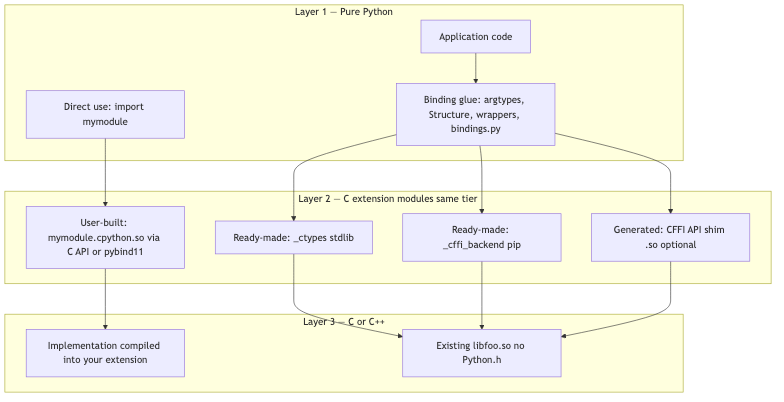
| Layer | What lives here | Examples in this series |
|---|---|---|
| Layer 1 — Pure Python | Application code; binding glue (Python wrappers, argtypes, _fields_, keepalive) |
Part IV bindings.py, InputRecordPy; Part V HandleResource; scalar CDLL setup (Part III) |
| Layer 2 — C extension modules | All importable .so that speak the C API — same tier |
User-built: Part I mymodule.so, Part VII pybind11 mymodule.so. Ready-made: stdlib _ctypes, pip _cffi_backend. Generated: CFFI API shim (Part III) |
| Layer 3 — C / C++ | Native implementation | Code inside your extension (Parts I, VII); existing libfoo.so with no Python.h (Parts III–V) |
Critical clarification: _ctypes and _cffi_backend are C extension modules — the same kind of artifact as mymodule.cpython.so built with the C API or pybind11. CPython ships _ctypes; you install _cffi_backend. You do not author them; you import them. pybind11 and the raw C API are tools to author Layer 2 modules; ctypes/CFFI are pre-built Layer 2 modules you reuse.
Binding = Layer 1 Python code that calls Layer 2 (_ctypes) to reach Layer 3 (libfoo.so). Extension authoring = building a Layer 2 module whose Layer 3 implementation is compiled into the same .so, then using it directly from Layer 1 (import mymodule — no binding glue required).
12.1 Two Different Goals
The series covers two different goals that are easy to conflate because both connect Python to native code:
| Extension authoring | Binding | |
|---|---|---|
| Goal | Implement a normal Python module in C/C++ | Use an existing C/C++ library from Python |
| Where your work lives | Layer 2 — you build mymodule.cpython.so |
Layer 1 — Python glue; Layer 3 — plain libfoo.so |
| Layer 2 module used | your extension (C API or pybind11) | ready-made _ctypes / _cffi_backend (or CFFI-generated shim) |
| Typical Layer 1 usage | import mymodule — direct, no wrapper |
from my_pkg import Foo — Python wrapper over glue |
| Integrator needs python-dev? | yes — to compile your extension | no for ctypes user (only target .so; _ctypes already installed) |
| Python wrapper on Layer 1? | usually no | often yes — mirrors, handles, keepalive |
Layer 3 includes Python.h? |
yes (inside your extension) | no (plain library) |

Extension authoring: you produce a Layer 2 module. Layer 1 does import mymodule and calls native API directly — Parts I and VII. Part II explains dispatch into such modules.
Binding: you write Layer 1 glue that imports a Layer 2 extension someone else already built (_ctypes, not a module you authored for your library). That extension reaches Layer 3 libfoo.so. Parts III–V are binding patterns. Your libstruct_demo.so is not a Python extension; _ctypes is.
Overloaded word: “binding”
Terminology in the wild is messy:
- pybind11 documentation says “create Python bindings” — but the artifact is still an extension module you compile (Part VII).
- Part I §2 sometimes says “binding” when exposing a C struct via
PyTypeObject— that is extension authoring, not the binding pattern above. - Part VI title uses “Message Bindings” for a whole stack (Python classes + several
.sofiles + capsules).
Part VIII uses binding for the Layer 1 process of integrating existing Layer 3 libraries via a Layer 2 extension. Extension module names the Layer 2 artifact — whether you built it (C API, pybind11) or Python ships it (_ctypes).
12.2 The Python C API as the Shared Floor
Whatever path you choose, something must speak PyObject* — allocate Python objects, parse arguments, return values, manage refcounts. That is the Python C API.
To connect Python and C/C++ at all, a Layer 2 extension module must speak
PyObject*— allocate Python objects, parse arguments, return values, manage refcounts. That is the Python C API inside_ctypes,_cffi_backend,mymodule.so, and every other.soPython imports as a module.Extension authoring (Parts I, VII): you write the Layer 2 module; it marshals directly (C API) or via pybind11-generated wrappers. Binding (Parts III–V): your code stays on Layer 1; marshalling happens inside the ready-made Layer 2 module (
_ctypes+ libffi) on your behalf.
At the C level, the recurring work is bidirectional marshalling — always inside Layer 2, regardless of who built that module:
| Direction | Your extension (Layer 2, Parts I, VII) | Ready-made extension (Layer 2, Parts III–V) |
|---|---|---|
| Python → C/C++ | PyArg_ParseTuple; pybind11 casters |
_ctypes reads argtypes / _fields_; libffi packs |
| C/C++ → Python | PyLong_FromLong; py::cast |
_ctypes builds Structure / return values from restype |
The diagram below is a layered stack (top → bottom): Layer 1 Python values; Layer 2 extension modules where marshalling logic runs; Python C API as the bottom floor inside those modules; C/C++ native data below the marshalling boundary.
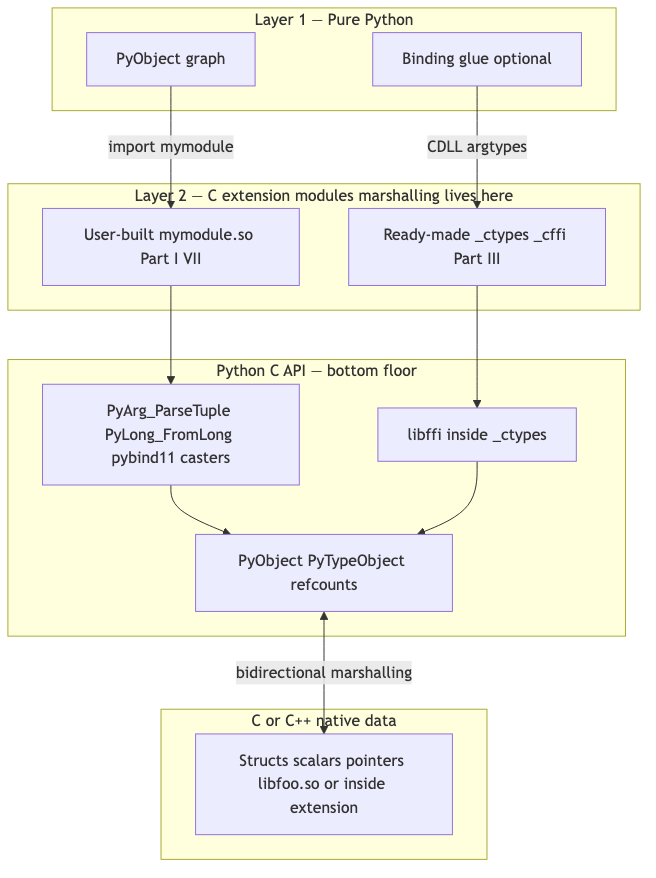
PyTypeObject (Part I) is part of the same floor: when an extension exposes a class, it registers a type object so Python’s attribute protocol, isinstance, and tp_call machinery apply. pybind11 generates that registration for you (Part VII). ctypes struct mirroring (Part IV) does not create a PyTypeObject for your C struct — it lays out bytes in a Structure buffer and passes pointers through _ctypes.
12.3 Extension Modules — Layer 2 (Parts I, II, VII)
Everything on Layer 2 is a C extension module: PyInit_*, links libpython, speaks the C API internally.
User-built (you compile):
- Part I — hand-written
PyModuleDef,PyTypeObject - Part VII — pybind11
PYBIND11_MODULE→ same runtime objects, less boilerplate
Ready-made (already compiled, you import):
_ctypes— stdlib; Part III §7_cffi_backend— pip package; Part III §7
After import mymodule (your extension) or import _ctypes (stdlib), Layer 1 calls into Layer 2. For extension authoring, the product is that import:
import mymodule
config = mymodule.Config(timeout=30, url="http://example.com", ssl=True)
config.process()
Parts I (c_ext_config_basic) and VII (c_ext_pybind11_config) expose the same Layer 1 API; one hand-writes ConfigType, the other uses py::class_<Config>. Both produce your Layer 2 mymodule.cpython.so.
Execution (Part II): config.process() → PyCFunctionObject in your Layer 2 module → direct native call. No libffi on the hot path.
12.4 Binding — Layer 1 Glue Using Layer 2 Extensions (Parts III–V)
A binding is not a Layer 2 artifact. It is Layer 1 Python (plus your plain Layer 3 library) that uses a ready-made Layer 2 extension:
- Layer 3: existing native code (
libadd.so,libstruct_demo.so, C++ behindextern "C"bridge) — noPython.h. - Layer 2: import
_ctypesor_cffi_backend— pre-built extension modules, same tier asmymodule.sobut authored by CPython / cffi maintainers. - Layer 1: your Python glue —
CDLL,argtypes/restype,ctypes.Structure_fields_, keepalive, wrapper classes.
Part IV’s bindings.py is Layer 1: it imports _ctypes (Layer 2), loads libstruct_demo.so (Layer 3), defines Structure subclasses, exposes transform() and InputRecordPy. Part V adds C++ HandlePool on Layer 3 with a C ABI shim — still Layer 1 ctypes glue calling _ctypes.
You do not emit PyInit_* for your library when binding via ctypes. You also do not skip the extension layer — _ctypes is the extension; binding lives above it.
The integrator does not compile Layer 2 for ctypes (CPython already did). You do need to build Layer 3 if you maintain libfoo.so.
12.5 Hybrid Cases — When Binding Still Ships Extensions
Real stacks blur the clean split. Treat these as labeled positions on the same diagram, not counterexamples:
| Case | Layer 2 artifact | Layer 1 / 3 role | Part |
|---|---|---|---|
| CFFI API mode | generated _add_cffi.cpython.so (you build Layer 2 shim) |
Layer 1 cdef + import generated module |
III |
| pybind11 | mymodule.cpython.so (extension authoring, not binding) |
Layer 1: direct import |
VII |
| ROS 2 / rosidl | multiple Layer 2 .so + _rclpy_pybind11 |
Layer 1 Python classes + binding stack | VI |
Part I PyCapsule |
your Layer 2 extension | exposes binding-style opaque handle API | I §2.1 |
Hybrids show which Layer 2 modules a production stack composes — not a fourth layer. CFFI API mode blurs lines because you generate a Layer 2 shim, closer to extension authoring than pure ctypes (where Layer 2 is always _ctypes).
12.6 Python Wrapper Code — Who Needs It?
| Pattern | Python wrapper? | Example |
|---|---|---|
Extension Config |
no | import mymodule; mymodule.Config(...) — Parts I, VII |
| Scalar ctypes | minimal | CDLL("libadd.so"); lib.add(2, 3) — Part III |
| ctypes complex struct | yes (recommended) | InputRecordPy, transform() — Part IV §8.9 |
| Handle pool | yes | Config, Counter, *Resource — Part V |
| ROS 2 messages | yes | generated _demo_status.py + user nodes — Part VI |
Why bindings tend to need wrappers:
- Layout fidelity —
_fields_and keepalive are easy to get wrong; a user API hides them (Part IV). - Lifetime — pointers into C heap or pool objects need explicit
close()/ context managers (Part IV §8.8, Part V). - Handle indirection — Python must not hold raw C++ addresses across ctypes (Part V).
- Ergonomic API — application code should not assemble FFI details on every call.
Extensions push marshalling into Layer 2 (your .so), so Layer 1 imports the module directly. Bindings keep orchestration on Layer 1 and delegate marshalling to a ready-made Layer 2 extension (_ctypes).
12.7 Decision Guide and Series Map
Which goal do you have?
- Implement a module API in C/C++ → extension authoring (Part I or VII).
- Call an existing
.sofrom Python with stdlib-only glue → binding via ctypes (Parts III–V). - Production stack with codegen and multiple
.solayers → study hybrids (Part VI; CFFI API in Part III).
| Part | Primary role | Layer 2 module | Layer 1 wrapper typical? |
|---|---|---|---|
| I | Extension authoring | your mymodule.so |
no |
| II | Execution model for Layer 2 | — | — |
| III | Binding (+ CFFI hybrid) | _ctypes / _cffi_backend / generated shim |
minimal to moderate |
| IV | Binding | _ctypes |
yes (user API) |
| V | Binding | _ctypes + Layer 3 C ABI shim |
yes |
| VI | Hybrid binding system | multiple Layer 2 .so |
yes |
| VII | Extension authoring | your mymodule.so via pybind11 |
no |
Compile-time vs runtime (Part VII §11.9): orthogonal to the layer model. pybind11 resolves signatures when you compile your Layer 2 module; ctypes binding resolves them when _ctypes calls libffi at runtime. Both are Layer 2 extensions; the difference is who builds Layer 2 and when layout/signature metadata is fixed.
12.8 Terminology Cheat Sheet
Use these terms consistently when reading or writing about native integration:
- Extension module (Layer 2) — any importable
.sowithPyInit_*that speaks the C API: your module (C API, pybind11) or ready-made_ctypes,_cffi_backend. - Extension authoring — you build a Layer 2 module; Layer 1 uses
import mymoduledirectly. - Binding — Layer 1 process: Python glue + wrapper classes that call a Layer 2 extension to reach Layer 3
libfoo.so. - Ready-made extension — Layer 2 module you import but did not author (
_ctypes,_cffi_backend); same tier as user-built modules. - Python glue / mirror / user API — Layer 1 binding code (
bindings.py,InputRecordPy,HandleResource). - Marshalling —
PyObject↔ C/C++ conversion; always happens inside Layer 2. - Target library (Layer 3) — plain
libfoo.so(binding) vs implementation compiled into your extension (extension authoring).
12.9 Binding Rests on C Extensions — Forms Differ in How Much Sits Above
Sections 12.0–12.8 separate extension module (Layer 2 artifact) from binding (Layer 1 process). That split is useful for navigation. One invariant cuts across both labels:
Every binding path reaches native code through a C extension module. Binding is not an alternative to extensions — it is extension plus additional code, in one of several forms.
A C extension module is the mandatory floor: something with PyInit_* that speaks PyObject* and performs marshalling (§12.2). Binding glue is mandatory too, but it is compiled native code inside an extension — hand-written C API, pybind11 C++, libffi logic in _ctypes, or the backend in _cffi_backend.
User-facing CDLL, argtypes, Structure, and CFFI cdef belong in the application layer: ordinary Python code the user writes. They are not glue — they declare layouts and signatures to an extension whose glue is already compiled. When ctypes must reach C++, an extern "C" bridge (bridge.cpp, no Python.h) exposes stable C symbols in the native library (Part V).
What varies is whether the application adds an optional mirror row (Node, HandleResource, …) and whether native glue is authored by you (pybind11 / hand C) or shipped inside _ctypes / _cffi_backend.
The diagram below is a layered stack read top to bottom. Application includes direct imports, ctypes/CFFI calls in user scripts, and high-level clients like rclpy. Only the mirror row may be skipped. Compiled glue and the C extension floor are always present — for ctypes/CFFI, glue is inside _ctypes / _cffi_backend, not in user Python.
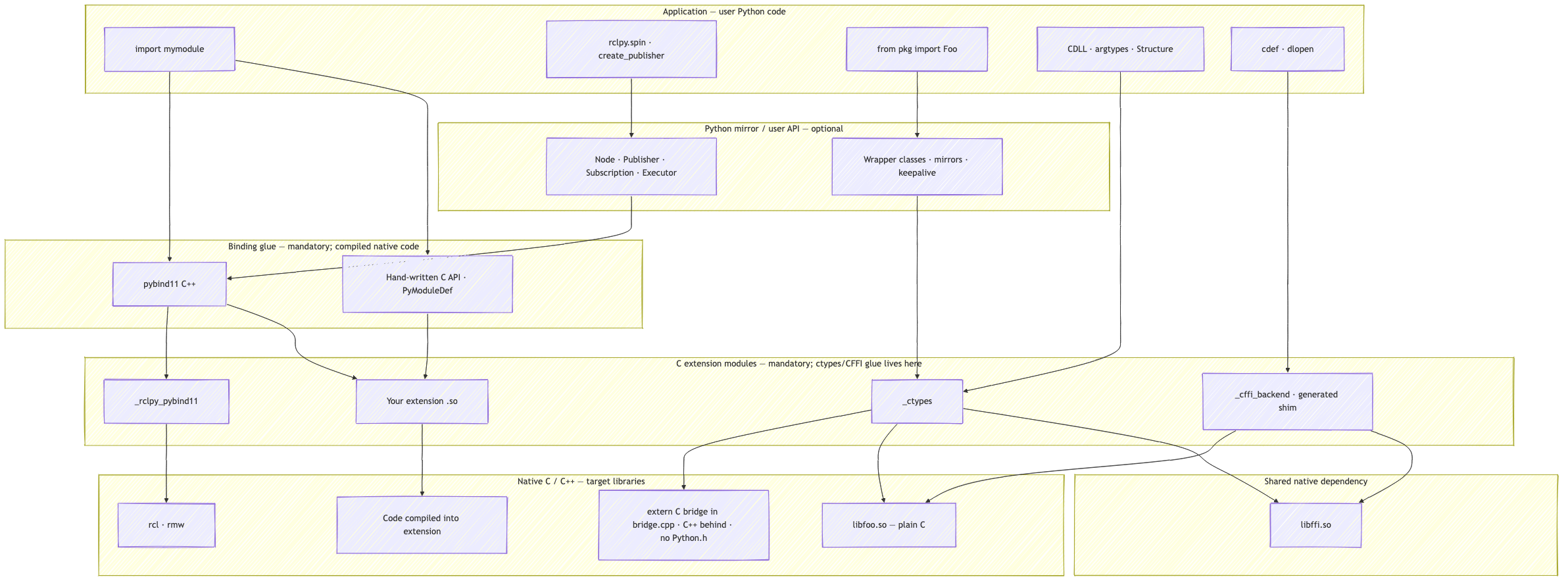
How to read it:
- Application — all user Python:
import mymodule;CDLL/argtypes/Structure(when you call ctypes directly in your script);cdef/ dlopen;from pkg import Foo;rclpy.spin. None of this is binding glue — it calls into extensions that already contain glue. - Python mirror / user API — optional wrappers for ergonomics and lifetime. rclpy puts
Node,Publisher,Executorhere; Part IV/V putInputRecordPy,HandleResourcehere. On thefrom pkg import Foopath, the user script stops here —CDLL/argtypes/Structurelive inside the package, not in the user’s file. Bare ctypes scripts skip this row and use the middle application node instead. - Binding glue — mandatory compiled code, visible as its own row only when you author it (hand C API, pybind11 C++ → your
.so). For ctypes/CFFI, marshalling logic is folded into_ctypes/_cffi_backendon the next row — both link againstlibffi.soat runtime to pack arguments and invoke foreign functions. - C extension modules — mandatory runtime floor.
libffi.so— shared native dependency of_ctypesand_cffi_backend(Part III §7.2). Not a Python layer; the compiled FFI engine both extensions use to calllibfoo.so.- Native C / C++ — target libraries — plain C
libfoo.so;extern "C"bridge wrapping C++ (Part V); or rcl / rmw.
The from pkg import Foo path — wrapper hides ctypes from the user
The diagram edge from pkg import Foo → wrapper → _ctypes means: your application script imports a friendly name; the package owns the ctypes setup and calls _ctypes on your behalf.
What the user writes (application — no CDLL, no _fields_):
from mypkg import InputRecordPy, transform

with transform(InputRecordPy("sensor-A", version=2, origin=(10, 20)), scale=1.5,
               min_weight=20, top_n=2) as out:
    print(out.title)
What the package contains (mirror / wrapper — ctypes lives here, not in user code):
# mypkg/bindings.py
import ctypes

_lib = ctypes.CDLL("libstruct_demo.so")
_lib.transform_record.argtypes = [ctypes.POINTER(InputRecord), ...]
_lib.transform_record.restype = OutputRecord

class InputRecordPy:
    """User-facing mirror — hides Structure layout and keepalive."""
    def to_ctypes(self):
        ...  # build InputRecord, return (struct, keepalive_list)

def transform(record: InputRecordPy, scale, min_weight, top_n):
    c_input, keepalive = record.to_ctypes()
    c_output = _lib.transform_record(ctypes.byref(c_input), ...)  # → _ctypes → libfoo.so
    return OutputRecordPy.from_ctypes(c_output)
Read the call chain:
user script          wrapper (mypkg)              extension        libffi           target
───────────          ───────────────              ─────────        ──────           ──────
transform(...)  →    _lib.transform_record(...)  →  _ctypes     →  libffi.so  →  libstruct_demo.so
                     CDLL · argtypes · Structure
Both _ctypes and _cffi_backend load libffi.so to perform the actual foreign-function call; your argtypes / cdef only tell them what to pack.
The user’s file is the top row only. InputRecordPy and transform are the mirror. CDLL / argtypes / Structure sit in bindings.py — still Python application code, but authored by the library maintainer, not repeated in every user script. That is why the diagram shows two application entry points: CDLL · argtypes when you ctypes directly, and from pkg import Foo when a package wraps the same machinery for you.
Synthesis: Application = user Python (including ctypes/CFFI declarations). Glue = compiled marshalling (in your extension or in _ctypes / _cffi_backend). Do not place argtypes in the glue layer — user code sets them; _ctypes executes them.
References
- Part I — Overview
- Part II — Execution
- Part III — ctypes and CFFI
- Part IV — Complex ctypes Structs and Handles
- Part V — ctypes Handle Pool
- Part VI — ROS 2 Message Bindings
- Part VII — pybind11
- Part IX — Inheritance Handle Pool
- Extending Python with C or C++
- Python/C API Reference
- ctypes — Python 3 documentation