Python/C IX — Inheritance Handle Pool
- Section 13: ctypes Handle Pool for C++ Inheritance
- 13.1 Inheritance vs Part V Flat Types
- 13.2 Python Classes Mirror C++ Inheritance
- 13.3 Single Pool Wrapper: AnimalObject and get_kind
- 13.4 HandleResource: Owned vs Borrowed
- 13.5 Returning Strings Across the C ABI
- 13.6 Bridge: Base Lookup, Then Derived Cast
- 13.7 Python Dispatch: handle_type + get_kind → Correct Class
- 13.8 Comparison and When to Use
- References
This article is Part IX of the Python C extension series. Part I — Overview covers hand-written extensions and PyCapsule opaque handles. Part II — Execution covers bytecode vs C method dispatch. Part III — ctypes and CFFI covers loading plain C libraries through _ctypes and libffi. Part IV — Complex ctypes Structs and Handles covers struct mirroring, keepalive, and the generalized handle idea behind ctypes.Structure. Part V — Handle Pool introduces the layered handle-pool pattern for C++ behind a C ABI. Part VI — ROS 2 Message Bindings applies the capsule pattern to ROS 2 rosidl Python bindings and rclpy. Part VII — pybind11 covers compile-time C++ bindings as an alternative to the handle-pool pattern. Part VIII — Extensions vs Bindings places the handle-pool design in the binding column of the series map.
Part IX extends Part V to C++ inheritance: a single pool wrapper type stores any Animal subclass, the bridge downcasts to Dog* or Cat* inside the library, and Python wrapper classes mirror the C++ hierarchy exactly — including which methods live on the base class and which on derived types.
Runnable demo: c_ext_handle_inheritance in the python repository.
make -C c_ext_handle_inheritance
python3 c_ext_handle_inheritance/test_handle_inheritance.py
| Section | Demo folder |
|---|---|
| §13.2–13.8 | c_ext_handle_inheritance — cpp/, python/, test_handle_inheritance.py |
| Part V contrast | c_ext_handle_binding (flat TypeId-per-class pool) |
Section 13: ctypes Handle Pool for C++ Inheritance
13.1 Inheritance vs Part V Flat Types
Part V stored each C++ business class as its own HandleObject subclass. HandlePool::get_as<Config>(handle, TypeId::Config) used a per-type TypeId enum and static_cast after the check. That works when types are unrelated — Config and Counter share no base class.
Part IX targets a C++ inheritance hierarchy:
Animal (abstract)
├── Dog
└── Cat
The pool still stores HandleObject instances, but there is only one pool wrapper type — AnimalObject — regardless of whether the wrapped pointer is a Dog* or Cat*. Heterogeneity lives inside the Animal* the wrapper holds, not in separate pool entry types.
Part V (c_ext_handle_binding) |
Part IX (c_ext_handle_inheritance) |
|
|---|---|---|
| C++ model | unrelated classes | base + derived hierarchy |
Pool HandleObject types |
one per business class (Config, Counter, …) |
one wrapper (AnimalObject) |
TypeId values |
Config = 1, Counter = 2, … |
single Animal = 1 |
| Bridge downcast | static_cast after TypeId check |
dynamic_cast from Animal* |
| Python type selection | handle_type only |
handle_type + animal_get_kind |
| Python class layout | one class per pool type | mirrors C++ inheritance tree |
The three-layer architecture from Part V (C++ → extern "C" bridge → ctypes Python) is unchanged. Part IX adds runtime kind dispatch on top of the existing handle-pool machinery.
13.2 Python Classes Mirror C++ Inheritance
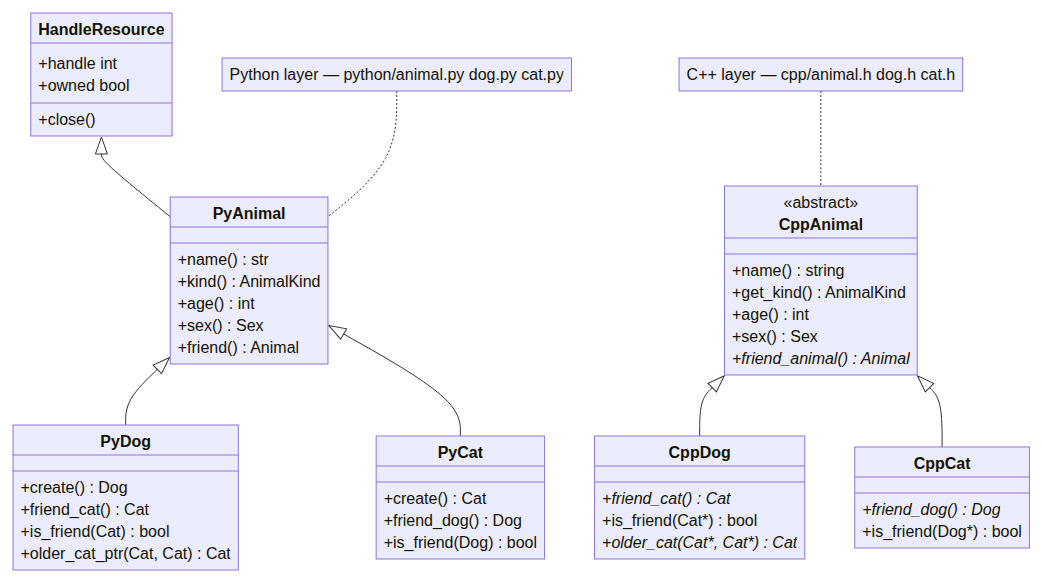
Rule: every C++ class in the hierarchy — base or derived — has a corresponding Python class. Inheritance and method placement match the C++ side exactly.
C++ layer — animal.h, dog.h, cat.h:
class Animal {
public:
    virtual ~Animal() = default;
    virtual std::string name() const = 0;
    virtual AnimalKind get_kind() const = 0;
    virtual int age() const = 0;
    virtual Sex sex() const = 0;
    virtual Animal* friend_animal() const = 0;
};

class Dog : public Animal {
public:
    Animal* friend_animal() const override;
    Cat* friend_cat() const;
    bool is_friend(const Cat* cat) const;
    Cat* older_cat(Cat* one, Cat* two) const;
    // ...
};

class Cat : public Animal {
public:
    Animal* friend_animal() const override;
    Dog* friend_dog() const;
    bool is_friend(const Dog* dog) const;
    // ...
};
Python layer — animal.py, dog.py, cat.py:
class Animal(HandleResource):
    def name(self) -> str: ...
    def kind(self) -> AnimalKind: ...
    def age(self) -> int: ...
    def sex(self) -> Sex: ...
    def friend(self) -> Animal | None: ...

class Dog(Animal):
    @classmethod
    def create(...) -> "Dog": ...
    def friend_cat(self) -> "Cat | None": ...
    def is_friend(self, cat: "Cat | None") -> bool: ...
    def older_cat_ptr(self, one: "Cat", two: "Cat") -> "Cat | None": ...

class Cat(Animal):
    @classmethod
    def create(...) -> "Cat": ...
    def friend_dog(self) -> "Dog | None": ...
    def is_friend(self, dog: "Dog | None") -> bool: ...
Methods that exist on the C++ base (name, age, friend_animal → friend()) live on Animal. Methods that exist only on a derived type (friend_cat, older_cat) live on Dog or Cat. Factory methods (Dog.create, Cat.create) call the C create API and pass the returned handle through wrap_handle, so callers always receive the correct Python subclass.
13.3 Single Pool Wrapper: AnimalObject and get_kind
The handle pool manages base-class objects only. Every stored animal — whether the underlying pointer is a Dog* or Cat* — is wrapped in AnimalObject, which implements HandleObject:
class AnimalObject : public HandleObject {
public:
    explicit AnimalObject(std::unique_ptr<Animal> animal);  // owned
    explicit AnimalObject(Animal* view);                    // borrowed view

    int type() const override;   // always TypeId::Animal
    bool owns() const;
    Animal* animal();
private:
    std::unique_ptr<Animal> owned_;
    Animal* view_;
};
There is only one pool TypeId:
enum class TypeId : int {
    Animal = 1,
};
Because all pool entries share the same TypeId, Python cannot distinguish Dog from Cat using handle_type alone. The bridge exposes a second query — animal_get_kind — that calls the virtual Animal::get_kind() method:
enum class AnimalKind : int {
    Animal = 0,
    Dog = 1,
    Cat = 2,
};

int animal_get_kind(int64_t handle) {
    Animal* animal = require_animal(handle);
    return static_cast<int>(animal->get_kind());
}
Two-level type identification:
| Query | Returns | Answers |
|---|---|---|
handle_type(handle) |
TypeId::Animal (or -1) |
What kind of pool entry is this? |
animal_get_kind(handle) |
AnimalKind::{Animal,Dog,Cat} |
What kind of C++ object does the entry wrap? |
The pool itself is homogeneous (AnimalObject only). Polymorphism is carried by the Animal* inside each wrapper and surfaced to Python through get_kind.
13.4 HandleResource: Owned vs Borrowed
Part V introduced HandleResource with a single ownership model — every wrapper owns its pool entry. Part IX adds a second mode because C++ objects can be owned by another object (e.g. a Dog owns its Cat friend via std::unique_ptr<Cat>) while Python still needs a handle to query the friend.
| Mode | C++ (AnimalObject) |
Python (HandleResource) |
close() behavior |
|---|---|---|---|
| Owned | unique_ptr<Animal> owned_ |
owned=True (default) |
calls handle_release → destroys C++ object |
| Borrowed | raw Animal* view_ |
owned=False |
drops Python reference only; pool entry kept |
class HandleResource:
    def __init__(self, handle: int, *, owned: bool = True) -> None:
        self._handle = handle
        self._owned = owned

    def close(self) -> None:
        if self._closed or self._handle == 0:
            return
        if self._owned:
            _lib.handle_release(self._handle)
        self._handle = 0
        self._closed = True
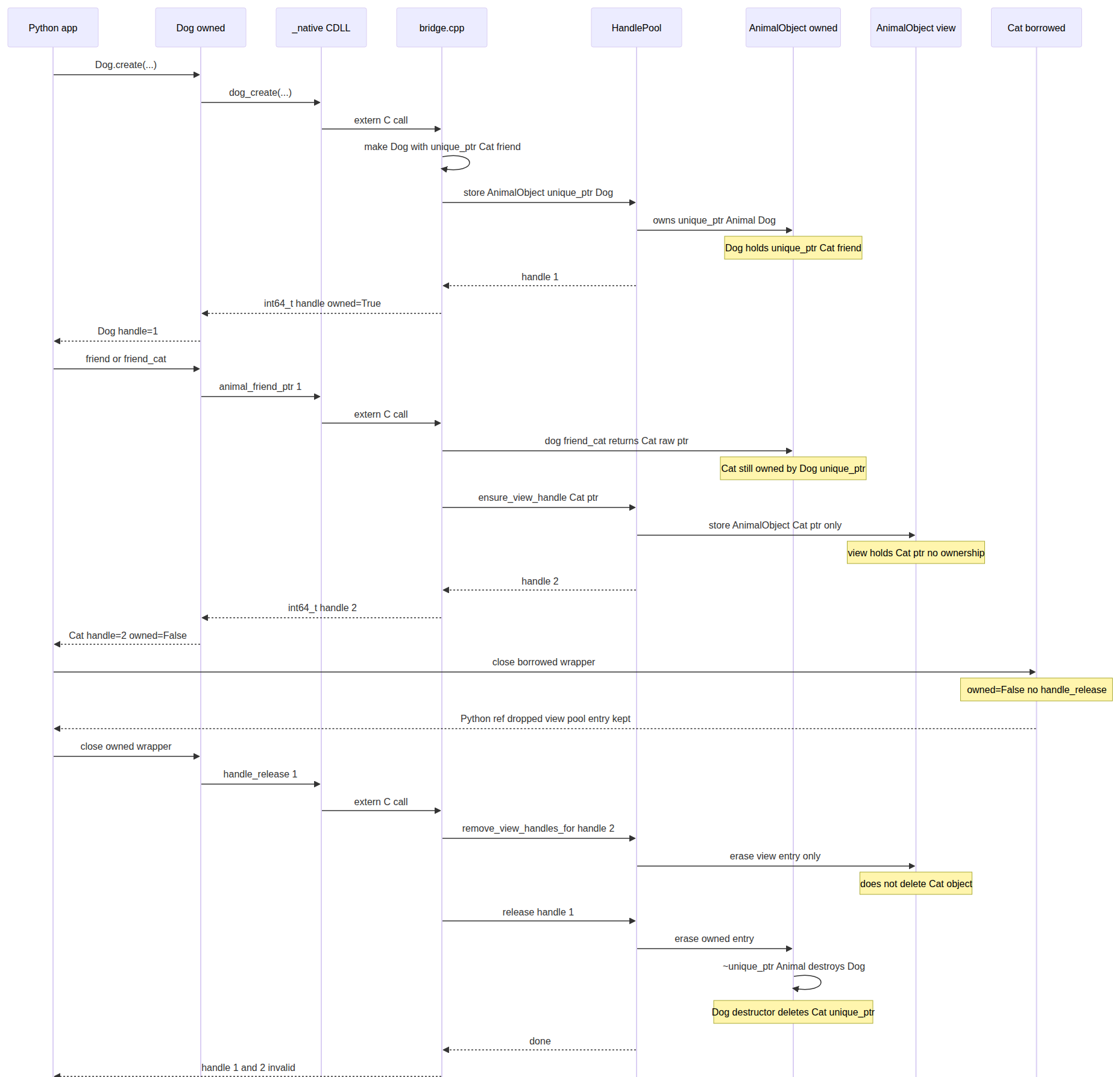
Creation path: dog_create builds a Dog that owns its Cat friend via std::unique_ptr<Cat>. The bridge stores one owned AnimalObject wrapping unique_ptr<Animal> (the Dog). The embedded Cat is not a separate pool entry.
Access path: when Python calls dog.friend() or dog.friend_cat(), the bridge reads dog->friend_cat() — a raw Cat* into memory owned by the Dog. It stores a second view AnimalObject that holds only that pointer (view_), with no unique_ptr. The Cat object remains owned by the Dog’s unique_ptr<Cat>.
HandleId ensure_view_handle(const Animal* animal) {
    const HandleId existing = lookup_animal_handle(animal);
    if (existing != kInvalidHandle) {
        return existing;
    }
    return store_view_animal(const_cast<Animal*>(animal));  // AnimalObject(Cat*) view
}
Python wraps the view handle with owned=False. Closing the borrowed wrapper does not call handle_release. When the owned primary is released, the bridge removes the view pool entry (which does not delete the Cat), then erases the owned entry. Destroying the owned AnimalObject runs its unique_ptr<Animal> destructor, which destroys the Dog; the Dog destructor in turn deletes its owned Cat.
Best practice: create pool entries for embedded objects on demand from the Python side. If friend() is never called, no view handle enters the pool.
13.5 Returning Strings Across the C ABI
std::string cannot cross the ctypes boundary directly — ctypes knows C types (char*, fixed buffers), not C++ STL containers. The bridge copies into a caller-provided buffer; Python allocates the buffer and decodes the result into a native str.
C bridge — bridge.cpp:
int copy_string(const std::string& value, char* out, int out_size) {
    if (out == nullptr || out_size <= 0) {
        set_error("output buffer must not be null");
        return -1;
    }
    std::snprintf(out, static_cast<size_t>(out_size), "%s", value.c_str());
    return 0;
}

int animal_get_name(int64_t handle, char* out, int out_size) {
    Animal* animal = require_animal(handle);
    if (animal == nullptr) {
        return -1;
    }
    return copy_string(animal->name(), out, out_size);
}
Python — _native.py:
NAME_MAX = 256

def _to_string(fn, handle: int) -> str:
    buf = ctypes.create_string_buffer(NAME_MAX)
    _check_status(fn(handle, buf, NAME_MAX))
    return buf.value.decode()
Why this pattern:
- C++ owns the
std::stringinternally; only a copy crosses the ABI. - Python allocates a fixed-size buffer (
NAME_MAX = 256) on its stack — no dangling pointer. - The decoded Python
stris fully owned by Python after the call returns. snprintftruncates safely if the name exceedsNAME_MAX - 1.
The same out-buffer pattern applies to any C++ method that returns std::string, std::vector, or other heap-backed types that cannot be expressed as a plain C struct.
13.6 Bridge: Base Lookup, Then Derived Cast
Every typed C API function follows the same two-step pattern inside the bridge:
- Get the base wrapper from the pool (
AnimalObject). - Cast to the derived type with
dynamic_cast.
template <typename T>
T* get_animal_as(HandleId handle) {
    AnimalObject* wrapper = g_pool.get_as<AnimalObject>(handle);
    if (wrapper == nullptr) {
        set_error(/* ... */);
        return nullptr;
    }
    T* animal = dynamic_cast<T*>(wrapper->animal());
    if (animal == nullptr) {
        set_error("invalid handle or wrong type");
        return nullptr;
    }
    return animal;
}
Example — dog-specific API:
int64_t dog_friend_cat_ptr(int64_t dog_handle) {
    Dog* dog = get_animal_as<Dog>(dog_handle);
    if (dog == nullptr) {
        return kInvalidHandle;
    }
    return ensure_view_handle(dog->friend_cat());
}

int dog_is_friend_cat_ptr(int64_t dog_handle, int64_t cat_handle) {
    Dog* dog = get_animal_as<Dog>(dog_handle);
    Cat* cat = get_animal_as<Cat>(cat_handle);
    if (dog == nullptr || cat == nullptr) {
        return -1;
    }
    return dog->is_friend(cat) ? 1 : 0;
}
Contrast with Part V: there, get_as<Config> used static_cast after a TypeId check because each pool entry type mapped 1:1 to a C++ class. Here, all entries are AnimalObject, so the bridge must recover the derived type from the stored Animal* pointer. dynamic_cast is safe inside the C++ library where RTTI is available. The C ABI itself still passes only int64_t handles — no C++ type information crosses the boundary.
Call chain for a typed operation:
handle → AnimalObject → Animal* → dynamic_cast<Dog*> → Dog::friend_cat()
13.7 Python Dispatch: handle_type + get_kind → Correct Class
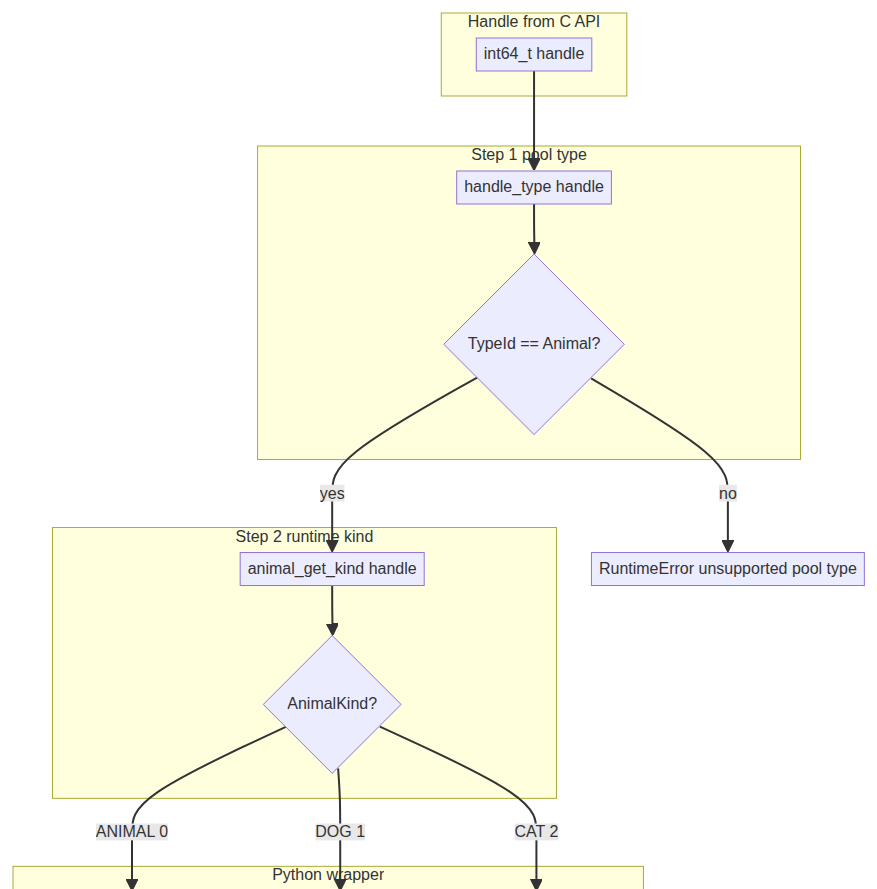
When any C API returns a handle, Python must construct the right wrapper class. wrap_handle performs a two-step dispatch so the real C++ type is always known on the Python side:
def wrap_handle(handle: int, *, owned: bool = True) -> "Animal":
    from .animal import Animal
    from .cat import Cat
    from .dog import Dog
    from .types import AnimalKind, TypeId

    pool_type = _check_int(_lib.handle_type(handle))
    if pool_type != int(TypeId.ANIMAL):
        raise RuntimeError(f"unsupported pool type id: {pool_type}")

    kind = AnimalKind(_check_int(_lib.animal_get_kind(handle)))
    mapping: dict[AnimalKind, type[Animal]] = {
        AnimalKind.ANIMAL: Animal,
        AnimalKind.DOG: Dog,
        AnimalKind.CAT: Cat,
    }
    cls = mapping.get(kind, Animal)
    return cls(handle, owned=owned)
Step 1 — pool type: handle_type(handle) confirms the entry is an AnimalObject (TypeId::Animal). A wrong pool type raises immediately.
Step 2 — runtime kind: animal_get_kind(handle) calls the C++ virtual get_kind() and selects Animal, Dog, or Cat from the mapping.
Every handle-returning path funnels through wrap_handle or wrap_optional_handle:
| C API | Python entry point | Result type |
|---|---|---|
dog_create |
Dog.create → wrap_handle |
Dog |
cat_create |
Cat.create → wrap_handle |
Cat |
animal_friend_ptr |
Animal.friend → wrap_optional_handle |
Animal \| None (re-dispatched to Dog/Cat) |
dog_friend_cat_ptr |
Dog.friend_cat → wrap_optional_handle |
Cat \| None |
dog_older_cat_ptr |
Dog.older_cat_ptr → wrap_optional_handle |
Cat \| None |
Callers never receive a bare int handle from the public Python API. isinstance(dog, Dog) and dog.friend_cat() type hints are accurate because dispatch happens at wrap time.
13.8 Comparison and When to Use
| Part V flat pool | Part IX inheritance pool | |
|---|---|---|
| C++ model | unrelated classes | base + derived hierarchy |
Pool HandleObject types |
one per business class | one wrapper (AnimalObject) |
| Python type selection | handle_type only |
handle_type + get_kind |
| Downcast in bridge | static_cast + TypeId |
dynamic_cast from Animal* |
| Python class tree | flat (one class per pool type) | mirrors C++ inheritance |
| Embedded object handles | N/A | lazy view handles on demand |
Use Part IX when:
- The C++ API is organized around a polymorphic base class with virtual methods.
- Derived types add type-specific operations (
Dog::older_cat,Cat::friend_dog). - You want Python
isinstance/ inheritance to match the C++ class tree. - Objects can be owned or borrowed within the same hierarchy.
Use Part V when:
- C++ types are unrelated (no common base beyond
HandleObject). - Each type has a distinct pool entry and
TypeId. - No runtime downcast is needed in the bridge.
When to prefer Part VII (pybind11) instead: you can compile a dedicated extension module and want pybind11 to generate the inheritance bindings (py::class_<Animal>, py::class_<Dog, Animal>) without a handle pool or C ABI shim.
References
- Part I — Overview
- Part II — Execution
- Part III — ctypes and CFFI
- Part IV — Complex ctypes Structs and Handles
- Part V — Handle Pool — flat
TypeId-per-class pattern - Part VI — ROS 2 Message Bindings
- Part VII — pybind11
- Part VIII — Extensions vs Bindings
- ctypes — Python 3 documentation
- Handle (computing)
- Demo: c_ext_handle_inheritance
- Part V contrast: c_ext_handle_binding