Python/C IV — Structs & Handles
- Section 8: ctypes with Complex Structs
- 8.1 Beyond Scalar Arguments
- 8.2 C Layout Patterns in the Demo
- 8.3 Mapping C to
ctypes.Structure - 8.4 Nested Structs and Fixed Arrays
- 8.5 Strings: Embedded
char[]vschar* - 8.6 Arrays of Pointers (
Metric*) - 8.7 Binding the Function
- 8.8 Output Ownership and Cleanup
- 8.9 Demo User API:
InputRecordPyandOutputRecordPy - 8.10 ctypes Structs vs Hand-Written Extensions vs CFFI vs pybind11
- 8.11 Handles: A Generalized View
- References
This article is Part IV of the Python C extension series. Part I — Overview covers hand-written C extensions and binding C data to Python types. Part II — Execution covers bytecode and C method dispatch. Part III — ctypes and CFFI showed calling a plain C library with scalar add(int, int). Part V — ctypes Handle Pool builds a C++ HandlePool with integer handles and typed dispatch behind ctypes. Part VII — pybind11 covers compile-time C++ bindings as an alternative to struct mirroring. Part VIII — Extensions vs Bindings explains why this part is a binding pattern with Python user API (§8.9), not extension authoring.
Part IV covers how to handle complex C structures with ctypes: nested structs, fixed-size arrays, embedded char[] vs char*, pointer fields, marshalling through _ctypes + libffi, and keepalive for anything whose address crosses the boundary. It closes with handles — internal separation layers between your user API and C-managed resources (Wikipedia: file descriptors, PyCapsule, ctypes.Structure, buffer addresses, …). The demo’s InputRecordPy / OutputRecordPy are user API classes (§8.9), not handles themselves. Struct names in the demo are arbitrary fixtures for the binding patterns.
You still write Python-only glue (no new PyInit_* module); the new work is layout fidelity and lifetime management.
Runnable demo: ctypes_complex_struct in the python repository.
make -C ctypes_complex_struct
python3 ctypes_complex_struct/test_struct_demo.py
| Section | Demo folder |
|---|---|
| §8.2–8.11 | ctypes_complex_struct — struct_demo.h, bindings.py, test_struct_demo.py |
Section 8: ctypes with Complex Structs
8.1 Beyond Scalar Arguments
Part III’s ctypes example calls one function with two integers:
lib.add.argtypes = [ctypes.c_int, ctypes.c_int]
lib.add.restype = ctypes.c_int
assert lib.add(2, 3) == 5
Most real C APIs also use structs: a function takes a pointer to an input struct (and maybe scalars), and returns a struct or fills an output struct. The hard part is not dlopen — Part III already covered that — but expressing the C layout in Python and keeping pointer targets alive across the call.
The demo library exposes one such function so every pattern appears in a single test:
OutputRecord transform_record(
    const InputRecord *input,
    double scale,
    int min_weight,
    int top_n
);
ctypes maps each C struct to a ctypes.Structure subclass. _ctypes passes a pointer to the input through libffi (same machinery as Part III §7.2). That Structure instance is a handle in the broad sense (§8.11): it separates binding code from raw C memory. Application code should sit above that in a user API (§8.9) that owns the handles internally.
8.2 C Layout Patterns in the Demo
Full header: struct_demo.h
The header is intentionally dense: one small nested type, then input/output structs that combine the field kinds you typically mirror in ctypes. Names like Metric or InputRecord are arbitrary; focus on the field kinds:
| Pattern | Example in header |
|---|---|
| Nested struct | Point anchor inside Metric |
| Fixed array of structs | Metric metrics[MAX_METRICS], Point corners[2] |
| Fixed array of scalars | int weights[MAX_WEIGHTS] |
| 2D embedded char buffers | char categories[MAX_TAGS][MAX_LABEL] |
| Pointer to NUL-terminated string | char *description, char *tags[] |
| Pointer to struct | Metric *metric_ptrs[MAX_PTRS] |
| C-allocated output pointers | char *notes, Metric *ranked_ptrs[] in OutputRecord |
Nested types and shared caps (must match Python):
#define MAX_METRICS   4
#define MAX_LABEL     32
/* ... */

typedef struct {
    int x;
    int y;
} Point;

typedef struct {
    char  label[MAX_LABEL];
    int   weight;
    Point anchor;
} Metric;
Input struct — embedded arrays plus pointer fields:
typedef struct {
    char   header_id[MAX_LABEL];
    int    version;
    Point  origin;
    Point  corners[2];
    Metric metrics[MAX_METRICS];
    int    weights[MAX_WEIGHTS];
    char   categories[MAX_TAGS][MAX_LABEL];
    char  *description;
    char  *tags[MAX_TAGS];
    int    tag_count;
    Metric *metric_ptrs[MAX_PTRS];
    int    metric_ptr_count;
} InputRecord;
Output struct — same ideas on the return side, including pointers the C function may malloc:
typedef struct {
    char   title[MAX_LABEL];
    Point  bbox[2];
    int    total_weight;
    int    filtered_weights[MAX_WEIGHTS];
    int    filtered_weight_count;
    Metric top_metrics[MAX_PTRS];
    char   summary_lines[MAX_SUMMARY][MAX_LABEL];
    char  *notes;
    Metric *ranked_ptrs[MAX_PTRS];
    int    ranked_ptr_count;
} OutputRecord;
struct_demo.c reads and writes every field category above (embedded arrays, pointer strings, pointer-to-struct arrays, heap output). test_struct_demo.py asserts the round trip. You do not need the business logic — only that the C side touches each pattern so the bindings stay honest.
free_output_record frees heap fields (notes, ranked_ptrs[]) allocated inside transform_record — a second ctypes concern: output ownership (§8.8).
8.3 Mapping C to ctypes.Structure
Full bindings: bindings.py
Rule 1: Python MAX_* constants match the header.
Rule 2: Each ctypes.Structure subclass lists _fields_ in the same order as the C struct. Wrong order or wrong ctypes type corrupts memory or crashes — there is no compile-time check (structure alignment).
Start with leaf structs, then compose:
class Point(ctypes.Structure):
    _fields_ = [
        ("x", ctypes.c_int),
        ("y", ctypes.c_int),
    ]


class Metric(ctypes.Structure):
    _fields_ = [
        ("label", ctypes.c_char * MAX_LABEL),
        ("weight", ctypes.c_int),
        ("anchor", Point),
    ]
InputRecord and OutputRecord in Python mirror the C definitions field-for-field (see Structures and unions):
class InputRecord(ctypes.Structure):
    _fields_ = [
        ("header_id", ctypes.c_char * MAX_LABEL),
        ("version", ctypes.c_int),
        ("origin", Point),
        ("corners", Point * 2),
        ("metrics", Metric * MAX_METRICS),
        ("weights", ctypes.c_int * MAX_WEIGHTS),
        ("categories", (ctypes.c_char * MAX_LABEL) * MAX_TAGS),
        ("description", ctypes.c_char_p),
        ("tags", ctypes.c_char_p * MAX_TAGS),
        ("tag_count", ctypes.c_int),
        ("metric_ptrs", ctypes.POINTER(Metric) * MAX_PTRS),
        ("metric_ptr_count", ctypes.c_int),
    ]
Runtime layout: when Python executes this class body, the pre-built _ctypes extension (Part III §7) walks _fields_ in order, applies native alignment and padding rules, and records each field offset. Every InputRecord() instance is a single contiguous buffer of ctypes.sizeof(InputRecord) bytes — the same layout a C compiler would produce for the matching struct on the same platform and ABI, if the Python definition faithfully mirrors the header (order, ctypes types, MAX_* constants, nested Point / Metric layouts).
ctypes does not read the C header. You describe the layout manually; _ctypes only guarantees that the buffer it allocates follows the rules implied by that description. Wrong _fields_ still creates a valid Python object — C will then read the wrong offsets and corrupt memory or crash (Rule 2 above).
| Field category | Example in InputRecord |
What lives in the struct buffer |
|---|---|---|
| Embedded scalar / array | header_id, version, weights |
Bytes stored inside the struct |
| Embedded nested struct / array | origin, corners, metrics, categories |
Sub-structs laid out by value at computed offsets |
| Pointer slot | description, tags[], metric_ptrs[] |
Only the pointer value (e.g. 8 bytes on 64-bit); target memory is separate |
For pointer fields, slot position matches C, but ctypes does not allocate or wire up what they point to — that is handled later (§8.5–§8.6: encode strings, keepalive for metric_ptrs).
Common reasons Python and C layouts diverge: field order mismatch; c_int vs c_long; C #pragma pack without matching _pack_ on the Structure subclass; wrong nested struct definition. There is no compile-time check — verify explicitly:
print(ctypes.sizeof(InputRecord))
print(ctypes.offset(InputRecord, "version"))
print(ctypes.offset(InputRecord, "origin"))
print(ctypes.offset(InputRecord, "description"))
Compare against C (sizeof, offsetof) from the same header. Matching numbers mean ctypes.byref(record) passes a pointer C can treat as InputRecord *; the demo’s round-trip test in §8.7 is the functional proof on top of that.
Load the shared library built by make:
_LIB_PATH = Path(__file__).with_name("libstruct_demo.so")
_lib = ctypes.CDLL(str(_LIB_PATH))
8.4 Nested Structs and Fixed Arrays
| C pattern | ctypes |
|---|---|
Point anchor inside Metric |
("anchor", Point) |
Point corners[2] |
("corners", Point * 2) |
Metric metrics[MAX_METRICS] |
("metrics", Metric * MAX_METRICS) |
int weights[MAX_WEIGHTS] |
("weights", ctypes.c_int * MAX_WEIGHTS) |
char categories[MAX_TAGS][MAX_LABEL] |
("categories", (ctypes.c_char * MAX_LABEL) * MAX_TAGS) |
Assign nested structs by value:
record.origin = self.origin.to_ctypes()
record.corners[i] = corner.to_ctypes()
record.metrics[i] = metric.to_ctypes()
For a 2D char array slot, direct assignment to categories[i] is awkward; the demo uses from_address on the struct’s memory:
slot = (ctypes.c_char * MAX_LABEL).from_address(
    ctypes.addressof(struct) + field_type.offset + index * MAX_LABEL
)
That writes bytes into the correct offset inside the parent struct without guessing layout beyond what ctypes already knows.
8.5 Strings: Embedded char[] vs char*
Two common C patterns need different ctypes handling:
Embedded buffers (header_id, label, title): field type is c_char * N. Assign UTF-8 bytes (with a length guard):
def _encode_label(value: str) -> bytes:
    encoded = value.encode("utf-8")
    if len(encoded) >= MAX_LABEL:
        raise ValueError(f"label too long (max {MAX_LABEL - 1} bytes): {value!r}")
    return encoded

_write_label_field(record, "header_id", self.header_id)
Pointer strings (description, each tags[i]): C expects char * to NUL-terminated data. Use create_string_buffer and pass the buffer address:
description_buf = ctypes.create_string_buffer(self._description.encode("utf-8"))
record.description = ctypes.c_char_p(ctypes.addressof(description_buf))
Keepalive (critical): anything whose address you pass to C must stay alive until the C call returns. Buffers, c_char_p wrappers, standalone Metric structs, and POINTER(Metric) values are all ordinary Python objects — the GC can collect them if nothing references them.
to_ctypes() returns (record, keepalive):
keepalive: list[object] = []
# ... append description_buf, record.description, tag buffers, metric structs, pointers ...
keepalive.append(record)
return record, keepalive
transform() must hold the list through the call:
c_input, keepalive = input_record.to_ctypes()
_ = keepalive  # must survive through the C call
c_output = _lib.transform_record(ctypes.byref(c_input), ...)
If keepalive is dropped while C still reads those addresses, you get use-after-free — silent corruption or a crash.
8.6 Arrays of Pointers (Metric*)
When C has Metric *metric_ptrs[MAX_PTRS] — an array of pointers to structs, not an embedded array — ctypes uses:
("metric_ptrs", ctypes.POINTER(Metric) * MAX_PTRS),
Build each entry from a standalone struct and a pointer object; keep both:
metric_obj = metric.to_ctypes()
metric_storage.append(metric_obj)
metric_ptr = ctypes.pointer(metric_storage[-1])
record.metric_ptrs[i] = metric_ptr
keepalive.extend([metric_storage[-1], metric_ptr])
Read back through .contents:
MetricPy.from_ctypes(record.metric_ptrs[i].contents)
8.7 Binding the Function
_lib.transform_record.argtypes = [
    ctypes.POINTER(InputRecord),
    ctypes.c_double,
    ctypes.c_int,
    ctypes.c_int,
]
_lib.transform_record.restype = OutputRecord

_lib.free_output_record.argtypes = [ctypes.POINTER(OutputRecord)]
_lib.free_output_record.restype = None
Pass the input with byref (cheaper than pointer() for a one-shot call):
c_output = _lib.transform_record(
    ctypes.byref(c_input),
    ctypes.c_double(scale),
    ctypes.c_int(min_weight),
    ctypes.c_int(top_n),
)
restype = OutputRecord means the C return-by-value struct is copied into a new Python Structure instance. Pointer fields inside that copy (notes, ranked_ptrs[]) still point at C heap memory from the temporary C return value — you must read them before freeing, and you must call free_output_record on the Python copy’s backing layout (see §8.8).
Wrong _fields_ or argtypes still corrupts the stack or misreads memory — same runtime-only safety as Part III §7.2.
8.8 Output Ownership and Cleanup
When C allocates memory reachable through struct pointer fields (strdup, malloc into output.notes, output.ranked_ptrs[i], …), Python must call a matching free function. The demo exposes free_output_record; your real library will have its own name.
Pattern: wrap the returned Structure and call free from close() / __exit__:
def close(self) -> None:
    if self._closed:
        return
    _lib.free_output_record(ctypes.byref(self._record))
    self._closed = True

def __enter__(self) -> OutputRecordPy:
    return self

def __exit__(self, exc_type, exc, tb) -> None:
    self.close()
End-to-end test (test_struct_demo.py) builds input through the user API, calls transform, and checks scalars, embedded fields, and ranked pointer output:
inp = InputRecordPy("sensor-A", version=2, origin=(10, 20))
inp.set_corner(0, (0, 0))
inp.set_corner(1, (100, 50))
inp.add_metric(MetricPy("cpu", 80, (1, 2)))
inp.add_metric(MetricPy("io", 90, (5, 6)))
inp.set_weight(0, 10)
inp.set_weight(1, 20)
inp.set_weight(2, 30)
inp.add_tag("critical")
inp.add_metric_ptr(MetricPy("net", 70, (7, 8)))

with transform(inp, scale=1.5, min_weight=20, top_n=2) as out:
    assert out.total_weight == int((10 + 20 + 30) * 1.5)
    assert out.filtered_weights() == [30, 45]
    top = out.top_metrics()
    assert top[0].label == "io"   # highest weight across embedded + pointer metrics
The string values are arbitrary; the test proves each field category round-trips. After the with block, free_output_record has run — do not use out again.
8.9 Demo User API: InputRecordPy and OutputRecordPy
ctypes does not require InputRecordPy, MetricPy, or PointPy. In the demo they are the user API — the surface application code is meant to call. They are not handles; they sit on the user side and use handles internally (InputRecord, keepalive buffers, POINTER(Metric), …) when crossing into C.
InputRecordPy: methods likeadd_metric,set_weight,add_tagbuild logical input.to_ctypes()(insidetransform) assembles theInputRecordhandle and keepalive list — callers never see those objects.OutputRecordPy: methods likefiltered_weights(),top_metrics()read results.close()/ the context manager callsfree_output_recordon the internalOutputRecordhandle.
inp = InputRecordPy("sensor-A", version=2, origin=(10, 20))
inp.add_metric(MetricPy("cpu", 80, (1, 2)))
# inp: user API — no InputRecord or keepalive visible

with transform(inp, scale=1.5, min_weight=20, top_n=2) as out:
    # out: user API — reads results; bindings free C heap on exit
    assert out.filtered_weights() == [30, 45]
Without this user API every caller would assemble _fields_, manage keepalive, pass byref, and call free_output_record themselves — mixing application logic with handle management. The binding module centralizes handle work behind transform() and these classes.
8.10 ctypes Structs vs Hand-Written Extensions vs CFFI vs pybind11
ctypes Structure |
CFFI ffi.new (Part III §7.5) |
Hand-written extension (Part I) | pybind11 (Part VII) | |
|---|---|---|---|---|
| Layout definition | Python _fields_ |
cdef pasted from header |
C struct + PyTypeObject |
opaque C++ + generated wrapper |
| User-facing API | user API classes (§8.9) over internal handles | ffi struct objects |
native attributes / methods | native attributes / methods |
| Pointer / buffer safety | manual keepalive | manual keepalive | C API / object ownership | holder types / return policies |
| Build step | make for target .so only |
ABI or API CFFI build | setup.py C extension |
setup.py/CMake + pybind11 |
| Callable path | _ctypes + libffi |
_cffi_backend + libffi or generated .so |
direct C in mymodule.so |
direct C++ in mymodule.so |
Use ctypes struct mirroring when you have a stable C header and an existing shared library and want stdlib-only glue — the techniques in §8.3–8.8 apply regardless of what the structs represent.
Prefer a hand-written extension (Part I) or pybind11 (Part VII) when you need types integrated with Python’s attribute protocol, exceptions, and object identity as first-class module API.
Consider CFFI when you want header-driven layout (cdef) or compile-time checks in API mode; see CFFI struct/array example and Part III §7.5.
8.11 Handles: A Generalized View
Sections §8.3–8.8 are about layout at the FFI boundary. This section names the unifying idea behind capsules, ctypes structs, file descriptors, and keepalive buffers: the handle in computer programming — and how that differs from the user API in §8.9.
What “handle” means
Wikipedia defines a handle as an abstract reference to a resource used when software refers to memory or objects managed by another system (operating system, runtime, C library, …). The key property is separation: something on the user side holds a token; another layer owns or mediates the real resource.
A handle is not the user API itself (InputRecordPy.add_metric is API, not a handle). It is any internal layer that separates the user API from the resource — opaque integer, pointer, capsule, Structure, string buffer address, …:
| Handle (examples) | Separates user API from | Typical form |
|---|---|---|
| File descriptor | Kernel file / socket object | Integer (often opaque index) |
FILE * / C FILE |
OS file representation | Pointer or struct |
HWND (Windows) |
Desktop window object | Typed pointer / integer ID |
Part I PyCapsule |
struct ComplexConfig * in C heap |
Python capsule object |
ctypes.Structure (InputRecord) |
C struct layout + field addresses | Python Structure instance |
create_string_buffer + c_char_p |
NUL-terminated bytes in Python heap | Buffer + pointer wrapper |
POINTER(Metric) in keepalive |
Standalone metric struct address | ctypes pointer object |
A file descriptor is a handle even though it is “just an int”: its value is interpreted only by the kernel’s file table. A ctypes.Structure is a handle inside the binding module: the user API calls to_ctypes(), not record.metrics[i] = … on a raw struct. A PyCapsule is a handle because Python cannot inspect the C struct inside; only the extension dereferences it.
User API vs handles
| User API | Handle | |
|---|---|---|
| Who uses it | Application / test code | Binding code (module-internal) |
| Demo examples | InputRecordPy, transform(), out.filtered_weights() |
InputRecord, keepalive list, OutputRecord on self._record |
| Role | Express intent (add_metric("cpu", 80, …)) |
Mediate access to C-managed memory |
| Should leak to callers? | yes — that is the public contract | no — hide behind user API |
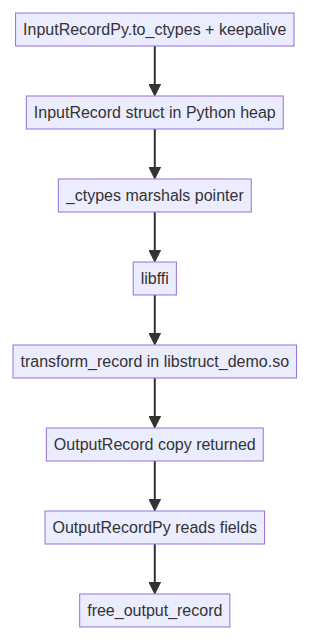
Handles can stack below the user API. In the demo:
application code          user API (what you call)
    → InputRecordPy.add_metric(…), transform(inp)
        → InputRecord + keepalive buffers     handles (binding-internal)
        → byref → _ctypes → libffi            handles (runtime FFI)
        → transform_record in libstruct_demo.so   resource (C memory / logic)
OutputRecordPy is user API; the OutputRecord stored on self._record is the handle it holds until free_output_record runs.
Handles vs pointers
Wikipedia contrasts handles with pointers: a pointer is the address of the referent; a handle is an abstraction managed externally. ctypes uses real pointer types (POINTER(Metric)), but they live inside the binding layer. The user API never exposes metric_ptrs[i] — only add_metric_ptr(MetricPy(...)).
Binding responsibilities (behind the user API)
Module-internal code that owns handles typically:
- Marshals — fill
Structurefields, buffers,pointer()values into_ctypes(). - Unmarshals — decode
c_chararrays andc_char_pin user API methods. - Manages lifetime — keepalive through the C call;
free_output_recordinOutputRecordPy.close():
class OutputRecordPy:
    def __init__(self, record: OutputRecord):
        self._record = record  # handle to C-backed output struct
        self._closed = False

    def close(self) -> None:
        if self._closed:
            return
        _lib.free_output_record(ctypes.byref(self._record))
        self._closed = True
Users call out.filtered_weights(); they do not call free_output_record — that is handle management inside the binding.
Same idea across this article series
| Part | User API (examples) | Handle (examples) | Resource |
|---|---|---|---|
| OS | read(fd, …) |
file descriptor | kernel file object |
| Part I §2.1 | process_config(capsule) |
PyCapsule |
C ComplexConfig * |
| Part III §7.2 | lib.add(2, 3) |
_FuncPtr / CDLL binding |
add in libadd.so |
| Part IV demo | InputRecordPy, transform() |
InputRecord, keepalive |
C structs in libstruct_demo.so |
| Part V handle pool | Config, Counter, *Resource |
int64_t handle |
C++ objects in HandlePool |
Same structural role for handles: token on the API side, mediator, resource on the other side. The user API is whichever functions and classes you publish; handles stay internal unless you deliberately expose low-level access. Part V makes the pool and TypeId check explicit for C++ behind ctypes (see Part V §9.8–9.9).
Practical guidance
- Keep ctypes
Structuresubclasses module-internal — they are handles at the FFI boundary. - Keep buffers,
c_char_p,POINTER(...)insideto_ctypes()/ keepalive — also handles. - Expose a user API (
InputRecordPy,transform, …) that owns handle assembly and cleanup. - Handle leaks (Wikipedia) still apply: forgetting
out.close()leaves C heap memory allocated, like forgettingclose(fd).
transform(inp: InputRecordPy, ...) takes user API on input; inside it builds InputRecord handles and passes byref to C. Callers hold InputRecordPy, not handles.
References
- Part I — Overview — §2 binding C structs via the C API
- Part II — Execution
- Part III — ctypes and CFFI — §7.2 scalar ctypes, libffi
- Part V — ctypes Handle Pool Design Pattern — §9 C++ handle pool, complex-type return via handles
- Part VII — pybind11 — compile-time C++ bindings alternative to struct mirroring
- Part VIII — Extensions vs Bindings
- ctypes — Structures and unions
- ctypes — Type conversions, Pointers
- ctypes —
create_string_buffer,byref - CFFI — struct/array example
- Handle (computing) — abstract reference to a resource managed by another system
- Demo: ctypes_complex_struct