Python/C VII — pybind11
- Section 11: pybind11 — Compile-Time C++ Bindings
- 11.1 Position in the Series
- 11.2 What pybind11 Is (and Is Not)
- 11.3 Internal Architecture — Compile Time, Import Time, Call Time
- 11.4
py::class_andPyTypeObjectGeneration - 11.5 Type Casters — Crossing the Boundary
- 11.6 Accepting and Returning Python Objects in User Code
- 11.7 pybind11 vs Hand-Written Python C API
- 11.8 Execution Path (Part II Tie-In)
- 11.9 pybind11 vs ctypes — Compile Time vs Runtime
- 11.10 Comparison Across the Full Series
- References
This article is Part VII of the Python C extension series. Part I — Overview covers hand-written extension functions and PyTypeObject binding. Part II — Execution covers bytecode, tp_call, and C method dispatch. Part III — ctypes and CFFI covers runtime FFI through _ctypes and libffi. Part IV — Complex ctypes Structs and Handles covers struct mirroring and keepalive. Part V — ctypes Handle Pool covers C++ behind a C ABI and integer handles. Part VI — ROS 2 Message Bindings applies capsule bindings at production scale; it already mentions _rclpy_pybind11 as a real pybind11 module. Part VIII — Extensions vs Bindings is the conceptual capstone for the series.
Part VII covers pybind11: how it works internally, how binding code accepts and returns Python objects at the C++ level, how it compares to hand-written C API code (Part I), and how it differs from ctypes on the compile-time vs runtime axis.
Runnable demo: c_ext_pybind11_config in the python repository — a pybind11 reimplementation of Part I’s c_ext_config_basic Config type, plus inspect(py::object) and summarize() returning a Python dict.
pip install pybind11
cd c_ext_pybind11_config
python3 setup.py build_ext --inplace
python3 test_pybind11_config.py
| Section | Demo folder |
|---|---|
| §11.2–11.7 | c_ext_pybind11_config — config.hpp, bindings.cpp, test_pybind11_config.py |
| §11.7 contrast (hand-written) | c_ext_config_basic (Part I §2.2.2) |
| §11.9 contrast (ctypes) | c_ext_ctypes_add (Part III §7.2) |
| §11.9 contrast (ctypes struct) | ctypes_complex_struct (Part IV) |
| §11.1 forward link | ros2_binding_demo — _rclpy_pybind11 (Part VI) |
Section 11: pybind11 — Compile-Time C++ Bindings
11.1 Position in the Series
The series so far covers two opposite poles:
- Part I (hand-written C API): full Python integration — real
PyTypeObject, attributes,isinstance, exceptions — but ~100 lines of boilerplate per simple type. - Parts III–V (ctypes): stdlib Python glue, no per-library
PyInit_*, but runtime libffi dispatch, manual struct layout mirroring, and awkward C++ (Part V’s handle pool exists precisely because ctypes cannot speak C++ classes natively).
pybind11 sits between them on the integration axis and beside Part I on the mechanism axis:
| Axis | ctypes (Parts III–V) | pybind11 (Part VII) | Hand-written C API (Part I) |
|---|---|---|---|
| When binding is resolved | runtime (libffi + Python metadata) | compile time (C++ templates) | compile time (your C code) |
| User binding code language | Python | C++ | C |
| Bridge you import | pre-built _ctypes (stdlib) |
your mymodule.cpython-….so |
your mymodule.cpython-….so |
PyTypeObject / attributes |
poor fit | full (generated) | full (hand-written) |
Part VI showed _rclpy_pybind11.cpython-312-aarch64-linux-gnu.so — production proof that pybind11 modules are first-class C extensions with SOABI-tagged filenames, same as Part I’s hand-written modules.
11.2 What pybind11 Is (and Is Not)
pybind11 is a header-only C++11 library. You #include <pybind11/pybind11.h>, write binding code in C++, and compile it into a shared library that Python imports. There is:
- No separate pybind11 runtime
.soto link against (onlylibpython). - No code generator step (contrast CFFI API mode in Part III, which emits C and compiles it).
- No pure-Python binding path (contrast ctypes, where user code stays in Python and calls the ready-made
_ctypesextension).
Minimal binding for the demo Config type:
#include <pybind11/pybind11.h>
namespace py = pybind11;

PYBIND11_MODULE(mymodule, m) {
    py::class_<Config>(m, "Config")
        .def(py::init<int, const std::string&, bool>(),
             py::arg("timeout") = 0, py::arg("url") = "", py::arg("ssl") = false)
        .def_readwrite("timeout", &Config::timeout)
        .def_property("server_url",
            [](const Config &c) { return c.server_url; },
            [](Config &c, const std::string &v) { c.server_url = v; })
        .def_readwrite("enable_ssl", &Config::enable_ssl)
        .def("process", &Config::process);
}
Python usage matches Part I exactly:
import mymodule

config = mymodule.Config(timeout=30, url="http://server.com", ssl=True)
config.timeout = 60
assert config.process() == 120
assert isinstance(config, mymodule.Config)
11.3 Internal Architecture — Compile Time, Import Time, Call Time
pybind11 is not a parallel object model. It generates the same CPython machinery Part I builds by hand — PyInit_*, PyTypeObject, method wrappers, argument parsing — using C++ templates at compile time and registration calls at import time.
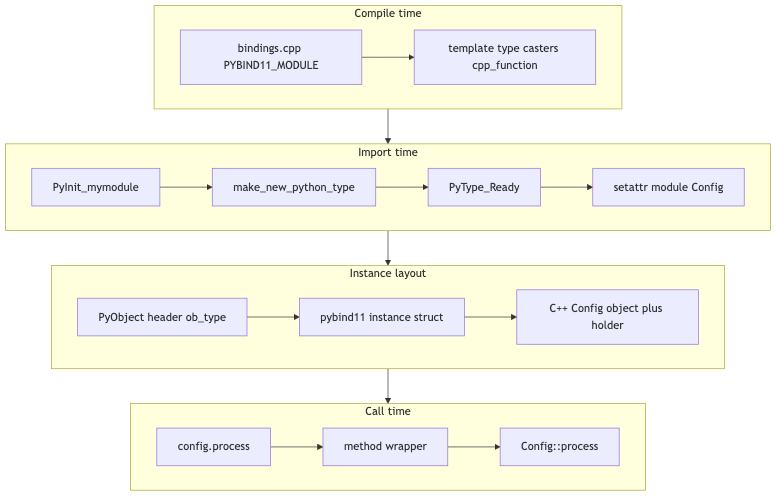
Compile time
When you write m.def("add", &add) or py::class_<Config>(...), the compiler instantiates template code in pybind11 headers (cpp_function, class_, type casters). Each C++ signature yields concrete wrappers that know how to:
- parse
PyObject*arguments into C++ types; - call your function or method;
- convert the return value back to
PyObject*.
Function signatures for help() are precomputed with constexpr where possible — one reason pybind11 binaries are smaller than Boost.Python’s.
Import time
PYBIND11_MODULE(mymodule, m) expands to a standard PyInit_mymodule entry point (Python 3). When Python runs import mymodule:
PyInit_mymoduleruns.py::class_<Config>callsmake_new_python_type(inpybind11/detail/class.h): allocates aPyHeapTypeObject, setstp_name,tp_base→ internalpybind11_object,tp_basicsize = sizeof(instance), callsPyType_Ready, registers the type on the module withsetattr.m.def(...)registers free functions as descriptors on the module dict.
This is the same registration sequence as Part I’s PyType_Ready(&ConfigType) + PyModule_AddObject(m, "Config", ...), but generated from declarative C++.
Call time
When Python calls config.process():
- Attribute lookup finds a bound method descriptor (pybind11’s
cpp_functionwrapper). - The wrapper extracts the C++
Configfrom the pybind11instancelayout inside the Python object. - It calls
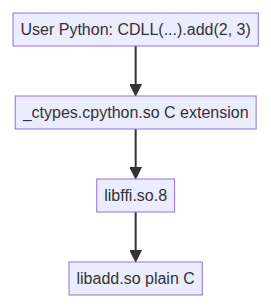
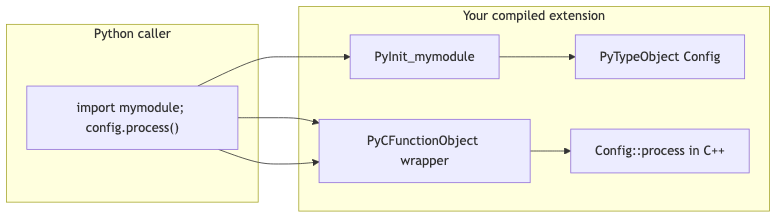
Config::process()directly — no libffi (contrast Part III’s ctypes path inpython_c_ext_ctypes_call_flow.png).
| Layer | pybind11 | Raw C API (Part I) |
|---|---|---|
| Module entry | PYBIND11_MODULE → PyInit_* |
PyModuleDef, PyModule_Create |
| Free functions | m.def → cpp_function |
PyMethodDef, PyArg_ParseTuple |
| Classes | py::class_<T> → make_new_python_type |
static PyTypeObject, PyType_Ready |
| Instances | instance struct: C++ object + holder in tp_basicsize buffer |
custom ConfigObject with PyObject_HEAD |
| Base infrastructure | internal pybind11_object supplies tp_new, tp_dealloc |
you write Config_new, Config_dealloc |
| Methods / properties | descriptors on type __dict__ |
tp_methods, tp_getset |
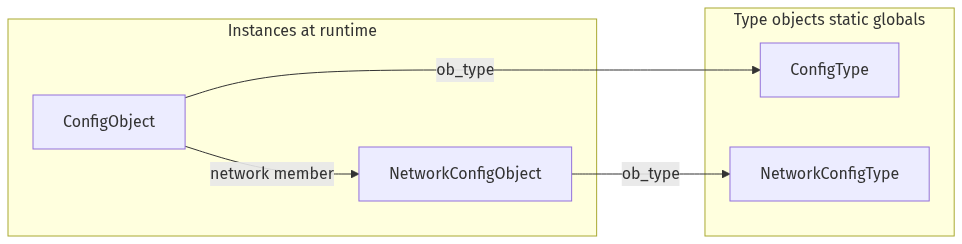
The runtime picture is the same as Part I’s python_c_ext_object_type_pairing.png: mymodule.Config is a real PyTypeObject; each instance has ob_type pointing at it; isinstance(config, mymodule.Config) works through the normal CPython type machinery.
11.4 py::class_ and PyTypeObject Generation
Part I §2.2.2 defines ConfigObject and a static ConfigType with explicit slots:
typedef struct {
    PyObject_HEAD
    int timeout;
    PyObject *server_url;
    bool enable_ssl;
} ConfigObject;

static PyTypeObject ConfigType = {
    PyVarObject_HEAD_INIT(NULL, 0)
    .tp_name = "mymodule.Config",
    .tp_basicsize = sizeof(ConfigObject),
    .tp_new = Config_new,
    .tp_init = (initproc)Config_init,
    .tp_dealloc = (destructor)Config_dealloc,
    .tp_getset = Config_getsetters,
    .tp_methods = Config_methods,
};
pybind11’s equivalent in bindings.cpp is ~15 lines of py::class_<Config> (see §11.2). Under the hood, make_new_python_type:
- Allocates a
PyHeapTypeObject. - Sets
type->tp_nameto the fully qualified name (e.g.mymodule.Config). - Sets
type->tp_basetopybind11_object— an internal base type that already implements generictp_new(pybind11_object_new→tp_alloc+ allocate holder layout) andtp_dealloc. - Sets
type->tp_basicsize = sizeof(instance)whereinstanceis pybind11’s internal struct wrapping the C++ object. - Calls
PyType_Ready(type)andsetattr(module, "Config", type).
Two-phase construction (same model as Part II §5 for any Python class):
| Phase | Slot / method | pybind11 | Part I |
|---|---|---|---|
| Allocate shell | tp_new |
pybind11_object_new |
Config_new |
| Construct payload | tp_init / __init__ |
py::init<...> wrapper |
Config_init |
py::init<int, const std::string&, bool>() registers an __init__ that placement-new’s a C++ Config into the instance holder. Omitting py::init leaves the default pybind11_object_init, which raises TypeError: No constructor defined!.
11.5 Type Casters — Crossing the Boundary
pybind11 moves data across the Python/C++ boundary through type casters — template specializations selected at compile time from C++ type information.
Three interaction modes (see cast overview):
| Mode | C++ side | Python side | What happens |
|---|---|---|---|
| Wrapper over C++ | Native Config |
Python proxy | Zero-copy: Python holds a shell around the real C++ instance (py::class_) |
| Wrapper over Python | py::dict, py::list |
Native object | Python object referenced, not copied |
| Conversion | std::vector<int> |
list |
Data copied both ways |
Contrast Part IV’s ctypes struct mirroring: ctypes requires you to describe C layout with _fields_ and manually match sizeof/offsetof. pybind11 never exposes C++ memory layout to Python — integration is through generated wrappers and casters, not byte-level struct equivalence.
Built-in casters cover scalars, strings, STL containers (#include <pybind11/stl.h>), chrono, Eigen, NumPy, and more. Custom types use py::class_ or a custom type caster specialization.
11.6 Accepting and Returning Python Objects in User Code
Binding code is C++, but you often need to accept arbitrary Python values, return Python collections, or call back into Python. pybind11 wraps PyObject* in RAII types.
Full source: bindings.cpp — inspect() and summarize().
Accept: py::object and typed wrappers
void inspect(py::object obj) {
    if (obj.is_none())
        return;

    if (py::isinstance<py::dict>(obj)) {
        for (auto item : obj.cast<py::dict>())
            /* ... */;
    } else if (py::isinstance<Config>(obj)) {
        const Config &cfg = obj.cast<const Config &>();
        /* ... */
    }
}
Export:
m.def("inspect", &inspect, py::arg("obj"));
mymodule.inspect({"a": 1})
mymodule.inspect(config)
mymodule.inspect(None)
| Parameter type | Accepts from Python | Notes |
|---|---|---|
py::object |
anything | inspect with py::isinstance, cast |
const py::dict& |
dict only | implicit check; TypeError if wrong |
Config& / const Config& |
bound Config instance |
unwraps C++ object from pybind11 shell |
py::args, const py::kwargs& |
*args, **kwargs |
kwargs must be last parameter |
Use py::handle for borrowed short-lived references (no refcount increment); py::object for stored/returned values (RAII, increments refcount). Wrong cast<T>() throws py::cast_error.
Return: Python objects from C++
py::dict summarize(const Config &cfg) {
    py::dict out;
    out["timeout"] = cfg.timeout;
    out["server_url"] = cfg.server_url;
    out["enable_ssl"] = cfg.enable_ssl;
    out["process_result"] = cfg.process();
    return out;   // refcount managed; Python receives a new dict
}
Any py::object subclass (py::dict, py::list, py::str, …) converts to a return value. For bound C++ types, returning Config by value creates or reuses a Python wrapper.
Call Python from C++
py::module_ math = py::module_::import("math");
py::object result = math.attr("sqrt")(py::float_(42));
double x = result.cast<double>();
This uses the same C API operations as Part I (PyImport_ImportModule, attribute lookup, PyObject_Call), wrapped in C++.
11.7 pybind11 vs Hand-Written Python C API
The demo c_ext_pybind11_config exposes the same Python API as Part I c_ext_config_basic. The Python tests are intentionally parallel.
| Concern | Hand-written C API (Part I) | pybind11 (Part VII) |
|---|---|---|
| Boilerplate | PyTypeObject, getset, methods, module init |
declarative py::class_, m.def |
| Type safety | C compiler on your structs | C++ compiler + templates on signatures |
| Refcounting | manual Py_INCREF / Py_DECREF |
RAII py::object, py::str, … |
| Errors | PyErr_SetString, return NULL |
C++ exceptions → Python (optional; py::register_exception) |
| What you still own | all semantics and ownership | return value policies, holder types, GIL release (py::gil_scoped_release) |
| Debug surface | your code is what runs | generated wrappers (harder to step through in a debugger) |
| Language | C | C++ required |
Key message: pybind11 is the C API — not a replacement runtime. It generates and wraps the same PyObject*, PyTypeObject, and method machinery Part I writes explicitly. Choose pybind11 when C++ is the implementation language and boilerplate cost dominates; choose hand-written C when you need minimal dependencies, C-only codebases, or maximum control over every slot.
11.8 Execution Path (Part II Tie-In)
Part II showed that config.process() on a hand-written extension resolves to PyCFunctionObject → direct C function pointer — no nested eval loop, no libffi.
pybind11-bound methods follow the same path: the wrapper pybind11 registers is still a PyCFunction-style callable. Contrast Part III:
| Call | Path |
|---|---|
config.process() (Part I or VII) |
PyCFunctionObject → direct C/C++ |
lib.add(2, 3) (Part III ctypes) |
_FuncPtr → _ctypes → libffi → add in libadd.so |
Both Part I and Part VII produce mymodule.cpython-<SOABI>.so modules that link against libpython. The difference is how the .so was authored — by hand or via pybind11 templates — not how Python dispatches the call once the module is loaded.
11.9 pybind11 vs ctypes — Compile Time vs Runtime
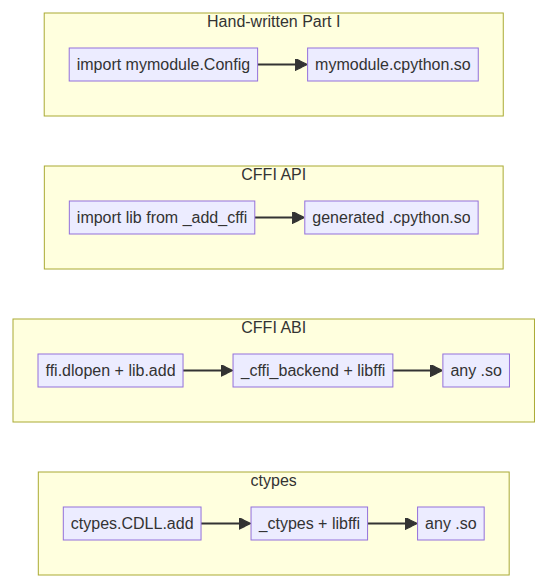
This is the central architectural split between Part VII and Parts III–V. Part VIII — Extensions vs Bindings §12.7 reframes it: pybind11 is extension authoring (compile-time); ctypes is binding through a bridge (runtime).
| pybind11 (Part VII) | ctypes (Parts III–V) | |
|---|---|---|
| User binding code | C++ (bindings.cpp) |
Python (_fields_, argtypes, wrapper classes) |
| Bridge module imported | your compiled mymodule.cpython.so |
pre-built stdlib _ctypes |
| When signatures are resolved | compile time (templates) | runtime (libffi + metadata) |
| Target code | C++ compiled into the extension | existing plain .so via dlopen |
| C++ classes | native (py::class_, virtual, STL) |
awkward — Part V handle pool exists as workaround |
PyTypeObject / attributes |
full (generated) | poor fit — Part IV mirrors layout only |
| Rebuild per Python version | yes (SOABI tag on your .so) |
no for _ctypes; struct layout must still match C |
| Per-call cost | direct function pointer | libffi dispatch |
ctypes model (runtime):
Python user code → ctypes (Python) → _ctypes (ready-made C ext) → libffi → dlopen'd libfoo.so
User code is Python. Signatures come from argtypes/restype and _fields_ at call time. The stdlib extension is already compiled.
pybind11 model (compile time):
C++ binding code → compiler + pybind11 headers → your mymodule.cpython.so → direct C++ calls
User code is C++. Signatures are read from C++ types at compile time. You ship a new C extension; there is no pre-built pybind11 module to import for your library.
Part IV’s runtime layout section applies only to ctypes: _ctypes allocates a buffer matching _fields_. pybind11 never requires _fields_ — the C++ object layout stays opaque; Python sees wrappers.
11.10 Comparison Across the Full Series
| Part I C API | Part VII pybind11 | Part III–IV ctypes | Part V handle pool | |
|---|---|---|---|---|
| Token / type model | PyTypeObject |
generated PyTypeObject |
Structure layout |
int64_t handle |
| User glue language | C | C++ | Python | Python |
| Build | setup.py + C |
setup.py/CMake + pybind11 |
make target .so only |
make + ctypes |
| C++ support | manual in C | first-class | via extern "C" shim |
via extern "C" shim + pool |
| Complex output | return Python objects from C API | return py::object / bound types |
out-param / return-by-value copy | out-param, by-value, or handle-return |
| Callable path | direct C | direct C++ | _ctypes + libffi |
_ctypes + libffi |
When to use pybind11:
- New or existing C++ codebase.
- Need Pythonic classes, methods, inheritance, STL, exceptions mapped to Python.
- Willing to compile and ship a per-Python-version extension module.
- Alternative to Part I when boilerplate cost is too high but you still need full
PyTypeObjectintegration.
When to stay with ctypes (Parts III–V):
- Existing plain C shared library, stable C ABI.
- Stdlib-only integration, no binding compiler for end users.
- Quick runtime
dlopenwithout rebuilding for each Python minor version.
When to stay with hand-written C API (Part I):
- C-only codebase, minimal dependencies, or you need explicit control over every
tp_*slot and error path.
Part VI’s _rclpy_pybind11 and rosidl plain-.so typesupport modules illustrate both poles in one stack: pybind11 for the ROS client library API; plain shared objects + capsules for message conversion.
References
- Part I — Overview — §2.2.2
Config/PyTypeObject - Part II — Execution — §5–§6 C extension dispatch
- Part III — ctypes and CFFI — §7.2 libffi, §7.4 three approaches
- Part IV — Complex ctypes Structs — §8 runtime layout, §8.10 comparison
- Part V — ctypes Handle Pool — §9.11 series comparison
- Part VI — ROS 2 Message Bindings —
_rclpy_pybind11 - pybind11 — documentation
- pybind11 — First steps
- pybind11 — Object-oriented code
- pybind11 — Cast overview
- pybind11 — Python C++ interface
- pybind11 — Python objects as arguments
- pybind11 source:
include/pybind11/detail/class.h(make_new_python_type),cast.h - Demo: c_ext_pybind11_config
- Contrast: c_ext_config_basic
- Part VIII — Extensions vs Bindings