Python/C I — PyTypeObject
- Section 1: Python C Extension Fundamentals
- Section 2: Binding Complex C Structures (Refactored)
- References
This article covers the fundamentals of Python C extensions: writing extension functions and binding C structures to Python types. Companion articles: Part II — Execution (interpreter model, bytecode vs C dispatch), Part III — ctypes and CFFI (FFI alternatives to hand-written extensions), Part IV — Complex ctypes Structs and Handles (ctypes mirroring, internal handles vs user API), Part V — ctypes Handle Pool (C++ handle pool behind ctypes), Part VI — ROS 2 Message Bindings (ROS 2 rosidl capsule bindings and rclpy), Part VII — pybind11 (compile-time C++ bindings, internals, contrast with ctypes), and Part VIII — Extensions vs Bindings (conceptual map — extension authoring vs binding patterns). Section 2 below uses “binding” for PyTypeObject exposure; Part VIII clarifies the broader distinction.
Runnable demos for every code example live in the python repository. Build any C extension demo with python3 setup.py build_ext --inplace then run the matching test_*.py.
| Section | Demo folder |
|---|---|
| §1.1, §1.4 | c_ext_spam_system |
| §1.2 | c_ext_exception_propagation |
| §1.3 | c_ext_reference_counting |
| §2.1 | c_ext_capsule_config |
| §2.2.2 | c_ext_config_basic |
| §2.2.3 | c_ext_config_nested |
| §2.3 | c_ext_config_marshal |
| §2 contrast (ctypes structs) | ctypes_complex_struct — Part IV |
| §2.1 contrast (ROS 2 codegen) | ros2_binding_demo — Part VI |
| §2.2.2 contrast (pybind11) | c_ext_pybind11_config — Part VII |
Section 1: Python C Extension Fundamentals
1.1 Basic C Extension Function Structure
Full source: c_ext_spam_system — spam.c, setup.py, test_spam.py
A minimal extension function wraps a C library call and exposes it to Python. The canonical example from the official documentation wraps system():
#define PY_SSIZE_T_CLEAN
#include <Python.h>
#include <stdlib.h>

static PyObject *
spam_system(PyObject *self, PyObject *args)
{
    const char *command;
    int sts;

    if (!PyArg_ParseTuple(args, "s", &command))
        return NULL;
    sts = system(command);
    return PyLong_FromLong(sts);
}

static PyMethodDef SpamMethods[] = {
    {"system", spam_system, METH_VARARGS, "Execute a shell command."},
    {NULL, NULL, 0, NULL}
};

static struct PyModuleDef spammodule = {
    PyModuleDef_HEAD_INIT,
    "spam",
    "Spam module.",
    -1,
    SpamMethods
};

PyMODINIT_FUNC
PyInit_spam(void)
{
    return PyModule_Create(&spammodule);
}
import spam

spam.system("true")   # 0
spam.system("false")  # non-zero exit status
Function signature conventions:
self: For module-level functions, points to the module object. For methods on extension types, points to the instance .args: A pointer to a Python tuple containing positional arguments. Keyword arguments requirePyArg_ParseTupleAndKeywords().- Return type: Always
PyObject *. ReturnNULLto signal an error (an exception must already be set). Return a non-NULLpointer on success.
Argument parsing with PyArg_ParseTuple():
- Parses Python arguments into C variables using a format string.
- Returns a non-zero value on success; returns
0on failure and raises an appropriate exception. - Common format codes:
s(UTF-8 string),i(int),f(float),O(object),|(everything after this is optional).
Return value construction:
PyLong_FromLong()— Clong→ PythonintPyUnicode_FromString()— C string → PythonstrPy_BuildValue()— construct complex return values from a format string
1.2 Python Exception Handling in C Extensions
Full source: c_ext_exception_propagation — spam_errors.c, setup.py, test_spam_errors.py
Python’s exception model is based on a per-thread global error state, not per-module. When an exception is active, three fields in the current thread state hold the equivalent of sys.exc_info():
exc_type— the exception class (e.g.,ValueError)exc_value— the exception instanceexc_traceback— the traceback object
All three are NULL when no exception is set.
Exception API functions:
- Setting exceptions (only where the error is first detected):
PyErr_SetString(exc_type, message)— set exception with a C string messagePyErr_SetFromErrno(exc_type)— construct value fromerrnoPyErr_SetObject(exc_type, value)— set exception with an arbitrary value
- Checking exceptions:
PyErr_Occurred()— returns the current exception object, orNULLif none is set
- Clearing exceptions:
PyErr_Clear()— clear the current exception; use only when handling it locally, not when propagating
Error propagation pattern:
#define PY_SSIZE_T_CLEAN
#include <Python.h>

static PyObject *SpamError = NULL;

/* Layer 3: deepest function — sets the specific error */
static PyObject *
layer3_func(PyObject *self, PyObject *args)
{
    int fail;
    if (!PyArg_ParseTuple(args, "i", &fail))
        return NULL;
    if (fail) {
        PyErr_SetString(SpamError, "Specific error: file not found");
        return NULL;
    }
    return PyLong_FromLong(42);
}

/* Layer 2: middle function — propagates and processes */
static PyObject *
layer2_func(PyObject *self, PyObject *args)
{
    PyObject *obj = layer3_func(self, args);
    if (obj == NULL)
        return NULL;  /* layer 3 already set the exception */
    long value = PyLong_AsLong(obj);
    Py_DECREF(obj);
    return PyLong_FromLong(value * 2);
}

/* Layer 1: top function — just propagates */
static PyObject *
layer1_func(PyObject *self, PyObject *args)
{
    PyObject *result = layer2_func(self, args);
    if (result == NULL)
        return NULL;
    return result;
}

static PyMethodDef SpamMethods[] = {
    {"call", layer1_func, METH_VARARGS, "Call through three C layers."},
    {NULL, NULL, 0, NULL}
};

static struct PyModuleDef spammodule = {
    PyModuleDef_HEAD_INIT,
    "spam_errors",
    "Exception propagation demo.",
    -1,
    SpamMethods
};

PyMODINIT_FUNC
PyInit_spam_errors(void)
{
    PyObject *m = PyModule_Create(&spammodule);
    if (m == NULL)
        return NULL;

    SpamError = PyErr_NewException("spam_errors.SpamError", NULL, NULL);
    if (SpamError == NULL) {
        Py_DECREF(m);
        return NULL;
    }
    Py_INCREF(SpamError);
    if (PyModule_AddObject(m, "SpamError", SpamError) < 0) {
        Py_DECREF(SpamError);
        Py_DECREF(m);
        return NULL;
    }
    return m;
}
import spam_errors

spam_errors.call(0)   # 84
spam_errors.call(1)   # raises spam_errors.SpamError
Critical rule: Only the function that detects the error should call PyErr_SetString() (or related PyErr_* setters). All other functions in the call chain should return NULL or -1 to propagate the error upward. The Python interpreter’s main loop eventually handles the exception.
When returning an error, clean up any owned references you created (Py_DECREF / Py_XDECREF) before returning NULL.
1.3 Reference Counting
Full source: c_ext_reference_counting — refcount_demo.c, setup.py, test_refcount_demo.py
CPython uses reference counting for memory management. Extension authors must manually balance increments and decrements — conceptually similar to C++ shared_ptr, but without automatic cleanup.
Reference counting macros:
Py_INCREF(obj)— increment (unsafe ifobjisNULL)Py_DECREF(obj)— decrement; deallocate when count reaches zero (unsafe ifobjisNULL)Py_XINCREF(obj)— increment (null-safe; theXprefix means “do nothing if NULL”)Py_XDECREF(obj)— decrement (null-safe)Py_CLEAR(obj)— decrement and set the pointer toNULL(safest cleanup for struct members)
Owned vs borrowed references:
- Owned reference: You are responsible for eventually calling
Py_DECREF. - Borrowed reference: A pointer you did not increment; do not decref it. Valid only as long as the owner keeps the object alive.
Reference stealing:
Some APIs take ownership of your reference — you must not decref afterward:
/* PyModule_AddObject steals reference to obj */
PyObject *marker = PyUnicode_FromString("owned_by_module");
if (PyModule_AddObject(m, "marker", marker) < 0) {
    Py_DECREF(marker);
    Py_DECREF(m);
    return NULL;
}
PyList_SetItem also steals; PyList_Append does not — you must decref after append:
if (PyList_Append(list, value) < 0)
    return NULL;
Py_DECREF(value);  /* PyList_Append does not steal */
Reference returning:
static PyObject *
demo_new_reference(PyObject *self, PyObject *Py_UNUSED(ignored))
{
    PyObject *obj = PyList_New(0);            /* new reference — caller owns it */
    if (obj == NULL)
        return NULL;
    return obj;
}

static PyObject *
demo_borrowed_reference(PyObject *self, PyObject *args)
{
    PyObject *list;
    if (!PyArg_ParseTuple(args, "O", &list))
        return NULL;
    PyObject *item = PyList_GetItem(list, 0); /* borrowed — do not decref */
    return PyLong_FromLong(PyLong_AsLong(item));
}
See Reference Counting in C for the full rules.
1.4 Module Initialization
Full source: c_ext_spam_system (basic module); custom exceptions in c_ext_exception_propagation
Modern Python 3 modules use PyModuleDef and a PyInit_<name> entry point. The complete spam module is shown in §1.1 (PyMethodDef table + PyInit_spam). After import spam, Python calls PyInit_spam(), which registers the method table and returns the module object. Each exported function follows the PyObject *func(PyObject *self, PyObject *args) convention described above.
Custom exception types are registered the same way (spam_errors module):
SpamError = PyErr_NewException("spam_errors.SpamError", NULL, NULL);
Py_INCREF(SpamError);
PyModule_AddObject(m, "SpamError", SpamError);  /* steals SpamError ref */
Section 2: Binding Complex C Structures (Refactored)
When a C library exposes structs, arrays, or nested configuration objects, you need a strategy to pass them through Python. Two common approaches are capsules (opaque handles) and custom PyTypeObject instances (full Python types with attribute access).
2.1 Approach 1: Opaque Capsule (Simple)
Full source: c_ext_capsule_config — mymodule.c, setup.py, test_mymodule.py
A capsule wraps a C pointer in an opaque Python object. Python can pass it between C functions but cannot inspect or modify fields directly.
C struct definition:
#include <stdbool.h>

struct ComplexConfig {
    int timeout;
    char *server_url;
    bool enable_ssl;
    void *internal_data;
};

int process_config(struct ComplexConfig *config)
{
    int result = config->timeout;
    if (config->enable_ssl)
        result += 100;
    if (config->server_url != NULL && config->server_url[0] != '\0')
        result += (int)strlen(config->server_url);
    return result;
}
Capsule implementation:
static void
destroy_config(PyObject *capsule)
{
    struct ComplexConfig *config =
        PyCapsule_GetPointer(capsule, "ComplexConfig");
    if (config) {
        free(config->server_url);
        free(config);
    }
}

static PyObject *
py_create_config(PyObject *self, PyObject *args)
{
    int timeout;
    const char *url;
    int ssl;

    if (!PyArg_ParseTuple(args, "isi", &timeout, &url, &ssl))
        return NULL;

    struct ComplexConfig *config = malloc(sizeof(struct ComplexConfig));
    if (!config) {
        PyErr_NoMemory();
        return NULL;
    }
    config->timeout = timeout;
    config->server_url = strdup(url);
    if (!config->server_url) {
        free(config);
        PyErr_NoMemory();
        return NULL;
    }
    config->enable_ssl = (bool)ssl;
    config->internal_data = NULL;

    return PyCapsule_New(config, "ComplexConfig", destroy_config);
}

static PyObject *
py_process_config(PyObject *self, PyObject *args)
{
    PyObject *capsule;

    if (!PyArg_ParseTuple(args, "O", &capsule))
        return NULL;

    if (!PyCapsule_CheckExact(capsule)) {
        PyErr_SetString(PyExc_TypeError, "Expected Config capsule");
        return NULL;
    }

    struct ComplexConfig *config =
        PyCapsule_GetPointer(capsule, "ComplexConfig");
    if (!config) {
        PyErr_SetString(PyExc_ValueError, "Invalid config capsule");
        return NULL;
    }

    int result = process_config(config);
    return PyLong_FromLong(result);
}
Python usage:
import mymodule

config = mymodule.create_config(30, "http://server.com", True)
result = mymodule.process_config(config)  # 147
# Cannot access: config.timeout, config.server_url
# The capsule is opaque — pass it only to C functions
Pros: Simple; works for any C struct; no type boilerplate.
Cons: No attribute access from Python; harder to debug; no isinstance checks.
2.2 Approach 2: Custom PyTypeObject (Standard)
This approach creates a full Python type with attribute access, mirroring the C struct. Every such type follows the same *Object / *Type pattern (§2.2.1). The examples below progress from a basic struct to nested members and arrays.
2.2.1 The *Object / *Type Pairing
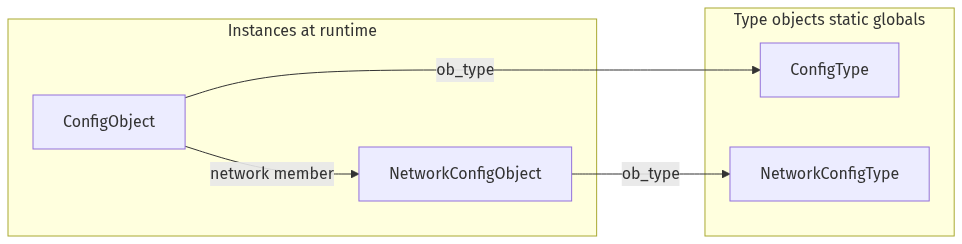
Every Python class in a C extension is defined by two C symbols:
| C symbol | What it is | Python equivalent |
|---|---|---|
ConfigObject |
Struct layout of one instance | one Config(...) object |
ConfigType |
Static PyTypeObject (the class) |
mymodule.Config |
NetworkConfigObject |
Struct layout of one instance (nested example in §2.2.3) | one NetworkConfig(...) object |
NetworkConfigType |
Static PyTypeObject (the class) |
mymodule.NetworkConfig |
Instance (*Object):
- Starts with
PyObject_HEAD, which expands toob_refcntandob_type. - Holds the per-instance data (fields you define after the header).
- Created at runtime by
type->tp_alloc()insidetp_new.
Type (*Type):
- A single global
PyTypeObjectstruct (not allocated per instance). - Describes behavior:
tp_new,tp_init,tp_dealloc,tp_getset,tp_methods,tp_basicsize, etc. - Registered with
PyType_Ready()and exposed on the module (e.g.PyModule_AddObject(m, "Config", ...)).
How they connect:
ConfigObject *cfg = ...;
cfg->ob_type == &ConfigType;   /* every instance points to its class */

NetworkConfigObject *net = ...;
net->ob_type == &NetworkConfigType;
In Python, isinstance(cfg, mymodule.Config) checks that cfg->ob_type is &ConfigType. A ConfigObject can store a NetworkConfigObject * as a member; the nested object still carries its own ob_type pointing to &NetworkConfigType.
2.2.2 Basic Example: Simple Struct with Primitive Fields
Full source: c_ext_config_basic — mymodule.c, setup.py, test_mymodule.py
Python object struct:
typedef struct {
    PyObject_HEAD
    int timeout;
    PyObject *server_url;  /* Python str object */
    bool enable_ssl;
} ConfigObject;
Type methods and slots:
static void
Config_dealloc(ConfigObject *self)
{
    Py_XDECREF(self->server_url);
    Py_TYPE(self)->tp_free((PyObject *)self);
}

static PyObject *
Config_new(PyTypeObject *type, PyObject *args, PyObject *kwds)
{
    ConfigObject *self = (ConfigObject *)type->tp_alloc(type, 0);
    if (self != NULL) {
        self->timeout = 0;
        self->server_url = NULL;
        self->enable_ssl = false;
    }
    return (PyObject *)self;
}

static int
Config_init(ConfigObject *self, PyObject *args, PyObject *kwds)
{
    static char *kwlist[] = {"timeout", "url", "ssl", NULL};
    int timeout = 0;
    PyObject *url = NULL;
    int ssl = 0;

    if (!PyArg_ParseTupleAndKeywords(args, kwds, "|iOi", kwlist,
                                     &timeout, &url, &ssl))
        return -1;

    self->timeout = timeout;
    self->enable_ssl = (bool)ssl;
    if (url) {
        Py_INCREF(url);
        Py_XDECREF(self->server_url);
        self->server_url = url;
    }
    return 0;
}

static PyObject *
Config_get_timeout(ConfigObject *self, void *closure)
{
    return PyLong_FromLong(self->timeout);
}

static int
Config_set_timeout(ConfigObject *self, PyObject *value, void *closure)
{
    if (!PyLong_Check(value)) {
        PyErr_SetString(PyExc_TypeError, "timeout must be int");
        return -1;
    }
    self->timeout = (int)PyLong_AsLong(value);
    return 0;
}

static PyObject *
Config_get_server_url(ConfigObject *self, void *closure)
{
    if (self->server_url == NULL)
        return PyUnicode_FromString("");
    Py_INCREF(self->server_url);
    return self->server_url;
}

static int
Config_set_server_url(ConfigObject *self, PyObject *value, void *closure)
{
    if (!PyUnicode_Check(value)) {
        PyErr_SetString(PyExc_TypeError, "server_url must be str");
        return -1;
    }
    Py_INCREF(value);
    Py_XDECREF(self->server_url);
    self->server_url = value;
    return 0;
}

static PyObject *
Config_get_enable_ssl(ConfigObject *self, void *closure)
{
    return PyBool_FromLong(self->enable_ssl);
}

static int
Config_set_enable_ssl(ConfigObject *self, PyObject *value, void *closure)
{
    if (!PyBool_Check(value)) {
        PyErr_SetString(PyExc_TypeError, "enable_ssl must be bool");
        return -1;
    }
    self->enable_ssl = (value == Py_True);
    return 0;
}

static PyGetSetDef Config_getsetters[] = {
    {"timeout", (getter)Config_get_timeout, (setter)Config_set_timeout,
     "timeout in seconds", NULL},
    {"server_url", (getter)Config_get_server_url, (setter)Config_set_server_url,
     "server URL", NULL},
    {"enable_ssl", (getter)Config_get_enable_ssl, (setter)Config_set_enable_ssl,
     "enable SSL", NULL},
    {NULL}
};

static PyObject *
Config_process(ConfigObject *self, PyObject *Py_UNUSED(ignored))
{
    int result = self->timeout * 2;
    return PyLong_FromLong(result);
}

static PyMethodDef Config_methods[] = {
    {"process", (PyCFunction)Config_process, METH_NOARGS, "Process config"},
    {NULL}
};

static PyTypeObject ConfigType = {
    PyVarObject_HEAD_INIT(NULL, 0)
    .tp_name = "mymodule.Config",
    .tp_doc = "Configuration object",
    .tp_basicsize = sizeof(ConfigObject),
    .tp_flags = Py_TPFLAGS_DEFAULT,
    .tp_new = Config_new,
    .tp_init = (initproc)Config_init,
    .tp_dealloc = (destructor)Config_dealloc,
    .tp_getset = Config_getsetters,
    .tp_methods = Config_methods,
};
Module initialization (register the type):
static struct PyModuleDef mymodule_def = {
    PyModuleDef_HEAD_INIT,
    "mymodule",
    "Basic Config type demo.",
    -1,
    NULL
};

PyMODINIT_FUNC
PyInit_mymodule(void)
{
    PyObject *m = PyModule_Create(&mymodule_def);
    if (m == NULL)
        return NULL;

    if (PyType_Ready(&ConfigType) < 0) {
        Py_DECREF(m);
        return NULL;
    }
    Py_INCREF(&ConfigType);
    if (PyModule_AddObject(m, "Config", (PyObject *)&ConfigType) < 0) {
        Py_DECREF(&ConfigType);
        Py_DECREF(m);
        return NULL;
    }
    return m;
}
Note: PyModule_AddObject() steals the reference to ConfigType, so you Py_INCREF before adding it.
Python usage:
import mymodule

config = mymodule.Config(timeout=30, url="http://server.com", ssl=True)
print(config.timeout)       # 30
config.timeout = 60           # setter works
print(config.server_url)      # http://server.com
result = config.process()     # 120
isinstance(config, mymodule.Config)  # True
Pros: Full Python integration, attribute access, type checking.
Cons: Requires boilerplate (~100 lines for a simple type). Part VII — pybind11 generates the same PyTypeObject machinery from C++ with far less code (c_ext_pybind11_config).
2.2.3 Advanced Example: Nested Structs and Arrays
Full source: c_ext_config_nested — mymodule.c, setup.py, test_mymodule.py
This example extends §2.2.2 with a nested extension type, a fixed C array, and a PyObject * holding a Python list.
Step 1: Define the nested type (NetworkConfigObject + NetworkConfigType)
typedef struct {
    PyObject_HEAD
    char *host;
    int port;
    bool use_ssl;
} NetworkConfigObject;

static PyTypeObject NetworkConfigType;

static void
Network_dealloc(NetworkConfigObject *self)
{
    free(self->host);
    Py_TYPE(self)->tp_free((PyObject *)self);
}

static PyObject *
Network_new(PyTypeObject *type, PyObject *args, PyObject *kwds)
{
    NetworkConfigObject *self =
        (NetworkConfigObject *)type->tp_alloc(type, 0);
    if (self) {
        self->host = NULL;
        self->port = 0;
        self->use_ssl = false;
    }
    return (PyObject *)self;
}

static int
Network_init(NetworkConfigObject *self, PyObject *args, PyObject *kwds)
{
    static char *kwlist[] = {"host", "port", "use_ssl", NULL};
    const char *host = NULL;
    int port = 0;
    int use_ssl = 0;

    if (!PyArg_ParseTupleAndKeywords(args, kwds, "|sii", kwlist,
                                     &host, &port, &use_ssl))
        return -1;

    if (host) {
        free(self->host);
        self->host = strdup(host);
        if (!self->host) {
            PyErr_NoMemory();
            return -1;
        }
    }
    self->port = port;
    self->use_ssl = (bool)use_ssl;
    return 0;
}

static PyObject *
Network_get_host(NetworkConfigObject *self, void *closure)
{
    if (self->host == NULL)
        return PyUnicode_FromString("");
    return PyUnicode_FromString(self->host);
}

static int
Network_set_host(NetworkConfigObject *self, PyObject *value, void *closure)
{
    if (!PyUnicode_Check(value)) {
        PyErr_SetString(PyExc_TypeError, "host must be str");
        return -1;
    }
    const char *host = PyUnicode_AsUTF8(value);
    free(self->host);
    self->host = strdup(host);
    if (self->host == NULL) {
        PyErr_NoMemory();
        return -1;
    }
    return 0;
}

static PyObject *
Network_get_port(NetworkConfigObject *self, void *closure)
{
    return PyLong_FromLong(self->port);
}

static int
Network_set_port(NetworkConfigObject *self, PyObject *value, void *closure)
{
    if (!PyLong_Check(value)) {
        PyErr_SetString(PyExc_TypeError, "port must be int");
        return -1;
    }
    self->port = (int)PyLong_AsLong(value);
    return 0;
}

static PyObject *
Network_get_use_ssl(NetworkConfigObject *self, void *closure)
{
    return PyBool_FromLong(self->use_ssl);
}

static int
Network_set_use_ssl(NetworkConfigObject *self, PyObject *value, void *closure)
{
    if (!PyBool_Check(value)) {
        PyErr_SetString(PyExc_TypeError, "use_ssl must be bool");
        return -1;
    }
    self->use_ssl = (value == Py_True);
    return 0;
}

static PyGetSetDef Network_getsetters[] = {
    {"host", (getter)Network_get_host, (setter)Network_set_host, "host", NULL},
    {"port", (getter)Network_get_port, (setter)Network_set_port, "port", NULL},
    {"use_ssl", (getter)Network_get_use_ssl, (setter)Network_set_use_ssl,
     "use_ssl", NULL},
    {NULL}
};

static PyTypeObject NetworkConfigType = {
    PyVarObject_HEAD_INIT(NULL, 0)
    .tp_name = "mymodule.NetworkConfig",
    .tp_basicsize = sizeof(NetworkConfigObject),
    .tp_flags = Py_TPFLAGS_DEFAULT,
    .tp_new = Network_new,
    .tp_init = (initproc)Network_init,
    .tp_dealloc = (destructor)Network_dealloc,
    .tp_getset = Network_getsetters,
};
NetworkConfigType is the class; Network_new allocates a NetworkConfigObject whose ob_type will point to &NetworkConfigType after tp_alloc.
Step 2: Define the main instance struct (ConfigObject)
typedef struct {
    PyObject_HEAD
    int timeout;
    PyObject *server_url;
    bool enable_ssl;
    NetworkConfigObject *network;   /* nested extension instance */
    int values[10];                 /* fixed C array */
    int values_count;               /* number of used slots in values[] */
    PyObject *items;                /* Python list (PyObject *) */
} ConfigObject;
values[]/values_count: pure C storage; expose to Python via methods.items: an owned reference to a Pythonlist; expose via a property getter/setter.network: pointer to another extension instance (NetworkConfigObject *).
Step 3: Nested member — getter/setter
static PyObject *
Config_get_network(ConfigObject *self, void *closure)
{
    if (self->network == NULL) {
        /* tp_new initializes host/port/use_ssl — do not use PyObject_New */
        self->network = (NetworkConfigObject *)
            NetworkConfigType.tp_new(&NetworkConfigType, NULL, NULL);
        if (self->network == NULL)
            return NULL;
    }
    Py_INCREF(self->network);
    return (PyObject *)self->network;
}

static int
Config_set_network(ConfigObject *self, PyObject *value, void *closure)
{
    if (!PyObject_TypeCheck(value, &NetworkConfigType)) {
        PyErr_SetString(PyExc_TypeError, "network must be NetworkConfig");
        return -1;
    }
    Py_INCREF(value);
    Py_XDECREF(self->network);
    self->network = (NetworkConfigObject *)value;
    return 0;
}
PyObject_TypeCheck(value, &NetworkConfigType) verifies the nested value is an instance of the nested type object.
Step 4: Fixed array and list members
Fixed C array — expose through methods:
static PyObject *
Config_get_value(ConfigObject *self, PyObject *args)
{
    int index;
    if (!PyArg_ParseTuple(args, "i", &index))
        return NULL;
    if (index < 0 || index >= self->values_count) {
        PyErr_SetString(PyExc_IndexError, "index out of range");
        return NULL;
    }
    return PyLong_FromLong(self->values[index]);
}

static PyObject *
Config_set_value(ConfigObject *self, PyObject *args)
{
    int index;
    PyObject *value;
    if (!PyArg_ParseTuple(args, "iO", &index, &value))
        return NULL;
    if (!PyLong_Check(value)) {
        PyErr_SetString(PyExc_TypeError, "value must be int");
        return NULL;
    }
    if (index < 0 || index >= 10) {
        PyErr_SetString(PyExc_IndexError, "index out of range");
        return NULL;
    }
    self->values[index] = (int)PyLong_AsLong(value);
    if (index >= self->values_count)
        self->values_count = index + 1;
    Py_RETURN_NONE;
}

static PyObject *
Config_get_values(ConfigObject *self, PyObject *Py_UNUSED(ignored))
{
    PyObject *list = PyList_New(self->values_count);
    if (list == NULL)
        return NULL;
    for (int i = 0; i < self->values_count; i++)
        PyList_SET_ITEM(list, i, PyLong_FromLong(self->values[i]));
    return list;
}
Python list member — store a PyObject * directly:
static PyObject *
Config_get_items(ConfigObject *self, void *closure)
{
    if (self->items == NULL)
        return PyList_New(0);
    Py_INCREF(self->items);
    return self->items;
}

static int
Config_set_items(ConfigObject *self, PyObject *value, void *closure)
{
    if (!PyList_Check(value)) {
        PyErr_SetString(PyExc_TypeError, "items must be a list");
        return -1;
    }
    Py_INCREF(value);
    Py_XDECREF(self->items);
    self->items = value;
    return 0;
}
Step 5: Complete type (ConfigType) and module init
Destructor, constructor, tables, and the ConfigType definition (reuse Config_init and primitive getters/setters from §2.2.2):
static void
Config_dealloc(ConfigObject *self)
{
    Py_XDECREF(self->server_url);
    Py_XDECREF(self->network);
    Py_XDECREF(self->items);
    Py_TYPE(self)->tp_free((PyObject *)self);
}

static PyObject *
Config_new(PyTypeObject *type, PyObject *args, PyObject *kwds)
{
    ConfigObject *self = (ConfigObject *)type->tp_alloc(type, 0);
    if (self != NULL) {
        self->timeout = 0;
        self->server_url = NULL;
        self->enable_ssl = false;
        self->network = NULL;
        self->values_count = 0;
        self->items = NULL;
        /* tp_alloc zero-fills memory, so values[] starts at {0, ...} */
    }
    return (PyObject *)self;
}

static PyGetSetDef Config_getsetters[] = {
    {"timeout", (getter)Config_get_timeout, (setter)Config_set_timeout,
     "timeout in seconds", NULL},
    {"server_url", (getter)Config_get_server_url, (setter)Config_set_server_url,
     "server URL", NULL},
    {"enable_ssl", (getter)Config_get_enable_ssl, (setter)Config_set_enable_ssl,
     "enable SSL", NULL},
    {"network", (getter)Config_get_network, (setter)Config_set_network,
     "network settings", NULL},
    {"items", (getter)Config_get_items, (setter)Config_set_items,
     "items list", NULL},
    {NULL}
};

static PyMethodDef Config_methods[] = {
    {"get_value", (PyCFunction)Config_get_value, METH_VARARGS, "Get value by index"},
    {"set_value", (PyCFunction)Config_set_value, METH_VARARGS, "Set value by index"},
    {"get_values", (PyCFunction)Config_get_values, METH_NOARGS, "Get all values"},
    {NULL}
};

static PyTypeObject ConfigType = {
    PyVarObject_HEAD_INIT(NULL, 0)
    .tp_name = "mymodule.Config",
    .tp_doc = "Configuration object with nested struct and arrays",
    .tp_basicsize = sizeof(ConfigObject),
    .tp_flags = Py_TPFLAGS_DEFAULT,
    .tp_new = Config_new,
    .tp_init = (initproc)Config_init,
    .tp_dealloc = (destructor)Config_dealloc,
    .tp_getset = Config_getsetters,
    .tp_methods = Config_methods,
};
Register NetworkConfigType before ConfigType:
static struct PyModuleDef mymodule_def = {
    PyModuleDef_HEAD_INIT,
    "mymodule",
    "Nested Config type demo.",
    -1,
    NULL
};

PyMODINIT_FUNC
PyInit_mymodule(void)
{
    PyObject *m = PyModule_Create(&mymodule_def);
    if (m == NULL)
        return NULL;

    if (PyType_Ready(&NetworkConfigType) < 0) {
        Py_DECREF(m);
        return NULL;
    }
    Py_INCREF(&NetworkConfigType);
    if (PyModule_AddObject(m, "NetworkConfig",
                           (PyObject *)&NetworkConfigType) < 0) {
        Py_DECREF(m);
        return NULL;
    }

    if (PyType_Ready(&ConfigType) < 0) {
        Py_DECREF(m);
        return NULL;
    }
    Py_INCREF(&ConfigType);
    if (PyModule_AddObject(m, "Config", (PyObject *)&ConfigType) < 0) {
        Py_DECREF(m);
        return NULL;
    }
    return m;
}
Python usage:
import mymodule

config = mymodule.Config(timeout=30)
config.network.host = "server.com"
config.network.port = 8080
config.network.use_ssl = True

isinstance(config, mymodule.Config)                    # True
isinstance(config.network, mymodule.NetworkConfig)     # True

net = mymodule.NetworkConfig(host="standalone.com", port=9000)
config.network = net

config.set_value(0, 10)
config.set_value(1, 20)
values = config.get_values()   # [10, 20]

config.items = [1, 2, 3, 4, 5]
items = config.items           # [1, 2, 3, 4, 5]
2.3 Summary: Opaque Capsule vs Full Python Type
The two binding approaches differ in how much of the C struct is visible to Python, not in whether C code can run at all. Both can call existing C functions directly from extension methods.
Opaque capsule (Approach 1)
- Wrap a plain C struct pointer in
PyCapsule_New; Python sees an opaque handle. - When a method needs to process the object, extract the pointer with
PyCapsule_GetPointerand pass it straight to existing C APIs — no field-by-field conversion. - Minimal boilerplate; ideal when Python only needs to create, pass, and destroy handles, not inspect or mutate fields.
- Downside: no
config.timeoutin Python, noisinstancechecks against a meaningful type, harder debugging in a REPL.
Full Python type mirror (Approach 2)
- The
*Objectstruct is the binding: instance data lives in C fields (and ownedPyObject *members), exposed through getters/setters and methods. - Methods still run as C functions —
Config_process(self, args)readsself->timeoutand can call any existing C library routine. You do not need to reimplement processing logic in Python. - Conversion is only required when the layout differs. If your library already uses
struct ComplexConfigand yourConfigObjectstores different types (e.g.PyObject *for strings instead ofchar *), you either:- design
ConfigObjectto match what the C API expects and call C directly, or - write a small marshal/unmarshal layer (Python mirror → stack/local C struct → call C function) at method boundaries.
That marshalling cost is paid at call sites, not by rewriting the library in Python.
- design
Sketch: marshal at the method boundary
Full source: c_ext_config_marshal — mymodule.c, setup.py, test_mymodule.py
Suppose the existing C library owns this layout and API:
/* Existing C library — unchanged */
struct ComplexConfig {
    int timeout;
    char *server_url;
    bool enable_ssl;
};

int process_config(const struct ComplexConfig *config)
{
    int result = config->timeout;
    if (config->enable_ssl)
        result += 1000;
    if (config->server_url != NULL)
        result += (int)strlen(config->server_url);
    return result;
}
Your Python-facing type stores Python objects instead (different layout):
typedef struct {
    PyObject_HEAD
    int timeout;
    PyObject *server_url;   /* Python str, not char * */
    bool enable_ssl;
} ConfigObject;
Build a stack-local C struct inside the method, call the library, then clean up:
/* Copy mirror fields → plain C struct (marshal) */
static int
config_to_c(ConfigObject *self, struct ComplexConfig *out)
{
    out->timeout = self->timeout;
    out->enable_ssl = self->enable_ssl;

    if (self->server_url == NULL) {
        out->server_url = NULL;
        return 0;
    }
    if (!PyUnicode_Check(self->server_url)) {
        PyErr_SetString(PyExc_TypeError, "server_url must be str");
        return -1;
    }
    out->server_url = strdup(PyUnicode_AsUTF8(self->server_url));
    if (out->server_url == NULL) {
        PyErr_NoMemory();
        return -1;
    }
    return 0;
}

static void
config_c_free(struct ComplexConfig *cfg)
{
    free(cfg->server_url);
    cfg->server_url = NULL;
}

static PyObject *
Config_process(ConfigObject *self, PyObject *Py_UNUSED(ignored))
{
    struct ComplexConfig cfg;

    if (config_to_c(self, &cfg) < 0)
        return NULL;

    int result = process_config(&cfg);   /* existing C code, unchanged */
    config_c_free(&cfg);
    return PyLong_FromLong(result);
}
import mymodule

config = mymodule.Config(timeout=30, url="http://server.com", ssl=True)
config.process()  # 1047
The pattern: ConfigObject holds Python-friendly data; methods marshal → call C → cleanup. Attribute access never touches struct ComplexConfig; only methods that call the legacy API pay conversion cost.
Shared rules regardless of approach
- Every full type needs an
*Object/*Typepair; nested types register before types that depend on them. - Owned
PyObject *members requirePy_XDECREFin the destructor; getters return borrowed or new references consistently. - C processing logic stays in C in both approaches — the choice is how much structure you expose to Python, not whether you abandon C for business logic.
References
- Extending Python with C or C++: Official tutorial covering extension functions, exceptions, reference counting, and module initialization.
- Build a C Extension Module for Python – Real Python: Practical walkthrough of building, compiling, and testing a C extension module.
- Python Internals: How Callables Work (PyCoder’s Weekly CN): Explains
CALL_FUNCTION,PyObject_Call,tp_call, and CEval fast paths forPyCFunctionandPyFunction. - Defining Extension Types: Official guide to creating custom
PyTypeObjectinstances with attributes and methods. - Reference Counting in C: Rules for owned, borrowed, and stolen references in extension code.
- C API — Reference Management: Complete reference for
Py_INCREF,Py_DECREF, and related macros. - Parsing arguments and building values: Format strings for
PyArg_ParseTuple,PyArg_ParseTupleAndKeywords, andPy_BuildValue. - Python Data Model — Code objects: Structure and role of
PyCodeObjectin the execution model. - dis — Disassembler: Tool for inspecting bytecode generated from Python source.
- Part VII — pybind11 — pybind11 reimplementation of §2.2.2
Config(c_ext_pybind11_config) - Part VIII — Extensions vs Bindings